

I am rating ShopifySHOP-- (NYSE: SHOP) a Buy, and the timing is driven by a specific catalyst: Rosenblatt Securities formally initiated coverage on August 19, 2026 with a Buy rating and a $175 price target. That target carries roughly 19% implied upside from the ~$146.58 close and sits above the ~$158 Street consensus target, which is the easy part of the story. The hard part is that Rosenblatt's case rests on treating the market's biggest objection to Shopify — that AI agents will disintermediate independent merchants and flatten the platform's economics — as overdone. I think the objection is overdone too, but the $175 number only works if Shopify can keep compounding revenue at 30% or better, and the company's Q2 2026 report, delivered two weeks before the initiation, is precisely the kind of evidence that makes that compounding look durable.
The catalyst: a fresh bull at a defensible entry
On August 19, Rosenblatt started coverage of Shopify with a Buy rating, calling Shopify the dominant e-commerce software enabler for long-term merchants and enterprise brands, and explicitly rebutting the AI-disintermediation fear as overdone. The timing matters more than the initiation itself: it landed just after Shopify reported a quarter that beat on revenue, earnings, gross merchandise volume (GMV — the total dollar value of all orders processed through the platform), and free cash flow, and guided the next quarter above what analysts had modeled. A price target is only a guess about a multiple; this one arrives with a fundamentals story underneath it.
The setup is important because the stock is not expensive-sounding at first blush but is expensive in fact. A ~$188.6 billion market cap at ~$146.58 with roughly $3.6 billion of trailing quarterly revenue puts Shopify at a demanding ~14.2x trailing price-to-sales. Anyone underwriting a Buy at this valuation is implicitly betting that growth stays exceptional for more than a couple of quarters, which is why the Q2 evidence — not the analyst initiation — carries the analytical weight.
The quarter that earned the initiation
Shopify reported Q2 2026 (quarter ended June 30) on August 5, 2026. Total revenue hit $3,583 million, up 34% year over year, beating the ~$3.45 billion consensus. GMV reached $115.6 billion, up 32%, its fifth consecutive quarter of growth above 30%, and beat the $111.4 billion consensus. This is the critical claim to scrutinize, and it holds: revenue is compounding off a genuinely large base and still accelerating relative to what the Street modeled, not merely holding a flat rate.
That breadth is what makes the quarter different from a typical software beat. Growth was broad-based across geographies and channels rather than concentrated in one line item: merchant solutions revenue grew 37%, subscription solutions grew 22%, B2B GMV grew 76%, international GMV grew 37%, POS (offline point-of-sale) GMV grew 32%, and Shop Pay GMV grew 53%. GMV expanding 32% while merchant solutions — the higher-margin transaction layer that captures payments, shipping, and other services — grows 37% is the sign of a take rate (the fee Shopify captures per dollar of order volume) that is rising, not eroding. That alone dismisses the most dangerous bear thesis: that competitive pressure would force Shopify to give back monetization.
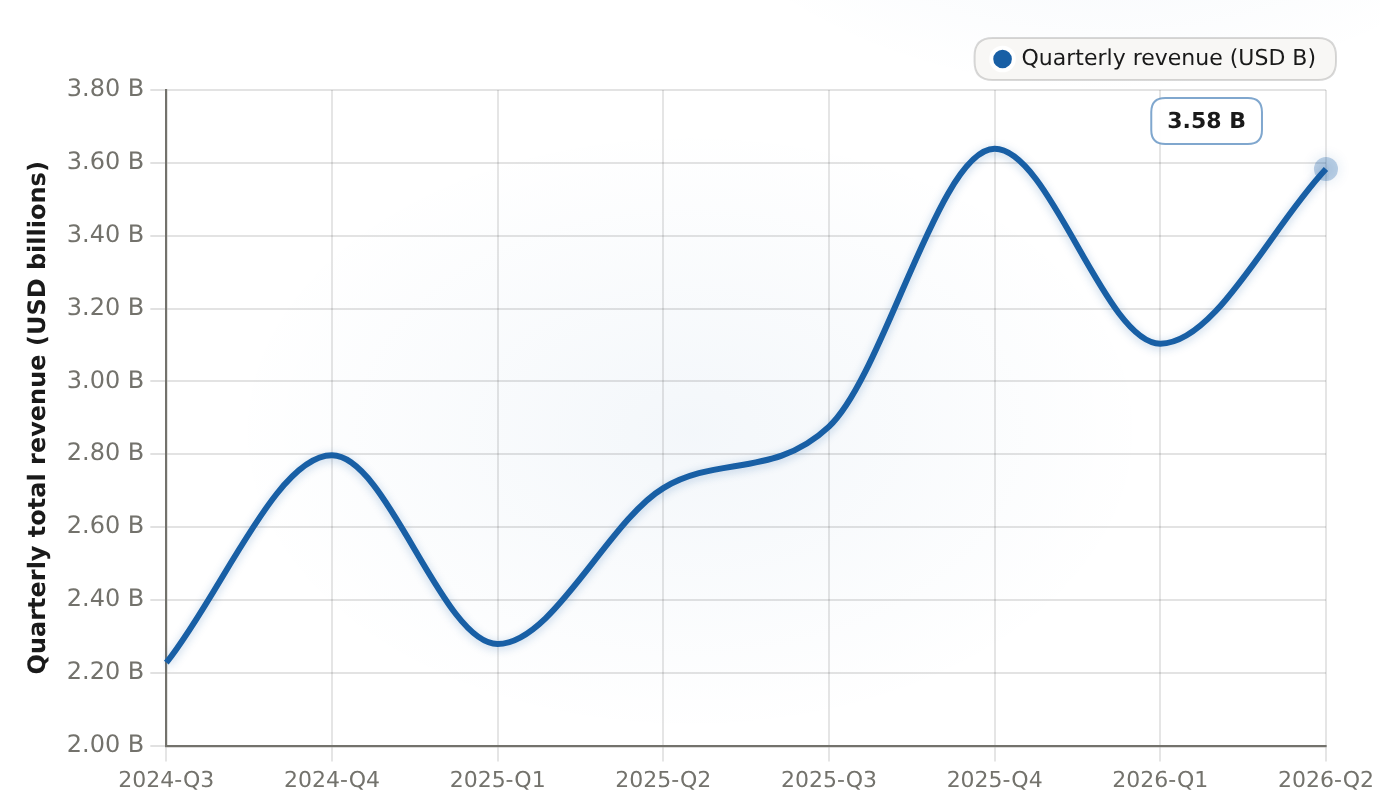
Shopify's quarterly revenue climbed from $2.23B in Q3-2024 to $3.58B in Q2-2026, sustaining annual growth in the low-30% range that underpins Rosenblatt's Buy initiation with a $175 target.
| Period | Quarterly revenue (USD B) (B) |
|---|---|
| 2024-Q3 | 2.2276 |
| 2024-Q4 | 2.7969 |
| 2025-Q1 | 2.2791 |
| 2025-Q2 | 2.7071 |
| 2025-Q3 | 2.8758 |
| 2025-Q4 | 3.6384 |
| 2026-Q1 | 3.1036 |
| 2026-Q2 | 3.583 |
The revenue trajectory inside the 8-K over the past two years shows how the growth picture has stabilized: quarterly revenue has moved from ~$2.23 billion in Q3 2024 to $3.58 billion in Q2 2026, sustaining a 30%+ clip even as the base doubles. The plottable quarterly series is taken from the company-reported Q2 figure, with the market-data series matching closely for prior quarters, so the story is not an artifact of a single quarter's print. The growth is durable at the top line, and crucially, it is converting into cash.
That conversion is the least-appreciated part of the bull case. Adjusted EPS came in at $0.42, up 20% year over year and above the $0.40 consensus. Operating income was $488 million (up from $291 million a year earlier) as operating expenses fell to 34% of revenue — a meaningful operating-leverage gain for a company still growing 34%. Free cash flow hit $654 million at an 18% margin, up from 16% a year earlier. A software company growing 30%+ that is also expanding its free cash flow margin is the exact profile that justifies paying a premium multiple; the margin expansion is not hypothetical, it is already in the reported numbers.

Why the bulls are re-rating: AI is a flywheel, not a threat
Rosenblatt's rebuttal of the AI-disintermediation fear is not just philosophical hand-waving; management's own commentary gives it a foundation. The core concern had been that AI shopping agents would let consumers bypass individual storefronts, funneling demand to marketplaces and cutting Shopify out of the transaction. The opposite appears to be happening. AI-referred traffic to Shopify stores ran roughly 8x year over year and orders originating from AI-powered search ran nearly 13x year over year in the Q1 data cited by Jefferies (which upgraded Shopify to Buy, calling it the likely infrastructure layer for agentic commerce). Management added that about 75% of AI-attributed orders in Q2 originated from outside the top-100 merchant categories — meaning the agentic wave is broadening demand across Shopify's long tail rather than concentrating spend in a few large stores where Shopify would have less pricing power.
The mechanism behind the re-rating is a clean flywheel. AI-assisted discovery feeds incremental demand into Shopify stores, which raises GMV; rising payments penetration — now 68% of global GMV, up 3 percentage points year over year — means a bigger share of that GMV runs through Shopify's higher-margin merchant solutions; that lifts merchant solutions revenue and total revenue above the 30% line; operating leverage at 34% of revenue converts into a rising free cash flow margin; and that combination of higher growth and expanding cash conversion is what supports the premium multiple and the fresh sell-side bull case. Flip the causal chain and you get the failure mode: if AI adoption plateaus, GMV growth stalls, or the take rate erodes under competitive pressure, revenue growth drops below the ~20% threshold and the multiple — priced for sustained 30%+ growth — has nowhere to go but down.
Valuation: paying up for growth that is still being delivered
The honest objection to a Buy here is the multiple, and it deserves straight answers. Per Ainvest's peer screen, Shopify trades at roughly 14.2x trailing price-to-sales and ~98x trailing EV/EBITDA, versus Amazon at ~3.7x price-to-sales, Adobe at ~4.3x, and Salesforce at ~3.9x. That is a 3-to-4x premium to mature software and commerce peers on a trailing basis, so the valuation only works if the growth differential persists.
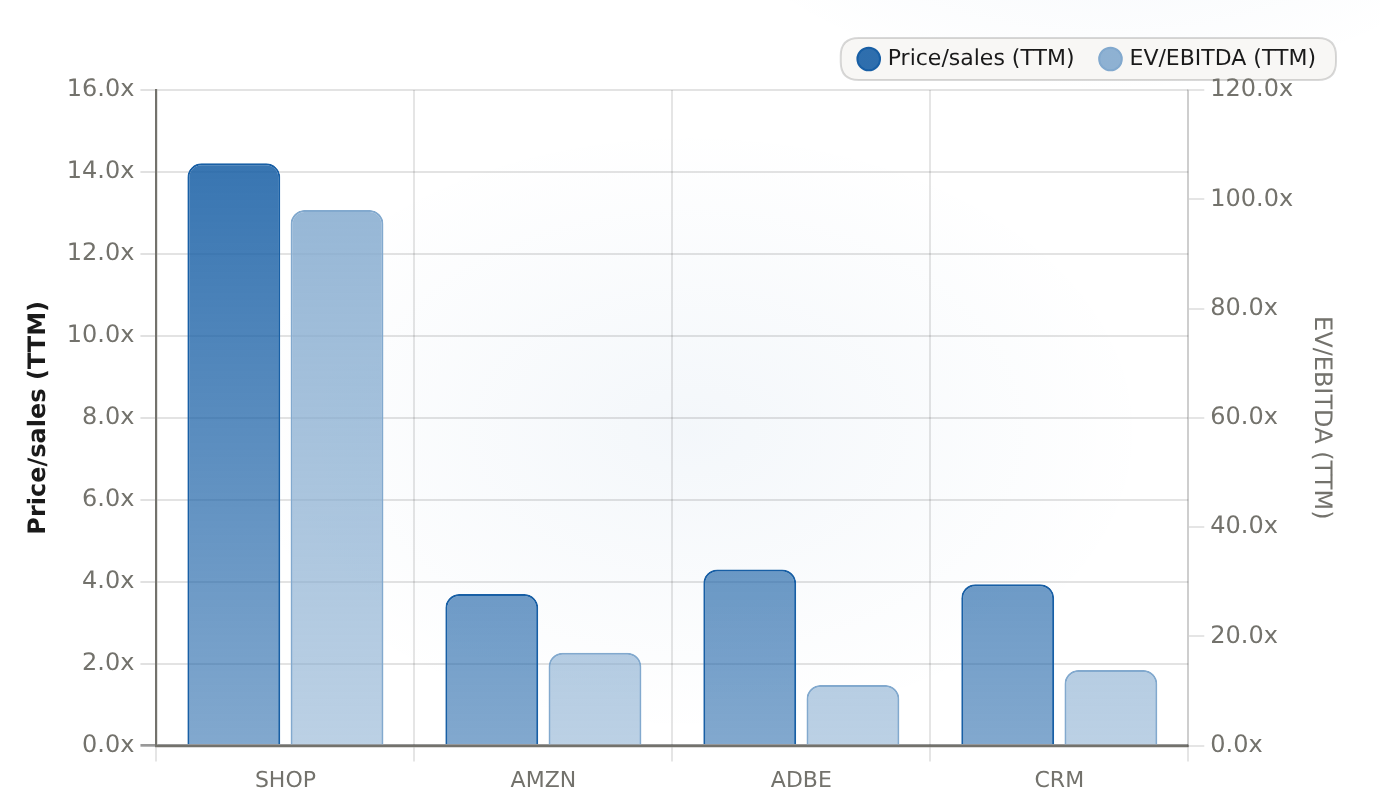
Shopify carries a premium multiple on both bases — about 3.5x large-cap peers on price/sales and roughly 6–7x on EV/EBITDA — the elevated TTM valuation that makes continued ~20%+ revenue growth binding for the bull case.
| Ticker | Price/sales (TTM) | EV/EBITDA (TTM) |
|---|---|---|
| SHOP | 14.21 | 98.05 |
| AMZN | 3.7 | 17.01 |
| ADBE | 4.3 | 11.1 |
| CRM | 3.94 | 13.86 |
The peer comparison is the crux of the valuation debate: Shopify's ~14.2x trailing P/S versus the ~3.7x–4.3x range for Amazon, Adobe, and Salesforce is precisely the kind of premium that looks indefensible if growth is decelerating to the mid-teens, and entirely defensible if growth holds at 30%+. The stock's 52-week range of ~$94 to ~$182.19 shows how much the multiple has swung with the narrative this past year — from the AI-disintermediation scare that drove it toward the low end to the post-earnings re-rating that took it toward the high end. At ~$146.58, the market is pricing roughly in the middle of that range, which is a fair reflection of an unresolved debate: is Shopify a 30% grower that happens to be expensive, or a 15% grower that is temporarily expensive?
The company's own guidance answers that question for at least the next quarter. Management guided Q3 2026 revenue to grow in the low-30s% year over year — well above the roughly 26% growth analysts had modeled — with gross profit growing mid-to-high-twenties percent, operating expenses at 33% to 34% of revenue, and free cash flow margin in the high-teens to low-twenties. When a company guides growth above consensus while simultaneously guiding margins up, the multiple has a reason to persist; that is the single most bullish datapoint the bears have to explain away.
Risks: where the bull case breaks
I cannot recommend a Buy at ~14x sales without being explicit about what would change my mind, and every one of these is a concrete, falsifiable trigger rather than a vague "macro risk" placeholder:
- Revenue deceleration below ~20%: The whole premium multiple rests on 30%+ growth. If that slows to the high-teens or lower for even two quarters, the multiple will re-rate, and there is no margin of safety to absorb the disappointment.
- GMV stalling or take-rate erosion: Merchant solutions growing faster than GMV is what keeps monetization rising. If merchant solutions growth converges toward GMV growth, the take rate has stopped expanding, and the story loses its primary margin lever.
- AI adoption plateauing: The agentic-commerce acceleration — the 8x AI-referred traffic and 13x AI-search order figures — is still early data, partly broker-cited rather than company-filed. If agentic demand fails to scale beyond the current cohort, the growth engine loses its newest fuel source.
- A consumer or macro slowdown: Shopify's GMV is levered to discretionary shopping. A pullback in consumer spending would hit merchant order volumes across the long tail, and Shopify's revenue growth rate would compress even without any company-specific misstep.
- Intensifying competition: The same week Rosenblatt initiated Shopify, it also initiated Amazon with a Buy and a $335 target on AI growth. Amazon's funding of AI-assisted commerce and its merchant services push is the strongest structural competitor; if the platform arms race forces Shopify to spend, the FCF margin expansion path narrows.
- Valuation derating on multiple compression alone: Even if the operating story holds, a market-wide de-rating of high-multiple software would compress the stock; the ~98x EV/EBITDA multiple means Shopify has a larger valuation gap to protect than its peers do.
One accounting note for clarity: I am deliberately not anchoring this thesis on the reported GAAP net income of roughly $1.5 billion, which appears inflated by one-time non-operating gains and is not a reliable run-rate earnings figure. The bull case stands on operating income, adjusted EPS, and free cash flow — all of which are cleaner, recurring measures of this business's actual cash-generating power.
Investor takeaway: buy the quarter, monitor the next four
My verdict is Buy, with the next twelve months as the evaluation window. Rosenblatt's $175 target gives investors a concrete reference point — roughly 19% above the current ~$146.58 and above the ~$158 consensus — and it is a target I consider reachable if the Q3 print (due in early November) confirms the guided low-30s% revenue growth and the high-teens FCF margin. The shares have already moved materially off the post-earnings high (~$158.53 close after the Aug 5 report), so the recent pullback to ~$146.58 enters the trade with a bit less optimism priced in.
The four metrics I will watch over the next four quarters, in order of importance: (1) quarterly revenue growth staying comfortably above the ~20% threshold, (2) merchant solutions growth continuing to outpace GMV growth, (3) payments penetration holding or rising from 68%, and (4) the FCF margin holding in the high-teens. The failure conditions that would force me to downgrade are equally specific: sustained revenue growth below ~20% for two consecutive quarters, GMV growth stalling below revenue growth, take-rate erosion, or margin/FCF compression that reverses the operating-leverage story. I am buying the growth multiple because the company is still delivering the growth that justifies it — and because Rosenblatt's initiation, grounded in the same Q2 evidence, argues that the AI-disintermediation discount was itself the mispricing.








Comments
No comments yet