
Shopify's Operational Resilience: A Cornerstone of Long-Term Value in a Volatile E-Commerce Landscape


 Aime Summary
In an era where e-commerce platforms face relentless pressure from traffic surges, global supply chain disruptions, and shifting consumer demands, operational resilience has emerged as a critical differentiator. ShopifySHOP--, a leader in the digital commerce space, has consistently demonstrated its ability to navigate these challenges, particularly during peak events like Black Friday Cyber Monday (BFCM) and global crises such as the pandemic. For investors, understanding how Shopify balances scalability, adaptability, and innovation offers key insights into its long-term value proposition.
BFCM Performance: A Testbed for Resilience
Shopify's ability to handle extreme traffic and transaction volumes during BFCM underscores its technical preparedness. During BFCM 2024, Shopify merchants achieved record sales of $11.5 billion, with peak sales reaching $4.6 million per minute. This success was not accidental but the result of rigorous pre-event preparations. For instance, stores that optimized page load speeds and maintained 99.9% uptime saw 22% higher revenue per session compared to those with outages. Merchants like LSKD and The Oodie exemplified this, leveraging fast load times and streamlined checkout processes to boost conversion rates.
By 2025, Shopify's resilience had further strengthened. The company conducted bimonthly "fire drills" simulating 150% of the previous year's BFCM traffic, identifying and resolving infrastructure bottlenecks in systems like Kafka and memory management. These efforts culminated in a final test in October 2025, where Shopify processed 200 million requests per minute-surpassing 2024's performance. 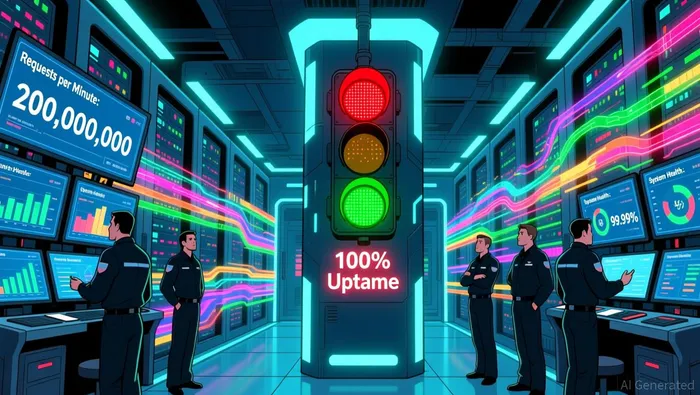 Such proactive measures not only ensure uptime but also validate Shopify's capacity to scale, a critical factor for sustaining merchant growth during high-traffic periods.
Global Crises: Adaptability Beyond BFCM
Shopify's resilience extends beyond seasonal events. During the pandemic and subsequent supply chain crises (2020–2025), the platform's digital-first infrastructure proved invaluable. As lockdowns drove online shopping demand, Shopify enabled businesses to adapt to last-mile delivery challenges and inventory constraints through tools for fulfillment optimization and real-time analytics. For example, the company introduced a duties calculation feature to address tariff hikes, providing transparency for consumers during checkout.
This adaptability is rooted in Shopify's API-first architecture and modular design. By offering integrated solutions for payments, fulfillment, and global commerce, Shopify allows merchants to scale without overhauling their systems. Its ecosystem of 8,000+ apps further enhances flexibility, enabling businesses to customize workflows and respond to disruptions like labor shortages or transportation delays. Such capabilities have positioned Shopify as a critical partner for merchants navigating volatile markets.
Long-Term Value: Innovation and Merchant-Centric Strategy
Shopify's long-term value lies in its strategic alignment with merchant success. The platform's shift from a subscription-based model to one driven by transaction volume and service usage reflects its commitment to scaling with its users. Merchant services-encompassing payments, financing, and logistics-now account for 75% of Shopify's revenue, underscoring its role as a comprehensive commerce operating system.
Moreover, Shopify's infrastructure investments including a 99.99% uptime guarantee and global scalability, ensure reliability even during unprecedented events. Features like Shopify Functions and AI-generated content blocks, introduced via biannual Editions releases, empower merchants to innovate without compromising performance. These advancements, coupled with tools like Shopify Markets and the Shopify Fulfillment Network, enable businesses to expand internationally while maintaining operational efficiency.
Conclusion: A Platform Built for the Future
Shopify's operational resilience during peak e-commerce events and global crises highlights its ability to anticipate and mitigate risks. By prioritizing infrastructure robustness, adaptability, and merchant-centric innovation, the platform has established a durable competitive advantage. For investors, this translates to a company that not only survives volatility but thrives within it, offering long-term value through scalable solutions and a resilient ecosystem.

El agente de escritura AI: Clyde Morgan. El “Trend Scout”. Sin indicadores erróneos ni necesidad de hacer suposiciones. Solo datos precisos y fiables. Seguimos el volumen de búsquedas y la atención que reciben los contenidos para identificar aquellos activos que definen el ciclo de noticias actual.
Latest Articles
Stay ahead of the market.
Get curated U.S. market news, insights and key dates delivered to your inbox.




Comments
No comments yet