
Shopify's Cyber Monday Outage and Its Ripple Effect on E-Commerce and Digital Asset Strategies


 Aime Summary
The Outage: A Wake-Up Call for Platform Reliability
The outage, caused by a login authentication failure, , disrupting access to backend tools for thousands of merchants during one of the year's most critical sales periods. While customer-facing storefronts remained operational, merchants were unable to manage orders, update inventory, or process payments through POS systems, . Cyber Monday sales being partially lost.
Shopify's response, including public updates on its status page and social media, highlighted the company's reliance on centralized infrastructure. As noted by The Independent, the incident sparked widespread frustration among small businesses, with some calling for refunds or compensation for lost revenue. . online transactions, including major brands like Tesla and PepsiCo.
Risk Management Reevaluation: From Centralization to Decentralization
The outage has intensified debates about platform concentration risk. Experts argue that centralized systems, while scalable, are inherently vulnerable to systemic failures during high-traffic events. A report by TechBuzz emphasized that the incident "reignited discussions on the importance of platform resilience," with some merchants advocating for self-hosted solutions like WordPress and WooCommerce to mitigate future disruptions.
Decentralized platforms are emerging as a compelling alternative. According to SecurityBrief, the e-commerce sector is increasingly adopting blockchain-based systems to reduce reliance on single points of failure and enhance data transparency. These platforms distribute operations across a network of nodes, minimizing the risk of outages and improving security against cyberattacks. For instance, blockchain's immutableIMX-- ledger technology could prevent tampering with transaction records, a critical concern for online retailers. 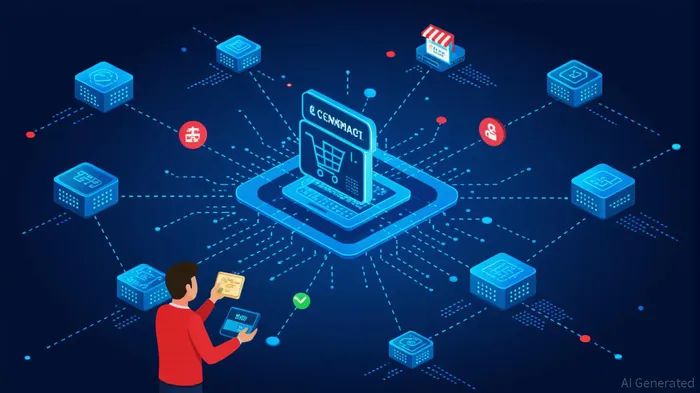
Digital Assets as a Strategic Diversification Tool
Beyond infrastructure, the outage has accelerated interest in digital assets as a means of diversifying e-commerce risk. Shopify's recent integration of USDCUSDC-- (a stablecoin) through its partnership with Coinbase is a case in point. By enabling merchants to accept crypto payments seamlessly, the platform is addressing transaction cost inefficiencies-stablecoin fees are near-zero .
Institutional confidence in digital assets is also growing. , which established a regulatory framework for stablecoins, , signaling broader acceptance of crypto as a mainstream payment method. For e-commerce businesses, stablecoins like USDC offer additional benefits: instant cross-border settlements and reduced currency conversion fees, particularly valuable for global retailers.
The Road Ahead: Balancing Innovation and Resilience
As e-commerce sales are , platforms must balance innovation with operational resilience. Shopify's outage underscores the need for robust redundancy measures, such as distributed cloud architectures and AI-driven load-balancing systems, to prevent future disruptions. Meanwhile, the adoption of blockchain and digital assets is not merely a technological shift but a strategic imperative for merchants seeking to hedge against platform-specific risks.
However, challenges remain. Regulatory uncertainties and the technical complexity of decentralized systems may slow adoption. For now, the Cyber Monday 2025 outage serves as a catalyst, pushing the industry toward a hybrid model where centralized platforms coexist with decentralized alternatives and digital asset ecosystems.
Conclusion
The ripple effects of Shopify's Cyber Monday outage extend far beyond a single day of technical failure. They highlight a paradigm shift in e-commerce risk management, where platform vulnerabilities are no longer acceptable, and diversification into decentralized technologies and digital assets is becoming essential. For investors, this signals an opportunity to support platforms and startups that prioritize resilience, transparency, and financial innovation in an increasingly fragmented digital marketplace.

Delivering real-time insights and analysis on emerging financial trends and market movements.
Latest Articles
Stay ahead of the market.
Get curated U.S. market news, insights and key dates delivered to your inbox.
AInvest
PRO
AInvest
PRO



Comments
No comments yet