
Shopify's Cyber Monday Outage and Its Implications for E-Commerce Reliability


 Aime Summary
Technical Failures and Merchant Impact
The outage stemmed from a failure in Shopify's login authentication flow, which cascaded into session management issues, rendering merchants unable to access critical tools. Despite rigorous pre-event testing-including bimonthly "fire drills" simulating 150% of previous year's traffic and chaos engineering exercises called "Game Days"-the incident exposed gaps in redundancy and real-time monitoring according to Shopify's engineering team. While Shopify's infrastructure had been optimized for Kafka partitions, memory usage, and connection timeouts, the authentication system's inability to handle high-traffic stress highlighted a systemic oversight according to technical analysis.
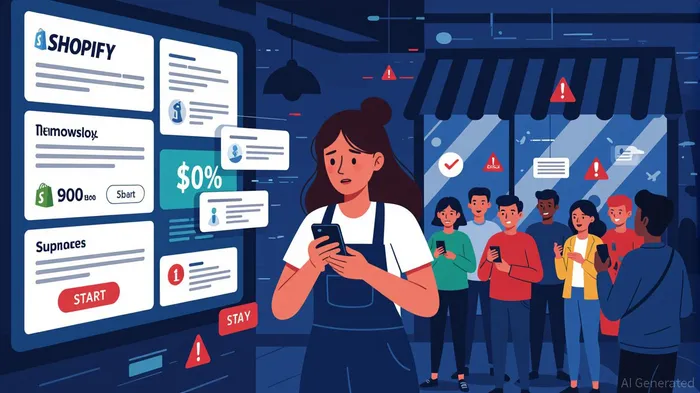
Merchants bore the brunt of the disruption. . . at peak times, businesses faced operational paralysis: orders could not be fulfilled, inventory levels could not be adjusted, and customer inquiries went unanswered according to merchant reports. For brands like Tesla, PepsiCo, and Red Bull-whose reliance on Shopify underscores its market dominance-the outage was a reputational blow according to industry observers.
Market Response and Investor Sentiment
The immediate market reaction was swift. , according to financial reports. Analysts noted that while Black Friday sales hit $6.2 billion-a 25% year-over-year increase-the Cyber Monday disruption eroded confidence in the platform's ability to sustain momentum according to market analysis.
Investor sentiment remained mixed in the aftermath. , , according to financial data. The outage also amplified scrutiny of SaaS platforms' preparedness for high-traffic events, with critics arguing that basic analytics tools are insufficient for capturing the complexity of peak e-commerce demand according to industry reports.
Competitive Positioning and Industry Standards
The incident has reshaped competitive dynamics in the e-commerce SaaS sector. Competitors and industry observers have emphasized the need for advanced analytics, AI-driven predictive maintenance, and regulatory compliance frameworks like the EU's (DORA), which mandates robust risk management for ICT service providers. Shopify's peers are increasingly leveraging technologies such as ERP integration and machine learning to streamline workflows and mitigate downtime according to industry analysis.
For Shopify, the outage exposed a critical vulnerability in its authentication infrastructure, a domain where competitors may now gain traction. The SaaS industry's shift toward ISO 31000 and NIST SP 800-82 standards-focusing on enterprise risk management and operational technology systems-further pressures platforms to prioritize redundancy and real-time monitoring according to industry experts.
Lessons for SaaS Investors
The Cyber Monday 2025 outage serves as a cautionary tale for investors. Operational resilience is no longer a technical afterthought but a core determinant of competitive positioning and valuation. Key metrics to monitor include:
1. : Platforms that conduct rigorous stress tests and simulate failure scenarios (e.g., Shopify's Game Days) demonstrate proactive risk management according to engineering documentation.
2. : Compliance with standards like DORA and ISO 31000 signals institutional preparedness for global operational risks according to compliance analysis.
3. : Advanced analytics and predictive maintenance tools can mitigate downtime and optimize performance during peak events according to market research.
For Shopify, the path forward hinges on rebuilding merchant trust and demonstrating that its authentication systems can withstand future surges. While the company's AI-driven innovations and strong free cash flow position it for long-term growth, the outage underscores the need for continuous investment in infrastructure resilience according to financial analysis.
Conclusion
The Cyber Monday 2025 outage is a microcosm of broader challenges in the e-commerce SaaS sector. As global e-commerce traffic grows and regulatory expectations tighten, operational resilience will become a defining factor in investor decision-making. Platforms that prioritize redundancy, AI-driven analytics, and regulatory compliance-while transparently addressing failures-will outperform those that treat reliability as an afterthought. For Shopify, the incident is a test of its ability to adapt and innovate in a market where downtime is no longer tolerable.

Delivering real-time insights and analysis on emerging financial trends and market movements.
Latest Articles
Stay ahead of the market.
Get curated U.S. market news, insights and key dates delivered to your inbox.




Comments
No comments yet