
Shopee's Hyperlocal Delivery Network and its 300% Stock Surge: How Underutilized Labor Segments Are Reshaping E-Commerce Logistics in Southeast Asia
 Aime Summary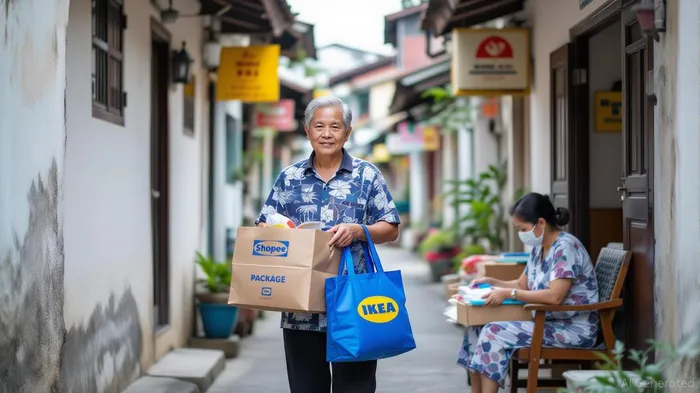
Shopee's meteoric 300% stock surge since early 2024 is not a fluke—it is the result of a meticulously engineered logistics revolution. At the heart of this transformation lies SPX Express, Shopee's hyperlocal delivery network, which has redefined e-commerce logistics in Southeast Asia by leveraging underutilized labor segments: retirees, homemakers, and students. This model, built on community trust and localized infrastructure, has not only slashed costs but also created a scalable, adaptive system that positions Shopee as a dominant force in a $120 billion market. For investors, the implications are clear: a logistics strategy that balances human capital with technological innovation is driving both operational efficiency and long-term value.
The Human Capital Advantage: Retirees, Homemakers, and Students as the Backbone of SPX Express
Shopee's hyperlocal delivery network thrives on the flexibility and familiarity of local workers. Retirees like John, a 64-year-old Singaporean, deliver hundreds of parcels daily within a quarter-mile radius, leveraging their intimate knowledge of urban housing blocks. Homemakers such as Pearlyn Tan and Diyana Scott operate SPX collection points from their homes, handling up to 80 parcels a day. Students and part-timers, meanwhile, fill gaps during peak shopping seasons, ensuring delivery capacity scales with demand.
This labor model is inherently cost-effective. By paying workers as little as S$0.30 per parcel, Shopee minimizes fixed labor costs while incentivizing volume. The gig-like structure also eliminates the need for large warehouses or fleets, reducing capital expenditures. According to internal data, SPX Express achieved a 6% reduction in logistics cost per order in Asia and a 21% drop in Brazil by Q1 2025. These savings are passed on to sellers and buyers, reinforcing Shopee's price competitiveness in a region where affordability drives e-commerce growth.
Scalability Through Community Integration
The true genius of SPX Express lies in its ability to adapt to Southeast Asia's fragmented geography. Collection points are embedded in public housing estates, warungs (Indonesian family-run shops), and convenience stores in Taiwan, turning everyday spaces into micro-hubs. This hyperlocal approach ensures next-day delivery in Singapore and two-day delivery for 50% of orders across the region. By 2024, SPX Express captured 25% of Southeast Asia's logistics market, a leap from near-zero in 2022.
The model's scalability is further amplified by AI-driven route optimization and real-time inventory management. Sorting centers process 400,000 parcels daily, with color-coded plastic bags streamlining distribution. This hybrid of human and machine intelligence allows Shopee to handle surges in demand without proportional cost increases. For example, during Black Friday 2024, SPX Express maintained 90% on-time delivery rates despite a 40% spike in parcel volume.
Third-Party Validation and Long-Term Investment Potential
While Shopee's logistics model is internally developed, third-party analyses of the broader third-party logistics (3PL) market underscore its long-term viability. The global 3PL market, valued at $1.5 trillion in 2024, is projected to grow at a 10.1% CAGR through 2034, driven by e-commerce expansion and digitalization. SPX Express aligns with this trend, offering features like automated air waybills (20% faster processing) and deferred payment options (40% higher purchase completion rates).
Critically, SPX Express has demonstrated resilience in tight-margin environments. Despite payouts per parcel averaging S$0.50, the network's low overhead and high volume have enabled Shopee's logistics arm to achieve a 14% revenue growth in Q1 2025. This financial discipline is reflected in Shopee's adjusted EBITDA, which surged to $264.4 million in Q1 2025 from a $21.7 million loss in the same period in 2024.
Challenges and Strategic Resilience
No model is without risks. SPX Express faces regulatory scrutiny in Singapore over parcel sorting in shared spaces and concerns about low wages driving workers to handle more parcels. However, these challenges are manageable. Shopee's leadership, including logistics head Hoirul Hafiidz Bin Maksom, has prioritized community engagement, ensuring operations align with local norms. For instance, collection points are often relocated to private spaces when public areas become contentious.
Moreover, SPX Express is not confined to Shopee's ecosystem. The logistics arm has begun offering services to third-party sellers, a move that could unlock new revenue streams. With Southeast Asia's e-commerce GMV growing at 21.5% year-on-year, SPX Express is well-positioned to capture a larger share of the logistics pie.
Investment Thesis: A Scalable, Human-Centric Logistics Play
For investors, Shopee's hyperlocal delivery network represents a rare combination of operational innovation and market dominance. The integration of underutilized labor segments has created a logistics model that is both cost-effective and culturally embedded, giving Shopee a moat against rivals like Lazada and TikTok Shop. With SPX Express now handling 72% of Shopee's revenue and contributing $799 million in logistics revenue in Q1 2025, the financials are equally compelling.
The 300% stock surge since 2024 reflects investor confidence in this strategy. However, the long-term potential is even greater. As e-commerce penetration deepens in Southeast Asia and SPX Express expands into Brazil and other markets, the model's scalability will continue to drive growth. For those seeking exposure to the next phase of e-commerce logistics, Shopee's hyperlocal network is not just a bet on technology—it's a bet on the power of human capital to reshape global supply chains.

Stay ahead of the market.
Get curated U.S. market news, insights and key dates delivered to your inbox.


AInvest
PRO
AInvest
PRO



Comments
No comments yet