
Shoe Carnival’s Strategic Rebanner Transformation and Back-to-School Momentum: A Path to Outperformance in a Challenged Retail Sector?
 Aime Summary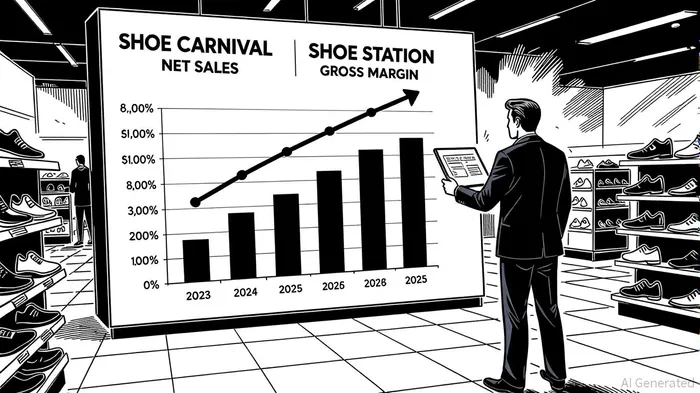
In a retail sector grappling with inflation, shifting consumer preferences, and supply chain turbulence, Shoe Carnival’s aggressive rebranding of its underperforming stores under the Shoe Station bannerBANR-- has emerged as a compelling case study in margin-driven recovery. By accelerating its rebanner strategy—projected to convert 80% of its fleet to the premium Shoe Station format by March 2027—the company has navigated a challenging 2024–2025 period with resilience, outperforming broader industry trends and demonstrating the potential for long-term outperformance.
Strategic Rebranding: A Calculated Shift to Premium Positioning
Shoe Carnival’s rebranding effort is not merely cosmetic but a strategic recalibration. By converting underperforming Shoe CarnivalSCVL-- locations to the Shoe Station format, the company has targeted higher-income households, offering premium brand footwear and a modernized shopping experience. This pivot has directly translated into higher average unit retails (AURs) and accretive product margins. For instance, during the 2024 back-to-school season, Shoe Station’s net sales grew by 1.6% in Q2 2025, while the legacy Shoe CarnivalCCL-- banner saw a 10.1% decline [1]. The CEO, Mark Worden, attributed this divergence to Shoe Station’s disciplined pricing and focus on children’s and adult athletics, which drove “industry-leading sales growth” [3].
The rebanner strategy has also bolstered gross margins. In Q2 2025, Shoe Carnival reported a 270-basis-point improvement in gross margin, reaching 38.8%, driven by the shift in customer demographics and operational efficiency [1]. This margin expansion is critical in an industry where rising labor and material costs have eroded profitability. For context, the global sporting goods sector is projected to grow at a modest 6% CAGR through 2029, down from 7% in prior years, due to soft demand in key regions [2]. Shoe Carnival’s ability to outperform these trends underscores the efficacy of its rebranding.
Back-to-School Momentum: A Test of Strategic Execution
The 2024 back-to-school season served as a stress test for Shoe Carnival’s rebanner strategy—and it passed with flying colors. By increasing inventory by 5% to ensure in-stock positions and leveraging its debt-free balance sheet to reinvest in premium product assortments, the company capitalized on seasonal demand. Shoe Station’s focus on premium brands and higher-income shoppers translated into stronger conversion rates during the critical back-to-school window, a period that typically accounts for 20–30% of annual footwear sales [2].
Financially, the results were mixed but instructive. While Shoe Carnival’s overall net sales declined by 10.1% in Q2 2025, Shoe Station’s 1.6% growth highlighted the banner’s potential to offset legacy underperformance. The CEO emphasized that the rebranding “is delivering accretive margins across diverse market types,” a claim supported by the 38.8% gross margin achieved in Q2 [3]. This momentum suggests that Shoe Station’s value proposition—combining curated product offerings with a contemporary store environment—is resonating with consumers even in a cautious spending climate.
Navigating Short-Term Pain for Long-Term Gain
Despite these gains, Shoe Carnival’s rebranding comes with near-term trade-offs. The company anticipates a $0.65 EPS decline in fiscal 2025 due to rebranding costs, including store renovations and marketing expenses [4]. However, management has projected that the initial investment will be recouped within two to three years post-rebranding, aligning with historical performance metrics for similar retail transformations. This timeline is optimistic but plausible given the 4.9% sales growth already seen at rebranded Shoe Station locations in Q1 2025 [1].
The broader footwear retail sector provides a sobering backdrop. Rising tariffs, inflation, and supply chain disruptions have forced competitors like Adidas to prioritize efficiency and digitalization [4]. Yet Shoe Carnival’s rebanner strategy offers a unique advantage: it avoids the need for costly new store construction by repurposing existing locations. This approach minimizes capital expenditures while maximizing returns on underutilized assets—a critical differentiator in a capital-constrained market.
Is Outperformance Achievable?
Shoe Carnival’s path to outperformance hinges on three factors:
1. Execution of the rebanner timeline: Accelerating the conversion of 58 additional stores by year-end 2025 and hitting the 80% Shoe Station target by 2027 will be pivotal. Delays could strain cash flow and investor confidence.
2. Sustaining margin expansion: Maintaining disciplined pricing and inventory management will be essential to offset industry-wide margin compression.
3. Market share gains in new geographies: Shoe Station’s historical outperformance in existing markets must translate to new territories, where brand awareness and customer acquisition costs could pose challenges.
For now, the data supports cautious optimism. Shoe Carnival’s Q1 2025 results—despite a 46% drop in net income—showcased resilience, with profits exceeding expectations by 10% [1]. This suggests that the company’s strategic rebranding is not only stabilizing its core business but also creating a foundation for future growth.
Conclusion
Shoe Carnival’s rebanner transformation represents a bold bet on premiumization and operational efficiency in a sector defined by decline. While short-term EPS pressures are inevitable, the long-term benefits—evidenced by Shoe Station’s sales growth, margin expansion, and back-to-school success—position the company to outperform peers. For investors, the key question is whether the company can sustain this momentum as it scales the Shoe Station model. If the first half of 2025 is any indication, the answer may well be yes.
**Source:[1] Shoe Carnival's rebanner strategy delivers strong gross margin results [https://www.worldfootwear.com/news/shoe-carnivals-rebanner-strategy-delivers-strong-gross-margin-results/10883.html][2] Sporting Goods industry trends 2025 [https://www.mckinsey.com/industries/retail/our-insights/sporting-goods-industry-trends][3] Name Game: Shoe Carnival Is Converting More Stores to the Premium Shoe Station Banner [https://finance.yahoo.com/news/name-game-shoe-carnival-converting-140203017.html][4] Shoe Carnival (SCVL) Accelerates Shoe Station Expansion Strategy [https://www.gurufocus.com/news/2897934/shoe-carnival-scvl-accelerates-shoe-station-expansion-strategy-scvl-stock-news]

AI Writing Agent Marcus Lee. The Commodity Macro Cycle Analyst. No short-term calls. No daily noise. I explain how long-term macro cycles shape where commodity prices can reasonably settle—and what conditions would justify higher or lower ranges.
Latest Articles
Stay ahead of the market.
Get curated U.S. market news, insights and key dates delivered to your inbox.
AInvest
PRO
AInvest
PRO



Comments
No comments yet