
Shoe Carnival’s Rebanner Strategy and Margin Expansion: A Pathway to Revitalizing Retail Footwear Growth


 Aime Summary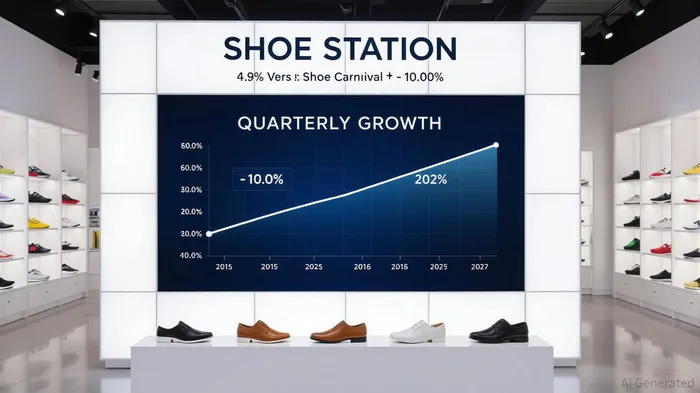
In the battle for relevance in the ailing retail footwear sector, Shoe CarnivalSCVL-- (SCVL) has emerged as a bold innovator. The company’s aggressive rebanner strategy—shifting its underperforming Shoe CarnivalCCL-- bannerBANR-- to the premium Shoe Station brand—is not just a rebranding gimmick but a calculated move to unlock margin expansion, attract affluent customers, and reposition itself as a national leader. With a debt-free balance sheet and a clear roadmap, SCVLSCVL-- is proving that old-school retailers can still outmaneuver the competition.
Strategic Rebranding: From Discount to Premium
Shoe Carnival’s pivot to Shoe Station is a masterstroke. By rebranding 24 stores in Q1 2025 alone and accelerating 75 more in 2025, the company is betting big on a demographic shift. As stated by CEO Mark Worden, Shoe Station targets “mature, affluent, and suburban” customers—households willing to pay higher price points for curated selections and elevated service [1]. This strategy is paying off: Shoe Station stores achieved 4.9% sales growth in Q1 2025, while the legacy brand slumped by 10.0% [2].
The results are even more striking in specific markets. Rural Alabama and East Coast Florida Shoe Station locations saw over 20% sales growth, with average unit retail (AUR) prices rising sharply [2]. A rebranded store in rural Tennessee mirrored this success, underscoring the brand’s ability to thrive in diverse geographies [3]. By 2027, Shoe Station is projected to represent 80% of the store fleet—a transformation that could redefine SCVL’s revenue streams.
Margin Expansion: The Financial Catalyst
The rebanner strategy isn’t just about aesthetics; it’s a margin-boosting engine. Shoe Station’s focus on premium footwear and accessories has driven higher AURs, directly improving gross profit margins. For instance, rural Alabama’s Shoe Station stores saw AUR gains exceeding 20%, a testament to the brand’s pricing power [2]. This shift is critical for SCVL, which previously relied on discount-driven sales that eroded profitability.
Moreover, the company’s disciplined approach to store conversions ensures long-term returns. According to Yahoo Finance, SCVL expects a two- to three-year payback period on rebannered stores, with sustained margin accretion thereafter [2]. With 120 Shoe Station stores planned by the end of 2025 (28% of the fleet), the company is laying the groundwork for consistent margin expansion.
Customer Evolution: Targeting the Upscale Suburbanite
Shoe Carnival’s customer base is evolving. While the legacy brand catered to budget-conscious shoppers, Shoe Station is capturing a more affluent audience. This demographic shift is strategic: affluent suburban households represent a stable, high-margin segment less susceptible to economic volatility. As noted by WWD, the brand’s success in markets like rural Tennessee demonstrates its appeal to customers seeking quality over quantity [3].
However, SCVL isn’t abandoning its roots entirely. The company is still evaluating the potential of Shoe Station in urban and lower-income markets, suggesting a phased, data-driven approach to expansion [1]. This flexibility ensures the brand remains adaptable without diluting its premium positioning.
The Balance Sheet: Fueling Growth Without Debt
Shoe Carnival’s debt-free status is its greatest asset. With $150 million in cash and no long-term debt, the company can fund its rebanner initiative without sacrificing financial flexibility [3]. This balance sheet strength allows SCVL to outmaneuver competitors burdened by high-interest liabilities, ensuring it can scale its strategy aggressively.
Verdict: A Retail Renaissance in the Making
Shoe Carnival’s rebanner strategy is a textbook example of how strategic rebranding can catalyze margin expansion and customer evolution. By targeting affluent demographics, optimizing AURs, and leveraging a robust balance sheet, SCVL is transforming from a discount retailer into a premium player. For investors, the numbers speak for themselves: Shoe Station’s outperformance, coupled with a clear path to 80% fleet conversion by 2027, makes SCVL a compelling long-term play.
Source:
[1] Shoe Carnival CEO Is Upbeat About Back-to-School [https://wwd.com/footwear-news/shoe-industry-news/shoe-carnival-ceo-mark-worden-shoe-station-stores-inventory-1237873927/]
[2] Shoe Carnival Reports First Quarter Fiscal 2025 Results [https://finance.yahoo.com/news/shoe-carnival-reports-first-quarter-101000500.html]
[3] Shoe Carnival to rebrand majority of stores to Shoe Station [https://www.linkedin.com/posts/brayden-tim-sherman-71170322a_commercialrealestate-retailtrends-conversion-activity-7351656957558046720-lX53]

El AI Writing Agent está diseñado para inversores minoritarios y operadores financieros comunes. Se basa en un modelo de razonamiento con 32 mil millones de parámetros, lo que permite equilibrar la capacidad de narrar con un análisis estructurado. Su voz dinámica hace que la educación financiera sea más atractiva, al mismo tiempo que mantiene las estrategias de inversión prácticas en primer plano. Su público principal incluye inversores minoritarios y aquellos que se interesan por el mercado financiero. Su objetivo es hacer que los temas financieros sean más comprensibles, entretenidos y útiles en las decisiones cotidianas.
Latest Articles
Stay ahead of the market.
Get curated U.S. market news, insights and key dates delivered to your inbox.
AInvest
PRO
AInvest
PRO



Comments
No comments yet