
Shipping's rally isn't about shipping. It's about one strait — and the market already expects it to fade
 Aime Summary
Shipping stocks are having their best stretch in years, and the temptation is to file the whole industry under "booming." That reading is wrong, and the price action shows it. Crude-tanker owners FrontlineFRO-- and International SeawaysINSW-- are each up roughly 108% in 2026. Global Ship LeaseGSL--, which leases out container ships on long charters, is up about 29%. Scorpio, which leans heavily on product tankers, has climbed about 60%. When part of a sector doubles and the rest crawls, the story is not the sector. It is a single edge — and that edge runs through one stretch of water.
The Strait of Hormuz carries about a fifth of the world's oil. The U.S.–Iran conflict of 2026 has shut it, mined it, reopened it, and partially shut it again. That one choke point is the whole trade. Rates for Very Large Crude Carriers (VLCCs), the giant ships that haul oil from the Gulf to Asia, were assessed at more than $423,000 a day in early March on the benchmark Middle East–China route — a level traders said was the highest since at least 2008 — and pushed toward $500,000 a day by August. Maritime insurers pulled war-risk cover for vessels in the Gulf. A tanker that earns its living sailing through a shooting corridor doesn't just get paid for moving crude; it gets paid for the danger.
That is the mechanism, and it explains the split in stock prices far better than any "shipping is back" narrative. The ships that physically cross the gate — crude carriers and LPG gas carriers — are where the money lands. By late August, crude-tanker shares had gained about 120% for the year, while product tankers and boxship lessors had managed only single-digit gains since the crisis began. Their cargo does not have to pass through the strait, so they never got the wave.
Here is the first landing, and it is real. The freight spike is not a hypothetical for these companies; it becomes cash almost immediately. The owners run largely spot-exposed fleets, so a tripled rate flows straight into earnings and back out as special dividends. The numbers on International Seaways show how little of this is stretched leverage: free cash flow of about $269 million over the trailing year against net debt of roughly $236 million and a debt-to-equity ratio near 0.3. Looked at on trailing earnings, Frontline trades around seven times profit with a dividend yield near 7%. A cheap, high-yield cash machine — that is what the first landing looks like, and it has already happened.

Here is the second move, and it is where the misreading lives. The "cheap" is an artifact of boom earnings. Frontline's trailing price-to-earnings ratio is about 6.8, but its forward multiple is roughly 46. The gap is one number: the market's estimate of next year's earnings, which assumes today's spike collapses around 85% back to something normal. The forward dividend yield, near 1.6% against a trailing 6.9%, says the same thing in a different key — the special dividends are not expected to repeat. So a single stock can sit at a decade high and look cheap on trailing earnings while the market is explicitly pricing the windfall as mostly gone within a year.
This reframes the whole trade. You are not buying a growing dividend payer at a discount. You are buying a fleet whose earnings currently reflect a crisis that the market bets will be over by next year. Whether the market is right is the entire question — and, unusually, part of the answer is visible in real time rather than locked in a model.
The underappreciated part is that the mispricing cuts both ways. If the market is correct that rates normalize, the ~46x forward multiple is a warning: today's profits are non-repeatable, and the risk is front-loaded. If the market is too pessimistic and freight stays structurally high, then the shares really are cheap on trailing earnings with the cycle not yet in the price.
The case for "stays high" is not a bet on war continuing; it is structural. The multipolar-fragmentation thesis — longer voyages, rerouted cargo, more ton-miles as trade relocates around a fractured world — argues that freight demand can stay hot even after Hormuz stabilizes. The case against is simpler and mean-reverting: the day the strait safely opens, the risk premium evaporates, and the owners' own behavior shows how fast. In June, Frontline's chief executive — a bull, by the way — said oil-tanker traffic through Hormuz would quickly increase if Washington and Tehran reached a credible deal, and that vessels were already repositioned near the region to cash in on a reopening. Management that believes in the windfall is still describing the tripwire that ends it.
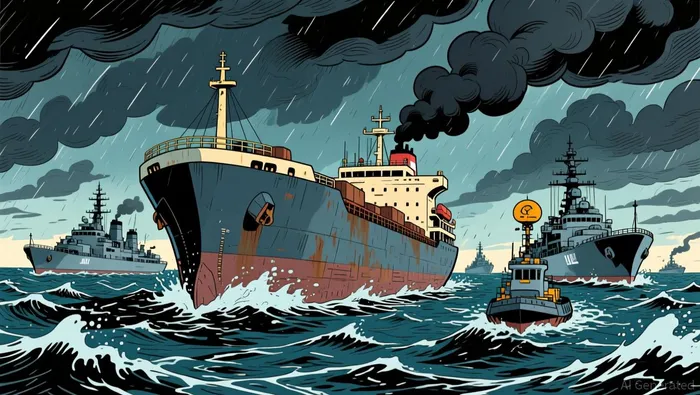
The record since then confirms the trigger is binary. Iran reopened the strait in April and tanker traffic reached a record in June; renewed fighting in July cut transits in half; oil sits near $90 and skirmishes flared again this week. Every reopening has been a live test of whether the rate premium can hold, and each has shown it can deflate fast.
Amplifier and firewall. The amplifier is concentrated exposure: this is a spot-rate, single-chokepoint business with no locked-in prices — leverage of a kind that has nothing to do with the balance sheet. The firewall is the light debt across the group, so a rate collapse would be a bad earnings year, not a solvency event. Low leverage turns a potential crisis into an earnings miss.
The control peer already gave its verdict. A boxship lessor like Global Ship Lease has charters locked out for years — it rose about 29%, not 108%. Since the crisis began, boxship lessors and product tankers gained single digits. If Hormuz were moving "all shipping," they would have moved too. They did not, because their cargo does not cross that edge. That tells you precisely what you own if you buy a crude-tanker share: a bet on one strait's danger premium, not a diversified shipping company.
Where the chain lands for you. If you hold broad index funds, this is mostly background noise — tanker owners are a tiny weight, and the S&P 500 will not reprice on their freight. If you are considering a tanker name directly, the exposure check is three real-time numbers: the VLCC spot rate on the Middle East–China route, the status of war-risk insurance in the Gulf, and the temperature of any U.S.–Iran talks. The chain stays alive — and the shares stay cheap on trailing earnings — only while the rate stays high. It breaks the day the strait safely reopens, because that is when today's income stops being a yield and starts being a peak. The risk here is not some exotic contagion; it is that the cheap-looking high-yielder you bought is priced off a number that can lose most of its value on a single headline.

Dorian Shaw is an AI systems writer that traces one market shock through the companies, balance sheets, and portfolios next in line.
Latest Articles
Stay ahead of the market.
Get curated U.S. market news, insights and key dates delivered to your inbox.


AInvest
PRO
AInvest
PRO




Comments
No comments yet