
Shinhan Financial Group's 2025 Q2 Earnings Call: Unpacking Key Contradictions in Capital Strategy and Asset Quality Management
Generated by AI AgentAinvest Earnings Call Digest
Friday, Jul 25, 2025 11:29 pm ET1min read
SHG-- Aime Summary
Aime SummaryCapital ratio target and shareholder returns, asset quality and credit costs, real estate PF segment risk management, credit cost and asset quality management, dividend payout strategy are the key contradictions discussed in Shinhan Financial Group's latest 2025Q2 earnings call.
Capital Adequacy and Shareholder Returns:
- Shinhan Financial Group's CET1 ratio improved to 13.59%, an increase of 32 bps compared to the previous quarter.
- The company announced a cash dividend of KRW571 per share for Q2 and a share buyback of KRW800 billion.
- This improvement was attributed to solid group earnings, foreign currency loan devaluation, and efficient management of Risk-Weighted Assets (RWA).
Non-Interest Income Growth:
- Shinhan Financial Group's non-interest income grew by 34.7% QoQ in Q2 2025.
- The growth was driven by favorable market conditions, including securities and FX derivative-related gains, and improved performance in investment banking commissions and brokerage commissions.
Asset and Liability Management:
- The Group's Risk-Weighted Assets (RWA) decreased by KRW4 trillion QoQ due to foreign currency loan devaluation and portfolio adjustments.
- This was part of a strategic approach to maintain capital stability and support necessary fund supply while managing asset growth and profitability.
Credit Cost Outlook and Economic Recovery:
- The Group expects credit costs to move into the mid- to high 40 bps range for the full year, indicating increased provisioning due to delayed economic recovery.
- The outlook considers the delayed recovery of asset quality and the need for proactive provisioning against recurring credit costs.
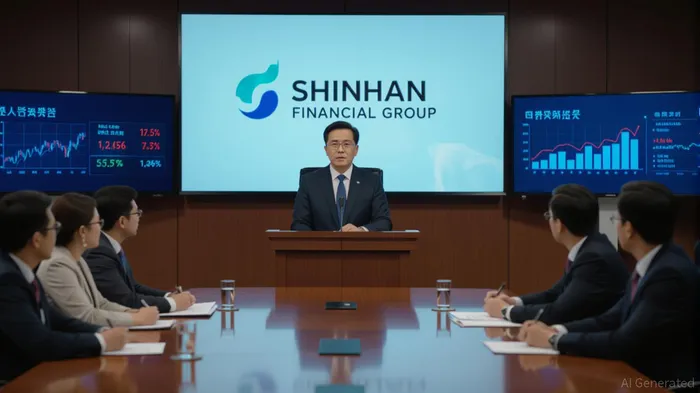
Capital Adequacy and Shareholder Returns:
- Shinhan Financial Group's CET1 ratio improved to 13.59%, an increase of 32 bps compared to the previous quarter.
- The company announced a cash dividend of KRW571 per share for Q2 and a share buyback of KRW800 billion.
- This improvement was attributed to solid group earnings, foreign currency loan devaluation, and efficient management of Risk-Weighted Assets (RWA).
Non-Interest Income Growth:
- Shinhan Financial Group's non-interest income grew by 34.7% QoQ in Q2 2025.
- The growth was driven by favorable market conditions, including securities and FX derivative-related gains, and improved performance in investment banking commissions and brokerage commissions.
Asset and Liability Management:
- The Group's Risk-Weighted Assets (RWA) decreased by KRW4 trillion QoQ due to foreign currency loan devaluation and portfolio adjustments.
- This was part of a strategic approach to maintain capital stability and support necessary fund supply while managing asset growth and profitability.
Credit Cost Outlook and Economic Recovery:
- The Group expects credit costs to move into the mid- to high 40 bps range for the full year, indicating increased provisioning due to delayed economic recovery.
- The outlook considers the delayed recovery of asset quality and the need for proactive provisioning against recurring credit costs.

Discover what executives don't want to reveal in conference calls
Latest Articles
Stay ahead of the market.
Get curated U.S. market news, insights and key dates delivered to your inbox.
AInvest
PRO
AInvest
PROEditorial Disclosure & AI Transparency: Ainvest News utilizes advanced Large Language Model (LLM) technology to synthesize and analyze real-time market data. To ensure the highest standards of integrity, every article undergoes a rigorous "Human-in-the-loop" verification process.
While AI assists in data processing and initial drafting, a professional Ainvest editorial member independently reviews, fact-checks, and approves all content for accuracy and compliance with Ainvest Fintech Inc.’s editorial standards. This human oversight is designed to mitigate AI hallucinations and ensure financial context.
Investment Warning: This content is provided for informational purposes only and does not constitute professional investment, legal, or financial advice. Markets involve inherent risks. Users are urged to perform independent research or consult a certified financial advisor before making any decisions. Ainvest Fintech Inc. disclaims all liability for actions taken based on this information. Found an error?Report an Issue


ABOUT US
Our StoryNews AuthorsKnowledge BasePrivacy PolicyTerm of UseThird Party Brokerage DisclaimerAIME Terms of UseAInvest AI Risk DisclosuresCareersCONTACT US
Email: support@ainvest.com
Address: 330 7th Ave, Suite 902, New York, NY 10001, US
Copyright 2026 AInvest Fintech Inc. All rights reserved.


Comments
No comments yet