
Shifting Tides in Housing Demand: Strategic Opportunities in Construction and Consumer Goods
 Aime Summary
The U.S. housing market, once a pillar of economic resilience, is now navigating a complex landscape of waning demand and rising borrowing costs. The latest Mortgage Bankers Association (MBA) Purchase Index, released for the week ending July 11, 2025, underscores a troubling trend: a 12% seasonally adjusted decline in home purchase activity compared to the prior week, with the index plummeting to 159.60—a level not seen since May 2025. This contraction, driven by a 5 basis point jump in mortgage rates to 6.82% for 30-year fixed-rate loans, signals a market in flux. Yet within this turbulence lies a mosaic of opportunities for investors attuned to the interplay between housing demand and its ripple effects on construction and consumer goods sectors.
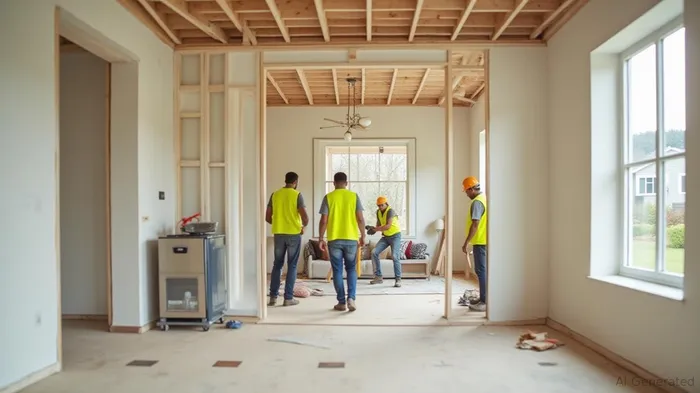
Construction: Efficiency, Sustainability, and Digital Transformation
The construction sector is recalibrating to a world of tighter margins and constrained demand. Labor shortages, soaring material costs, and regulatory hurdles have forced builders to adopt a dual strategy: efficiency through innovation and sustainability as a selling point.
A striking 84% of residential projects now incorporate eco-friendly materials, a shift not only driven by environmental concerns but also by cost savings. Prefabrication is emerging as a game-changer, reducing labor costs by up to 30% and shortening construction timelines by 40%. For investors, this trend highlights the importance of firms specializing in modular construction, such as those leveraging AI-driven design tools or 3D printing technologies.
Digital purchasing platforms are also transforming the industry, with nearly half of materials expected to be procured online by 2030. This shift enhances gross margins by up to 100 basis points, as evidenced by companies adopting blockchain-based supply chains to reduce waste and improve transparency.
Consumer Goods: From Ownership to Rental-Centric Innovation
As home purchases decline, the consumer goods sector is witnessing a paradigm shift. Millennials and Gen Z, facing affordability crises, are increasingly embracing rental living. This demographic pivot is reshaping demand patterns: furniture, appliances, and home improvement products are now tailored for renters, emphasizing modularity, compactness, and multi-functionality.
Companies like WayfairW-- and IKEA are reengineering product lines to cater to this audience, offering stackable storage solutions, convertible furniture, and energy-efficient appliances that align with the transient needs of urban and suburban renters. Meanwhile, the rise of “curated home goods packages” in partnership with real estate developers is opening new revenue streams.
The rental market itself is evolving, with high-end suburban properties blending luxury with practicality. This trend is creating synergies between real estate and consumer goods, as developers pre-stock units with brand-specific furnishings to enhance tenant retention and reduce turnover costs.
Navigating Uncertainty: A Call for Adaptive Investing
The MBA data and sector adaptations reveal a market in transition. For investors, the key lies in identifying firms that are not merely reacting to the current environment but are anticipating structural shifts.
- Construction Sector: Prioritize firms with expertise in prefabrication, digital supply chains, and green building technologies. Look for companies with strong balance sheets to weather near-term volatility.
- Consumer Goods: Target brands with agile product development cycles and partnerships with rental platforms. Companies leveraging AI to analyze shifting consumer behavior—such as predictive inventory systems for rental markets—offer compelling long-term potential.
The broader lesson is clear: in a world of economic uncertainty, adaptability is the new competitive advantage. As mortgage rates and housing demand continue to oscillate, investors who align with the rhythms of these transformations will find fertile ground for value creation.
In the end, the housing slowdown is not a harbinger of decline but a catalyst for reinvention. Those who recognize the interdependencies between sectors—and the strategic innovations emerging within them—will be best positioned to navigate the challenges and opportunities ahead.

Stay ahead of the market.
Get curated U.S. market news, insights and key dates delivered to your inbox.


AInvest
PRO
AInvest
PRO



Comments
No comments yet