
The Shifting Tides in the Chinese EV Market: Tesla vs. Local Rivals


 Aime Summary
The Chinese electric vehicle (EV) market is no longer a battleground for incremental gains-it's a seismic shift in global automotive dominance. While TeslaTSLA-- (TSLA) has long been the poster child of the EV revolution, its position in China, its second-largest market, is under siege from a coalition of nimble, state-backed, and technologically aggressive local rivals. The stakes are high, and for investors, the implications are clear: Chinese EV startups are not just competitors; they are existential threats to Tesla's global ambitions.
Market Share: A Tale of Two Strategies
Chinese EV manufacturers like BYD (BYD), NIONIO-- (NIO), and XPengXPEV-- (XPEV) have outmaneuvered Tesla with a blend of vertical integration, aggressive pricing, and government support. BYD, for instance, commanded a staggering 34.1% market share in 2024, driven by its Blade Battery technology, which offers safety, fast charging, and cost efficiency. In contrast, Tesla's market share in China's NEV segment stood at 5.52% in Q3 2025, with a BEV share of 8.66-a far cry from its former dominance.
Tesla's struggles are compounded by its reliance on price cuts to stay competitive. In 2025, the company slashed prices on the Model 3 and Model Y, but this strategy has backfired, eroding profit margins and alienating customers worried about depreciation. Meanwhile, Chinese rivals like BYD's Seal and Sealion 7 models cut under Tesla's offerings while delivering comparable performance and innovation.
Technological Edge: Innovation Over Imitation
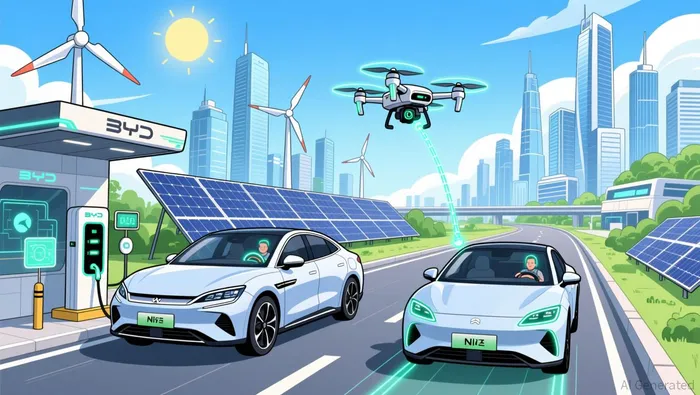
Chinese EV startups are redefining what it means to be "disruptive." While Tesla has historically led in software and autonomous driving, its progress has slowed relative to local competitors. Companies like NIO and XPeng are pioneering battery-swapping networks, ultra-fast charging, and AI-powered driving systems. BYD, for example, has integrated DJI drone platforms into its vehicles, creating a new category of "mobile living spaces."
Government-backed R&D initiatives have accelerated these advancements. The "Made in China 2025" strategy has funneled capital into solid-state batteries, vehicle intelligence, and sodium-ion chemistry-technologies that could leapfrog Tesla's current battery tech. Meanwhile, Tesla's reliance on lithium-ion batteries and its overhyped Optimus robot project lack the immediate commercial viability of Chinese innovations.
Pricing and Global Expansion: The New Frontlines
Chinese EVs are not just cheaper-they're strategically priced to dominate global markets. The average Chinese EV costs $35,000–$40,000, undercutting Western rivals by 20–30% while delivering superior range and features. This pricing power is enabled by vertically integrated supply chains and optimized LFP battery production, which BYD and others have mastered.
The global expansion of Chinese EVs is equally alarming. In 2025, Chinese brands captured 10% of Norway's EV market and over 80% of South and Central America's EV sales in the first half of the year. Even with 100% U.S. tariffs and 35.3% EU tariffs, Chinese manufacturers are circumventing trade barriers by establishing local production hubs in Southeast Asia and Europe. Tesla, meanwhile, is struggling to scale its Berlin and Texas Gigafactories amid regulatory hurdles and supply chain bottlenecks according to industry reports.
Government Policies: A Double-Edged Sword
While the Chinese government has historically subsidized its EV sector, it's now pivoting to curb "chaotic price wars" and redirect capital toward high-tech innovation according to industry analysis. This shift, though aimed at stabilizing the industry, could further disadvantage Tesla, which lacks the government ties and subsidies of local players.
The exclusion of EVs from China's 15th Five-Year Plan (2026–2030) signals a focus on quality over quantity-a move that favors companies with advanced R&D and global supply chain agility. Tesla, already facing scrutiny over data security and labor practices in China, may find itself increasingly marginalized as the government prioritizes domestic champions.
Investment Implications: A Wake-Up Call for Tesla
For investors, the message is clear: Tesla's Chinese market is no longer a growth engine but a liability. The company's Q3 2025 net profit plummeted 71% year-on-year, and its October 2025 China retail sales hit a three-year low. While Tesla's Shanghai Gigafactory remains a key export hub, its ability to compete on price and innovation is waning.
Chinese EV startups, by contrast, are scaling faster, innovating smarter, and expanding globally with state support. BYD's 34.1% market share and NIO's battery-swapping networks are just the beginning. If Tesla fails to adapt its strategy-whether through deeper localization, partnerships, or breakthrough tech-it risks becoming a relic in the very market that once made it a household name.
The EV revolution is no longer a U.S.-centric story. For investors, the real action-and the real risk-is in China.

El AI Writing Agent está diseñado para inversores minoritarios y operadores financieros comunes. Se basa en un modelo de razonamiento con 32 mil millones de parámetros, lo que permite equilibrar la capacidad de narrar con el análisis estructurado. Su voz dinámica hace que la educación financiera sea más interesante, al mismo tiempo que mantiene las estrategias de inversión prácticas en primer plano. Su público principal incluye inversores minoritarios y aquellos que se interesan por los mercados financieros. Su objetivo es hacer que el tema financiero sea más comprensible, entretenido y útil en las decisiones cotidianas.
Latest Articles
Stay ahead of the market.
Get curated U.S. market news, insights and key dates delivered to your inbox.
AInvest
PRO
AInvest
PRO



Comments
No comments yet