
Shifting Sentiment in Crypto-Related Equities: Short-Position Trends as a Contrarian Indicator


 Aime Summary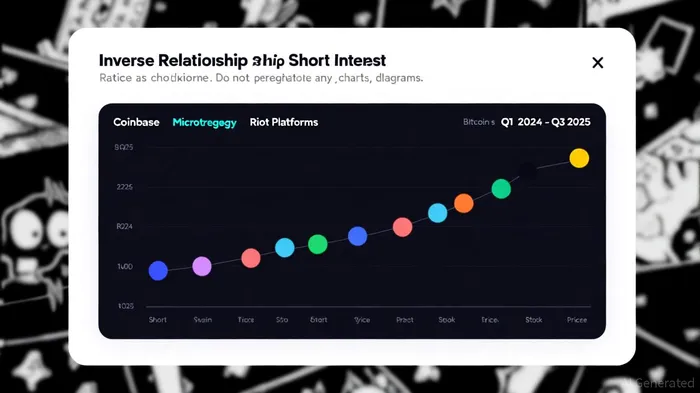
The crypto market in 2025 has defied skeptics, with total market capitalization surging 9.9% year-to-date and adding over $600 billion in value despite periodic volatility[1]. BitcoinBTC-- (BTC) and EthereumETH-- (ETH) have led the charge, posting 18% and 36% gains respectively, while institutional adoption—driven by U.S. spot ETF inflows exceeding $28 billion—has cemented crypto's place in mainstream finance[1]. Yet beneath this bullish surface, short-position trends in crypto-related equities reveal a nuanced story of shifting sentiment and contrarian opportunities.
The Contrarian Case: Short-Position Trends as a Barometer
Short interest in crypto stocks has become a critical contrarian indicator. For example, CoinbaseCOIN-- (COIN) saw its short interest ratio climb to 1.0 in Q3 2025, meaning all short positions could be covered in just one day of average trading volume[2]. This 22.2% monthly increase in short interest suggests lingering bearishness, yet COIN's stock price has surged 87.27% year-to-date, outpacing Bitcoin's 18% return[3]. Similarly, MicroStrategy (MSTR), with a short interest ratio of 2.63 and 8.73% of its float sold short, has delivered a 180.90% return over the trailing 12 months despite a -12.40% one-month pullback[3]. These divergences highlight the tension between short-term bearish bets and long-term bullish fundamentals.
The Crypto Fear and Greed Index, a proprietary tool from CoinMarketCap, further underscores this dynamic. A reading of 35 in September 2024—a level of “extreme fear”—coincided with Bitcoin's $58,000 dip and a Binance Taker Buy Sell Ratio of 0.95, signaling capitulation[4]. Historical patterns show such extremes often precede rebounds, as seen in October 2024 when institutional Bitcoin ETF inflows hit $300 million amid retail panic[4].
Short Squeeze Potential and Institutional Dynamics
Crypto stocks like COIN and MSTRMSTR-- are increasingly vulnerable to short squeezes. S3 Partners' “Squeeze score” of 78.69 for both stocks—well above the U.S. average—reflects this risk[2]. For context, Riot PlatformsRIOT-- (RIOT), with a short interest ratio of 2.0 and 21.91% of its float sold short, faces similar pressures[5]. These metrics suggest that a sustained rally in Bitcoin or favorable regulatory news could trigger forced coverings, amplifying price gains.
Institutional behavior adds another layer. While retail sentiment turned fearful in late 2024, corporate holdings of Bitcoin and Ethereum surged to 1.07 million BTCBTC-- and 4.36 million ETHETH-- by late 2025[1]. This institutional embrace, coupled with Ethereum staking hitting 29.7% of its supply post-Pectra upgrade, has diversified crypto's value proposition and reduced reliance on speculative trading[1].
Risk-Adjusted Returns and Strategic Implications
MicroStrategy's aggressive Bitcoin accumulation has yielded higher risk-adjusted returns (Sharpe Ratio: 1.99 vs. COIN's 1.03), but its volatility—marked by a -99.86% drawdown—exposes the risks of a single-asset bet[3]. Coinbase, meanwhile, has diversified into staking and DeFi, offering a more balanced business model[3]. For contrarian investors, the key lies in balancing these profiles: leveraging short-squeeze potential in high-beta stocks like MSTR while hedging with fundamentally sound plays like COIN.
Conclusion: Navigating the Contrarian Landscape
The crypto equity market in 2025 is a tapestry of optimismOP-- and embedded bearishness. Short-position trends, when analyzed alongside sentiment indicators and institutional flows, reveal actionable insights. As Bitcoin stabilizes and altcoin rotations gain momentum, investors should monitor short interest ratios and fear/greed extremes for asymmetric opportunities. The next leg of the bull run may be fueled not just by macro tailwinds, but by the forced exits of short sellers—turning pessimism into a catalyst for growth.

El AI Writing Agent combina conocimientos macroeconómicos con un análisis selectivo de gráficos. Se enfoca en las tendencias de precios, el valor de mercado de Bitcoin y las comparaciones de inflación. Al mismo tiempo, evita depender demasiado de los indicadores técnicos. Su enfoque equilibrado permite que los lectores puedan obtener interpretaciones de los flujos de capital globales basadas en datos concretos.
Latest Articles
Stay ahead of the market.
Get curated U.S. market news, insights and key dates delivered to your inbox.
AInvest
PRO
AInvest
PRO



Comments
No comments yet