
The Shifting Sands of Crypto Enforcement: How Inconsistent Legal Outcomes Undermine Investor Trust and Market Stability


 Aime Summary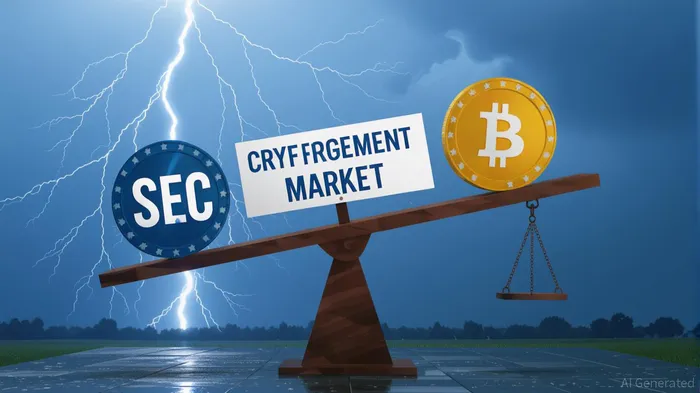
The cryptocurrency market has long been a Wild West of innovation and speculation, but in recent years, it's become a battleground for regulatory uncertainty. At the heart of this chaos lies a critical flaw: inconsistent legal outcomes for fraudsters. The U.S. Securities and Exchange Commission (SEC) has oscillated between aggressive enforcement and strategic retreat, creating a regulatory environment where investors, innovators, and even regulators themselves are left guessing. This inconsistency isn't just a bureaucratic quirk—it's a systemic risk that threatens to erode trust, destabilize markets, and stifle innovation.
The SEC's Enforcement Shift: From Aggressive to Measured
Between 2023 and mid-2025, the SEC's approach to crypto enforcement underwent a dramatic transformation. Under the previous administration, the agency pursued a broad, enforcement-driven strategy, filing lawsuits against major players like CoinbaseCOIN--, Ripple, and Terraform Labs. These actions were often rooted in the Howey Test, a 1946 legal framework that classifies assets as securities if they involve an investment of money in a common enterprise with the expectation of profit from the efforts of others. However, this approach was criticized for its lack of clarity and predictability.
In early 2025, a new leadership team under Chairman Paul Atkins and Acting Chairman Mark Uyeda introduced a “back-to-basics” strategy. The SEC began dismissing cases from the prior administration, including the high-profile Coinbase lawsuit, and shifted focus to traditional fraud enforcement. The formation of the Crypto Task Force and the Cyber and Emerging Technologies Unit (CETU) signaled a pivot toward rule-based regulation over ad hoc enforcement. Yet, this shift created its own set of problems.
Case Studies: Inconsistent Outcomes and Legal Gray Areas
The inconsistency in enforcement is best illustrated by contrasting cases. In September 2023, the SEC took action against Stoner Cats 2, LLC (SC2), a company that sold NFTs to fund a web-based animated series. The agency argued the NFTs were unregistered securities, leading to a $1 million settlement. SC2 neither admitted nor denied wrongdoing, but the case sent a clear message: the SEC was targeting NFTs as securities.
By February 2025, however, the SEC had dismissed its case against Coinbase, a platform it had previously accused of operating as an unregistered securities exchange. This reversal, framed as a strategic pivot to prioritize investor protection over broad regulatory crackdowns, left market participants scratching their heads. If NFTs could be securities, why not staking tokens or stablecoins? The lack of a consistent framework created a regulatory minefield.
Market Impacts: Volatility and Investor Anxiety
The consequences of this inconsistency are measurable. A 2025 study titled “Uncertain Regulations, Definite Impacts” found that SEC announcements classifying crypto assets as securities triggered immediate sell-offs. On average, prices dropped 5.2% within three days and 17.2% over 30 days. Smaller, less liquid assets bore the brunt of this volatility, with trading volumes collapsing as investors fled uncertainty.
The psychological toll is equally alarming. RedditRDDT-- forums and social media platforms buzzed with stories of investors experiencing anxiety, panic attacks, and even suicidal ideation during market crashes linked to regulatory announcements. This isn't just about money—it's about trust. When investors can't predict how a regulator will act, they lose faith in the system itself.
Broader Implications: Innovation vs. Regulation
The SEC's inconsistent enforcement has also had a chilling effect on innovation. Startups and developers now face a paradox: innovate in a space where the rules change overnight, or risk being caught in a regulatory crossfire. This uncertainty has driven activity offshore, where decentralized platforms operate in legal gray areas. While this may preserve innovation, it also exposes investors to higher risks, from fraud to operational instability.
Investment Advice: Navigating the Uncertain Landscape
For investors, the lesson is clear: diversify, hedge, and stay informed. Here's how to approach the current environment:
1. Avoid Overexposure to Illiquid Assets: Smaller crypto projects are more vulnerable to regulatory shocks. Stick to well-established tokens with strong fundamentals.
2. Monitor Regulatory Signals: Track SEC staff statements and court rulings. For example, the 2025 clarifications on meme coins and stablecoins offer some guidance, but they're not a substitute for a coherent framework.
3. Consider Alternative Markets: If U.S. regulators continue to flip-flop, explore markets with clearer rules, such as Singapore or Switzerland, where crypto innovation is more regulated but predictable.
4. Prioritize Investor Protection: Use custodial services with strong security and insurance. In a world of regulatory uncertainty, asset safety is paramount.
Conclusion: The Path Forward
The crypto market's future hinges on regulatory clarity. Until the SEC and other agencies establish consistent, rule-based frameworks, systemic risks will persist. Investors must recognize that the current environment is not a temporary hiccup but a structural flaw in how regulators approach digital assets. By staying informed, hedging risks, and advocating for clearer policies, investors can navigate this turbulent landscape—and perhaps even thrive in it.
The question isn't whether crypto will survive. It's whether regulators can adapt to a world where innovation outpaces regulation. Until then, the seesaw will keep tilting, and the market will keep paying the price.

Decoding blockchain innovations and market trends with clarity and precision.
Latest Articles
Stay ahead of the market.
Get curated U.S. market news, insights and key dates delivered to your inbox.
AInvest
PRO
AInvest
PRO



Comments
No comments yet