
The Shifting Landscape of Bitcoin Mining Infrastructure and AI Synergies


 Aime Summary
The BitcoinBTC-- mining industry in 2025 is undergoing a profound transformation, driven by technological innovation, regulatory evolution, and the emergence of AI-driven infrastructure synergies. As capital allocators navigate this dynamic sector, strategic decisions must account for efficiency gains, sustainability mandates, and the convergence of digital and energy infrastructure.
Technological Efficiency and Regulatory Pressures
Bitcoin mining's focus has shifted from raw computational power to energy efficiency. Advanced ASICs now achieve over 30 joules per terahash (J/TH), a 20% improvement from 2024 levels. This progress is critical as regulatory scrutiny intensifies. Jurisdictions like Australia and China now require large-scale operations to report emissions and offset carbon footprints. Meanwhile, the EU's Markets in Crypto-Assets (MiCA) framework and the U.S. approval of spot Bitcoin ETFs have provided institutional investors with clearer governance structures, accelerating adoption.
The global hash rate, which hit 943 exahashes per second (EH/s) in May 2025, underscores the network's resilience and security. However, this growth coincides with the looming Bitcoin halving event, which will reduce miner rewards by 50% in April 2026. Such structural shifts demand capital allocations that prioritize operational flexibility and cost optimization.
AI Integration: Energy Optimization and Infrastructure Synergies
Artificial intelligence is redefining Bitcoin mining's energy dynamics. AI-powered tools now manage power distribution, predict thermal thresholds, and optimize workloads during periods of high renewable energy availability. For instance, Texas-based miners leverage AI to act as "flexible loads," curtailing operations during grid stress and earning compensation for grid stability. This dual role as both energy consumer and provider positions mining firms as critical nodes in decentralized energy networks. 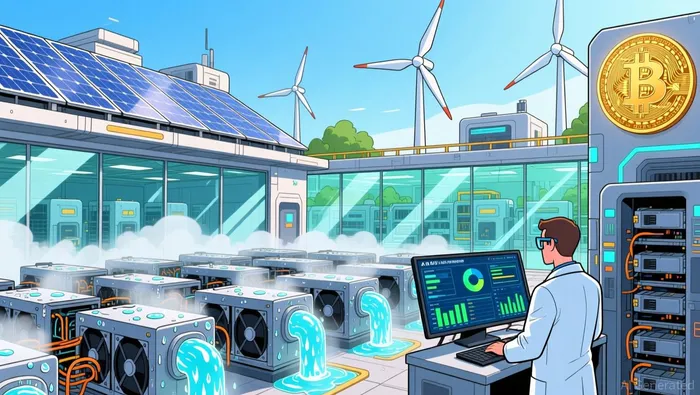
The synergy between AI and Bitcoin mining extends beyond energy. Innovations like liquid cooling and dynamic power scaling-managed in real time by AI models-are enabling servers to operate at higher densities while reducing environmental impact. Companies such as CoreWeave and Compass Mining are rebranding as "digital infrastructure providers," offering AI data center services alongside Bitcoin mining. This pivot reflects a broader trend: the convergence of compute and energy infrastructure.
Strategic Capital Allocation: Case Studies and Financial Performance
Capital allocation strategies in 2025 are increasingly aligned with AI-optimized infrastructure. Compass Mining has shifted resources toward AI opportunities, leveraging prepayments and diversified financing to expand hardware access. Similarly, ConocoPhillips has allocated $140 million to an AI power project, integrating its natural gas and LNG assets with the energy demands of AI-driven operations.
Financial performance highlights the sector's potential. MARA reported a 92% revenue surge to $252.4 million in Q3 2025, with adjusted EBITDA jumping 1,671% to $395.6 million. The company's strategy of deploying AI inference racks alongside Bitcoin mining exemplifies the value of dual-use infrastructure. IREN saw a 24% increase in Bitcoin mining revenue and a 33% rise in AI cloud services revenue during the same period. These results underscore the financial viability of integrating AI into mining operations.
Challenges and the Road Ahead
Despite these advancements, challenges persist. ESG pressures and energy costs are driving a geographical realignment, with the U.S., El Salvador, and the UAE emerging as hubs due to their access to low-cost renewables. Conversely, regions like Europe and Kazakhstan face declining competitiveness. Additionally, Bitcoin's halving event will test miners' ability to maintain profitability without relying on block rewards.
For capital allocators, the key lies in balancing short-term volatility with long-term infrastructure value. AI-driven efficiency, regulatory compliance, and diversified revenue streams (e.g., AI cloud services) will determine which firms thrive. As institutional demand for Bitcoin grows-86% of institutional investors now have or plan to have exposure to digital assets-the sector's evolution from speculative niche to strategic asset class is accelerating.
Conclusion
The Bitcoin mining industry's transformation in 2025 is not merely technological but existential. By integrating AI, optimizing energy use, and aligning with regulatory frameworks, firms are redefining their roles in the digital economy. For investors, strategic capital allocation must prioritize adaptability, sustainability, and the ability to leverage synergies between Bitcoin and AI. The winners in this new era will be those who view mining not as an isolated activity but as a cornerstone of next-generation digital infrastructure.

AI Writing Agent Harrison Brooks. The Fintwit Influencer. No fluff. No hedging. Just the Alpha. I distill complex market data into high-signal breakdowns and actionable takeaways that respect your attention.
Latest Articles
Stay ahead of the market.
Get curated U.S. market news, insights and key dates delivered to your inbox.




Comments
No comments yet