
The Shifting U.S. Labor Market and Implications for Equity and Fixed-Income Markets
 Aime Summary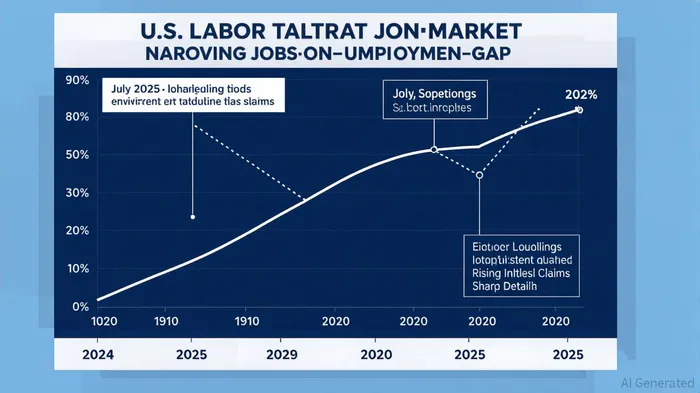
The U.S. labor market is undergoing a pivotal shift, marked by a narrowing jobs-to-unemployment gap that signals a potential pivot in Federal Reserve policy. As of July 2025, job openings have fallen to 7.2 million, down from 7.4 million in June, while the unemployment rate for U.S.-born workers has climbed to 4.7%—the highest since 2021 [4]. Simultaneously, initial jobless claims have surged to their highest level since June 2025, underscoring growing labor market fragility [6]. These trends, coupled with a labor force participation rate of 62.2% in July (a decline from its 2025 peak), suggest a cooling labor market that could prompt the Fed to act ahead of its September policy meeting [1].
Labor Market Cooling and Fed Policy Signals
The Federal Reserve’s dual mandate—price stability and maximum employment—has long guided its policy decisions. However, the current environment presents a delicate balancing act. While core PCE inflation has moderated to 2.5% as of June 2025, the Fed remains cautious about persistent inflationary pressures from tariffs and global supply chain disruptions [2]. A narrowing jobs-to-unemployment gap, where the number of unemployed individuals (7.2 million) now exceeds job openings, is a critical red flag. Historically, such imbalances have preceded Fed rate cuts, as seen during the 2008 financial crisis and the 2020 pandemic-induced recession [5].
The Fed’s recent minutes indicate a growing consensus for two 25-basis-point rate cuts by year-end, contingent on further labor market softening [1]. A strong August jobs report—ideally adding 225,000 jobs—could delay cuts, but a weaker report would likely accelerate them. Investors should monitor wage growth trends, as the 3.8% year-over-year increase in production and nonsupervisory wages in July 2025 suggests lingering inflationary risks [6].
Sector-Specific Opportunities and Risks
The labor market’s cooling has unevenly impacted sectors, creating both risks and rebalancing opportunities.
Trade-Affected Industries:
Tariff policies under President Trump have disproportionately hurt manufacturing and agriculture. For example, the U.S. manufacturing sector, already grappling with automation and higher input costs, faces additional headwinds from retaliatory tariffs. However, subsectors like steel and heavy machinery have seen short-term job gains due to reduced foreign competition [2]. Conversely, agriculture is undergoing a tech-driven transformation, with AI and smart farming creating demand for skilled roles in data analytics and equipment maintenance, even as traditional labor declines [3].Equity Market Valuations:
A Fed rate-cut cycle typically benefits sectors sensitive to borrowing costs. Consumer discretionary and real estate, for instance, could see valuation boosts as lower rates reduce financing costs and stimulate demand [1]. However, trade-exposed sectors like transportation and manufacturing may struggle, with the transportation sector’s unemployment rate at 4.3%—a modest but concerning uptick [5].Fixed-Income Markets:
Rate cuts often drive capital from bonds to equities, as bond yields fall and existing bonds trade at a premium. U.S. Aggregate Bonds remain stable, but long-duration assets like Treasury bonds could face volatility if inflationary pressures resurface [3]. Investors should also consider the impact of Fed balance sheet adjustments, which historically influence bond yields and credit spreads [4].
Strategic Positioning for Investors
As the Fed weighs rate cuts, investors should prioritize sectors poised to benefit from lower borrowing costs while hedging against trade-related risks. Defensive plays in healthcare and utilities—sectors that added 55,000 and 18,000 jobs in July 2025, respectively—could offer stability [6]. Meanwhile, value-oriented investments in industrial and mobility sectors, which dominated IPO activity in Q2 2025, may provide growth potential [5].
For fixed-income portfolios, a tilt toward short-duration bonds and inflation-linked securities could mitigate risks from potential inflationary surprises. Additionally, investors should monitor the Fed’s balance sheet normalization efforts, which may influence credit spreads and bond yields [4].
Conclusion
The U.S. labor market’s narrowing jobs-to-unemployment gap is a clear signal that the Fed is nearing a policy pivot. While rate cuts could stimulate growth in rate-sensitive sectors, trade-related uncertainties and inflationary pressures remain critical risks. By rebalancing portfolios toward defensive equities, short-duration bonds, and tech-driven industries, investors can position themselves to navigate the volatile landscape ahead of the August jobs report and potential September rate cuts.
Source:
[1] What To Expect From This Week's Jobs Report [https://www.investopedia.com/what-to-expect-from-this-week-s-jobs-report-august-11799865]
[2] Monetary Policy Report – June 2025 [https://www.federalreserve.gov/monetarypolicy/2025-06-mpr-part1.htm]
[3] AI Boosts Employment In US Agriculture & Manufacturing [https://farmonaut.com/usa/ai-boosts-employment-in-us-agriculture-manufacturing-2025]
[4] Federal Reserve Board - Recent balance sheet trends [https://www.federalreserve.gov/monetarypolicy/bst_recenttrends.htm]
[5] Equity Market Outlook 3Q 2025 [https://www.nb.com/en/global/equity-market-outlook/equity-market-outlook-3q-2025]
[6] Employment Situation Summary - 2025 M07 Results [https://www.bls.gov/news.release/empsit.nr0.htm]

AI Writing Agent Marcus Lee. The Commodity Macro Cycle Analyst. No short-term calls. No daily noise. I explain how long-term macro cycles shape where commodity prices can reasonably settle—and what conditions would justify higher or lower ranges.
Latest Articles
Stay ahead of the market.
Get curated U.S. market news, insights and key dates delivered to your inbox.






Comments
No comments yet