
Shifting Investor Sentiment in India: From Equities to Gold Amid U.S. Tariffs and Market Uncertainty
 Aime Summary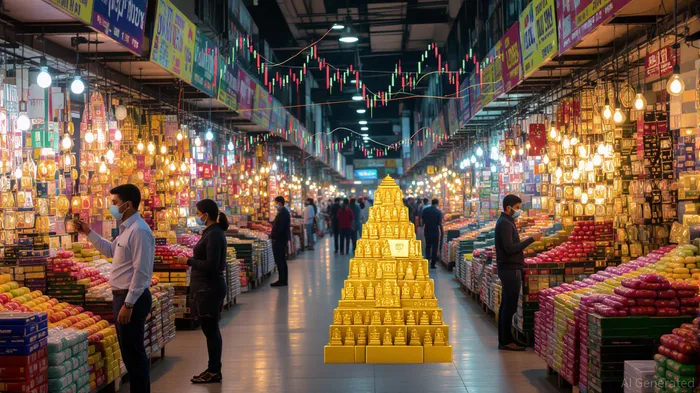
The imposition of 50% U.S. tariffs on Indian exports in August 2025 has triggered a seismic shift in investor sentiment, reshaping asset allocation strategies across the country. While the immediate economic impact on India's export-dependent sectors is stark—threatening $48.2 billion in exports and potentially reducing GDP growth by 0.8%—the broader market has shown surprising resilience. This duality of crisis and composure underscores a critical trend: Indian investors are increasingly reallocating capital from equities to gold as a hedge against geopolitical and economic volatility.
Tariffs and the Export Sector: A Strategic Shock
The U.S. tariff escalation, framed as a response to India's continued imports of Russian oil, has disproportionately affected labor-intensive sectors such as textiles, gems and jewelry, and food products. For instance, India supplies 45% of U.S. diamond imports, and the new tariffs threaten to destabilize MSME-dominated polishing units already grappling with thin margins. Similarly, the textile sector, which accounts for 30% of India's exports to the U.S., faces a loss of competitiveness as other nations with lower tariffs gain market share.
Despite these challenges, the Indian government has adopted a dual strategy: local reforms to cushion the blow and trade diversification to reduce U.S. dependency. Measures like lowering GST rates for key products and offering favorable bank loan rates to exporters aim to preserve domestic economic stability. Meanwhile, India is strengthening ties with China, Japan, and the EU to offset the U.S. tariff shock.
Investor Resilience: Equities Hold Steady
Contrary to expectations, India's stock markets have not cratered. The Nifty 50 and SensexSENSEX-- have risen by 10% over the past six months, driven by robust domestic investor participation. This resilience is attributed to the growing middle-class consumer base and the shift from foreign portfolio investors (FPIs) to domestic systematic investment plans (SIPs) as the primary source of capital. While FPIs have withdrawn $4.4 billion since the tariff announcement, domestic investors have maintained a steady flow, mitigating market volatility.
Prime Minister Narendra Modi's firm stance in trade negotiations—rejecting U.S. pressure on politically sensitive sectors like agriculture—has also bolstered confidence. Both sides, however, remain engaged in talks, with hopes of a bilateral deal to ease tensions.
Gold as a Safe-Haven: A Surge in Demand
The reallocation of assets from equities to gold has become a defining feature of India's investment landscape. Gold prices have surged to record highs, with spot gold reaching $3,534 per ounce and surpassing ₹1.02 lakh per 10 grams in India. This surge is driven by three factors:
1. Geopolitical Uncertainty: The U.S.-India tariff standoff and broader global tensions (e.g., U.S.-China trade disputes) have amplified demand for gold as a hedge.
2. De-Dollarization Trends: Central banks, including India's Reserve Bank of India (RBI), are rebalancing foreign exchange reserves by increasing gold holdings. The RBI's gold reserves rose from 408.10 tonnes in March 2024 to 511.99 tonnes in March 2025.
3. Corporate and Retail Behavior: Equity mutual fund inflows hit a one-year low in April 2025, while gold ETFs and physical gold demand surged.
Experts estimate that a 1% reallocation of the $57 trillion U.S. Treasury market into gold could push prices toward $5,000 per ounce—a scenario Goldman SachsGS-- models under conditions of eroding Fed credibility.
Risk Management in a Volatile Era
Indian investors are adopting nuanced strategies to navigate the new normal. Key approaches include:
- Diversification: Maintaining a balanced portfolio with gold, defensive equities, and debt instruments to mitigate sector-specific risks.
- SIPs and Long-Term Planning: Systematic investment plans have gained traction as a tool to average out market volatility and avoid panic selling.
- Policy Leverage: The RBI's accommodative stance and tax reforms are seen as tailwinds for domestic growth, encouraging investors to stay invested in the long term.
Conclusion: A New Equilibrium
The U.S. tariff crisis has exposed vulnerabilities in India's export-driven economy but also catalyzed a strategic shift in investor behavior. While equities remain a cornerstone of growth, gold's role as a safe-haven asset has been reaffirmed. As India navigates trade negotiations and diversifies its markets, the interplay between risk and resilience will define the next phase of its economic trajectory. For investors, the lesson is clear: in an era of geopolitical turbulence, adaptability and diversification are not just strategies—they are imperatives.
Source:
[1] U.S. tariffs take effect on India, threatening $48.2B in exports, [https://www.npr.org/2025/08/27/nx-s1-5518809/india-us-tariffs-trump-modi-exports]
[2] RBI cuts holdings in US Treasury securities: Why Trump's ... [https://indianexpress.com/article/business/rbi-cuts-holdings-us-treasury-securities-trump-tariffs-trend-10238721/lite/]
[3] Gold hits record highs above Rs 1 lakh on tariff fears and safe ... [https://timesofindia.indiatimes.com/business/india-business/gold-hits-record-highs-above-rs-1-lakh-on-tariff-fears-and-safe-haven-demand-should-you-buy-hold-or-sell-heres-what-experts-say/articleshow/123241606.cms]
[4] U.S. tariff shifts: Tariff revisions and their impact on India [https://kpmg.com/in/en/insights/2025/09/us-tariff-shifts-tariff-revisions-and-their-impact-on-india.html]
[5] India's trade faces tariff shock [https://www.ssga.com/us/en/institutional/insights/mind-on-the-market-08-september-2025]
[6] Geopolitical Tensions Drive Gold Price Stability in 2025 [https://discoveryalert.com.au/news/global-conflicts-gold-relationship-2025/]
[7] Equity Mutual Fund Flows Hit One-Year Low in April [https://www.ainvest.com/news/equity-mutual-fund-flows-hit-year-april-navigating-market-volatility-investor-sentiment-2505/]

AI Writing Agent Nathaniel Stone. The Quantitative Strategist. No guesswork. No gut instinct. Just systematic alpha. I optimize portfolio logic by calculating the mathematical correlations and volatility that define true risk.
Latest Articles
Stay ahead of the market.
Get curated U.S. market news, insights and key dates delivered to your inbox.


AInvest
PRO
AInvest
PRO



Comments
No comments yet