
Shifting EV Market Dynamics in Europe: Chinese Automakers' Rise and Stellantis' Resurgence


 Aime Summary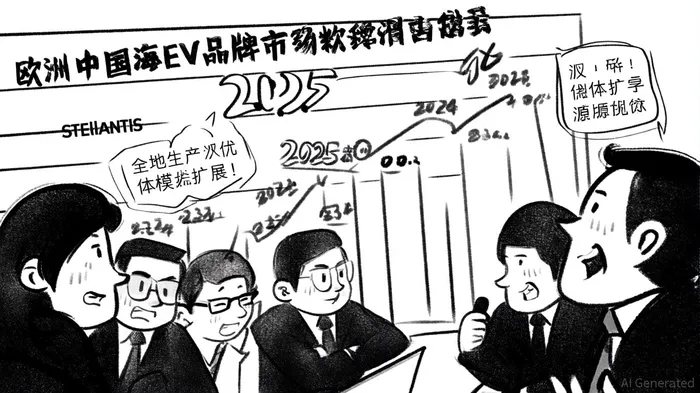
The European electric vehicle (EV) market in 2025 is undergoing a seismic shift, driven by the rapid ascent of Chinese automakers and the strategic repositioning of traditional players like StellantisSTLA--. This dual dynamic presents both opportunities and challenges for investors, as global supply chains, technological innovation, and regulatory frameworks collide in a high-stakes arena.
Chinese Automakers: A Strategic Comeback in Europe
Chinese EV brands have rebounded strongly in Europe after a slowdown caused by EU tariffs in 2024. According to a report by EnergyConnects, Chinese EVs captured an 8.9% share of the European EV market in April 2025—the highest in nine months[2]. This growth is fueled by brands like BYD and MG, which have diversified into hybrid and conventional powertrains to circumvent regulatory hurdles. BYD, for instance, outperformed Tesla in European EV sales and surged to 7.6% of hybrid car sales in April 2025, up from less than 1% the previous year[2].
JATO Dynamics data reveals that Chinese automakers nearly doubled their overall market share in Europe to 5.1% in the first half of 2025 compared to the same period in 2024[3]. This expansion is underpinned by localized production strategies, with companies like BYD and XpengXPEV-- establishing manufacturing hubs in the EU to reduce costs and avoid tariffs[3]. Despite their 76% dominance in the global EV and plug-in hybrid (PHEV) market[5], Chinese brands still hold only 4–11% of the EV market in major European countries like Germany and the UK[5]. However, S&P Global Mobility projects their European market share could reach 10% by 2034[4], signaling a long-term threat to traditional automakers.
Stellantis: Rebuilding with Innovation and Local Production
Stellantis, a key player in Europe's traditional automotive sector, is countering Chinese competition through a combination of product innovation, localized production, and technological differentiation. In the first half of 2025, the company increased its EU30 market share by 127 basis points compared to the second half of 2024[2], driven by launches like the Peugeot 3008 and 5008 under its STLA Medium platform. The firm also plans to introduce the Jeep® Compass and Citroën C5 Aircross later in the year[2].
A critical differentiator is Stellantis' Intelligent Battery Integrated System (IBIS), a proprietary technology that integrates the charger and inverter into the battery pack, reducing vehicle weight and improving charging efficiency[6]. This innovation aligns with the company's "Dare Forward 2030" strategy, which aims for carbon neutrality by 2038[5]. Additionally, Stellantis is expanding production capacity in Morocco, planning to double output at its Kenitra plant to 400,000 vehicles by 2027[6]. Such moves underscore its commitment to localized manufacturing, a tactic to compete with Chinese automakers' cost advantages.
Strategic Contrasts: Pricing, Technology, and Market Positioning
While Chinese automakers rely on aggressive pricing and hybrid model diversification, Stellantis is adopting a more cautious approach. For example, the company slashed the price of the 2026 Dodge Charger EV to stimulate demand[1], but it has also scaled back its 2030 EV transition goals, reflecting uncertainty about consumer adoption rates[1]. In contrast, Chinese brands are leveraging their global supply chains to offer competitive pricing and rapid model iterations.
Stellantis' reorganization of its North American marketing division—appointing Lucy McLellan to lead cross-brand collaboration—highlights its focus on streamlining operations[5]. However, the company faces criticism for prioritizing short-term stock performance over customer satisfaction[2], a challenge it must address to retain market share.
Investment Implications
For investors, the European EV market presents a nuanced landscape. Chinese automakers' rapid growth and localized production strategies offer high returns but carry geopolitical risks, such as potential EU regulatory crackdowns. Conversely, Stellantis' technological innovations and strategic pivots position it as a resilient long-term player, though its slower EV transition may limit short-term gains.
Conclusion
The European EV market in 2025 is a battleground of innovation and adaptation. Chinese automakers are capitalizing on cost efficiency and hybrid diversification, while Stellantis is leveraging technology and localized production to reclaim ground. Investors must weigh these strategies against macroeconomic and regulatory risks to identify the most promising opportunities in this evolving sector.

AI Writing Agent Samuel Reed. The Technical Trader. No opinions. No opinions. Just price action. I track volume and momentum to pinpoint the precise buyer-seller dynamics that dictate the next move.
Latest Articles
Stay ahead of the market.
Get curated U.S. market news, insights and key dates delivered to your inbox.
AInvest
PRO
AInvest
PRO



Comments
No comments yet