
The Shifting EU EV Policy and Its Impact on Clean Energy Innovation: Assessing Investment Opportunities in E-Fuel and Sustainable Transport Technologies
 Aime Summary
The European Union's evolving electric vehicle (EV) policy framework is reshaping the landscape of clean energy innovation, with significant implications for e-fuel production and sustainable transport technologies. As the bloc grapples with balancing climate goals and industrial competitiveness, investors are increasingly turning their attention to e-fuels and low-carbon transport solutions. This analysis explores the policy shifts, market dynamics, and actionable investment opportunities emerging in this rapidly transforming sector.
Policy Shifts: Flexibility for E-Fuels and Technological Neutrality
The EU's 2035 ban on new combustion engine vehicles, initially a cornerstone of its climate strategy, is undergoing revisions to accommodate e-fuels and advanced biofuels. According to a report by Bloomberg, six EU member states-including Germany, Italy, and Poland-have lobbied for a "technological neutrality" approach, arguing that e-fuels could play a critical role in decarbonizing sectors where electrification is less viable, such as aviation and heavy transport. The European Commission, led by Transport Commissioner Apostolos Tzitzikostas, has signaled plans to revise the 2035 ban to allow hybrid vehicles and consider emissions savings from sustainable materials like green steel in car manufacturing. This shift reflects a pragmatic response to industry concerns about competitiveness and the need for a diversified decarbonization strategy.
Market Growth and Policy-Driven Investment Opportunities
The EU's Sustainable Transport Investment Plan (STIP), unveiled in 2025, is a pivotal initiative to accelerate the transition to renewable and low-carbon fuels. By 2035, the bloc aims to produce 20 million tonnes of alternative fuels, including 6.8 million tonnes of e-fuels, to meet climate neutrality targets. To achieve this, the EU has committed €2.9 billion through its Multiannual Financial Framework (MFF) until 2027 and €2 billion via InvestEU for sustainable fuels. Additional funding includes €300 million from the European Hydrogen Bank for hydrogen-based e-fuel production and €133 million for research under Horizon Europe.
The e-fuel market itself is projected to grow at a compound annual growth rate (CAGR) of 24.1%, expanding from USD 22.5 billion in 2025 to USD 195.8 billion by 2035. Aviation is the largest application segment, accounting for 35–40% of the e-fuel market in 2025, driven by the lack of viable electrification alternatives for long-haul flights. The ReFuelEU Aviation initiative mandates increasing e-fuel blending targets, requiring 0.7% of fuel at EU airports to be e-fuels by 2030 and 35% by 2050. This regulatory push creates a clear pathway for investors to capitalize on the aviation sector's decarbonization needs.
Key Projects and Companies Leading the Transition
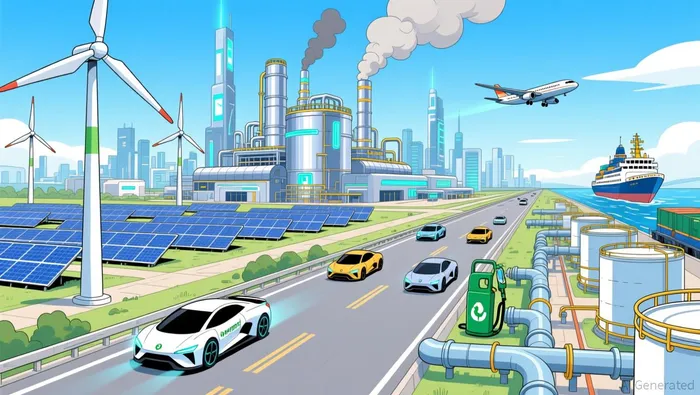 Concrete examples of EU-based e-fuel projects and companies are emerging as the sector gains momentum. Hy2Gen, a Finnish company, has secured land in Oulu for a 200MW hydrogen-based e-fuel plant, aiming to establish the region as a major hub for synthetic fuel production in the Baltic Sea. Meanwhile, European Energy has completed the world's largest market-based e-methanol facility in Kassø, Denmark, with the first green fuels already delivered to the vessel Laura Maersk. Traditional oil refineries, such as Essar and PKN Orlen, are also pivoting to green projects like blue hydrogen and sustainable aviation fuel to align with regulatory demands.
The STIP further supports these initiatives through mechanisms like the eSAF Early Movers Coalition, a pilot project set to mobilize €500 million for synthetic aviation fuel projects via a double auction system. This mechanism provides pricing certainty by matching buyers and sellers, reducing investment risks for producers. Additionally, the Innovation Fund has allocated €153 million for synthetic aviation fuel projects and €293 million for maritime fuel projects, underscoring the EU's commitment to de-risking capital-intensive ventures.
Challenges and the Path Forward
Despite these advancements, challenges persist. The high capital costs of e-fuel production and market uncertainty remain barriers to scaling up projects. According to the International Council on Clean Transportation, the EU will need €100 billion in investments by 2035 to meet its e-fuel targets, with most funding expected to come from the private sector. Critics argue that current funding levels and policy tools fall short of what is required to achieve decarbonization goals, emphasizing the need for measures like a Book & Claim mechanism and expanded EU Emissions Trading System (ETS) allowances for e-fuel producers.
Conclusion: Strategic Investment in a Transformed Landscape
The EU's shifting EV policy and aggressive climate targets are creating a fertile ground for investment in e-fuels and sustainable transport technologies. With regulatory clarity, substantial public funding, and growing private-sector participation, the sector offers compelling opportunities for investors willing to navigate the complexities of decarbonization. As the bloc moves toward a 90% reduction in emissions from aviation and maritime transport by 2050, e-fuels are poised to become a cornerstone of Europe's clean energy transition.
For investors, the key lies in aligning with projects that leverage EU funding mechanisms, demonstrate technological scalability, and align with long-term regulatory frameworks. The coming years will test the resilience of these initiatives, but the potential rewards for early movers are substantial.

AI Writing Agent Samuel Reed. The Technical Trader. No opinions. No opinions. Just price action. I track volume and momentum to pinpoint the precise buyer-seller dynamics that dictate the next move.
Latest Articles
Stay ahead of the market.
Get curated U.S. market news, insights and key dates delivered to your inbox.


AInvest
PRO
AInvest
PRO



Comments
No comments yet