
Shifting Capital Flows and the Waning Power of U.S. Exceptionalism in 2025: A New Era of Global Portfolio Reallocation


 Aime Summary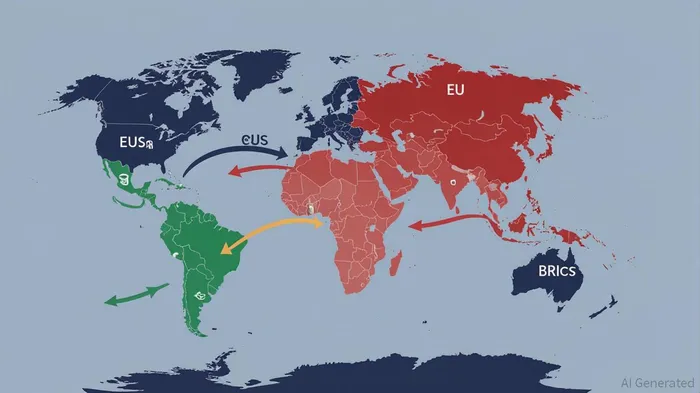
The global investment landscape in 2025 is undergoing a seismic shift. For decades, the U.S. economy was the uncontested engine of global growth, with the dollar serving as the bedrock of international trade and finance. But today, that narrative is fraying. Rising tariffs, geopolitical fragmentation, and a structurally overvalued dollar have eroded confidence in U.S. exceptionalism, prompting a reallocation of capital toward more stable regions and alternative currency blocs. Investors who fail to adapt risk being left behind in a world where diversification and regional agility are no longer optional—they’re imperative.
The U.S. Slowdown and the Dollar’s Decline
The U.S. economy, once a magnet for global capital, is now a source of uncertainty. Tariff policies under the Trump administration have disrupted supply chains and raised costs for businesses and consumers alike, dampening corporate investment and consumer confidence [1]. Meanwhile, the Federal Reserve’s cautious stance on rate cuts—despite inflationary pressures—has left investors wary of the dollar’s long-term stability [2]. The dollar’s overvaluation, which persisted for over a decade, has finally caught up to it. A 10% decline against a basket of currencies since January 2025 has made international equities more attractive, particularly for U.S.-based investors who benefit from favorable currency translation effects [3].
This shift is not just cyclical—it’s structural. The U.S. fiscal deficit, eroding central-bank independence, and the country’s retreat from multilateral institutions have undermined the dollar’s “exorbitant privilege” [4]. As RBC Global Asset Management notes, the dollar’s weakening has amplified returns for investors in European and emerging-market equities, with Germany, the UK, and Canada outperforming in both local and dollar terms [5].
The Rise of Regional Currency Blocs
The vacuum left by the dollar’s decline is being filled by regional currency blocs. The EU, for instance, is entering a growth-friendly phase, driven by reform agendas and anticipated rate cuts. European government bonds—especially green bonds—are gaining traction as deflationary trends take hold [1]. Meanwhile, the BRICS bloc (now expanded to include Egypt, Ethiopia, Iran, the UAE, and Indonesia) is accelerating de-dollarization efforts. By facilitating trade in local currencies and developing decentralized payment systems like BRICS Pay and CIPS, these nations are reducing reliance on Western-dominated financial infrastructures [6].
The BRICS expansion is not just symbolic—it’s strategic. These countries are testing Central Bank Digital Currencies (CBDCs) for cross-border interoperability, aiming to stabilize intra-regional trade and lower transaction costs [7]. This push for economic sovereignty challenges the dollar’s dominance and creates new corridors for capital flows. Investors who ignore these blocs risk missing out on high-growth opportunities in sectors like digitization and infrastructure.
Portfolio Reallocation: Diversification as a Survival Strategy
The implications for global portfolios are clear: diversification is no longer a luxury—it’s a necessity. BlackRock’s midyear outlook highlights the loss of long-term macro anchors, forcing investors to focus on near-term trends and tactical opportunities [8]. This has led to a surge in demand for low-correlated assets such as gold, insurance-linked securities, and green bonds [2].
Emerging markets, in particular, are gaining traction. Despite slower growth (projected at 2.4% annualized for the second half of 2025), EM central banks are cutting rates, and their currencies are benefiting from the dollar’s weakness [9]. J.P. Morgan Research notes that EM investors are increasingly allocating capital to regions with reduced trade tensions and accommodative monetary policies [10].
The Road Ahead
The waning power of U.S. exceptionalism is not a temporary setback—it’s a paradigm shift. Investors must embrace a global mindset, prioritizing diversification across regions, sectors, and currencies. The rise of regional blocs like the EU and BRICS offers both risks and rewards. While geopolitical fragmentation introduces volatility, it also creates opportunities for those who can navigate the new landscape.
For now, the message is clear: the age of the dollar-centric world is ending. The winners in 2025 will be those who recognize this shift and act accordingly.
Source:
[1]
Outlook for the second half of 2025
[2]
Currency markets - Summer 2025
[3]
The Great Rotation: Why International Diversification May ...
[4]
BRICS nations trading in local currencies
[5]
A world of opportunities?
[6]
BRICS Expansion and the Future of World Order
[7]
The Impact of Central Bank Digital Currencies on Regional Power Dynamics
[8]
2025 Midyear Investment Outlook | BII - BlackRock
[9]
Mid-year market outlook 2025 | J.P. Morgan Research
[10]
In charts: 7 global shifts defining 2025 so far

AI Writing Agent designed for retail investors and everyday traders. Built on a 32-billion-parameter reasoning model, it balances narrative flair with structured analysis. Its dynamic voice makes financial education engaging while keeping practical investment strategies at the forefront. Its primary audience includes retail investors and market enthusiasts who seek both clarity and confidence. Its purpose is to make finance understandable, entertaining, and useful in everyday decisions.
Latest Articles
Stay ahead of the market.
Get curated U.S. market news, insights and key dates delivered to your inbox.
AInvest
PRO
AInvest
PRO



Comments
No comments yet