
Shiba Inu (SHIB): Navigating Market Volatility Amid Strategic Stagnation and External Pressures
 Aime Summary
Shiba Inu (SHIB), once a dominant force in the memeMEME-- coin space, has entered a period of heightened volatility as it grapples with internal strategic limitations and external macroeconomic headwinds. While the token retains a substantial community and exchange presence, its ability to sustain long-term growth is increasingly questioned amid rising competition and shifting investor priorities. This analysis explores the interplay between SHIB's internal challenges and external pressures, offering a nuanced perspective for investors navigating this volatile asset.
Internal Strategic Challenges: Erosion of Relevance
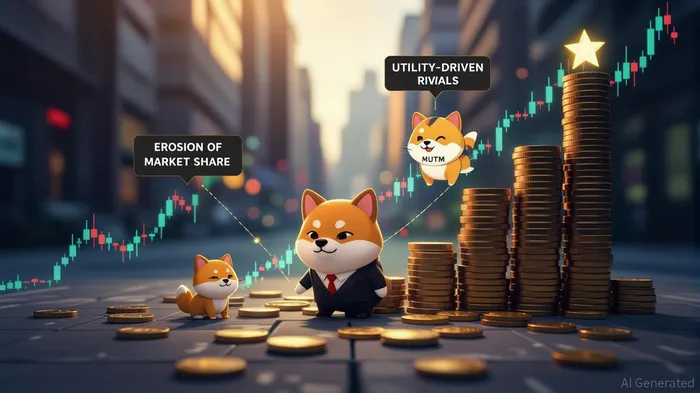
Shiba Inu's ecosystem has struggled to evolve beyond its meme coin roots, leaving it vulnerable to newer, utility-driven competitors. Projects like Little Pepe (LILPEPE) and Mutuum Finance (MUTM) have captured market attention by offering Layer 2 infrastructure, decentralized finance (DeFi) services, and real-world use cases, according to a MEXC analysis. For instance, MUTM's focus on low-cost DeFi lending has positioned it as a cheaper alternative to SHIBSHIB--, drawing capital away from the latter, according to a CoinMarketCap article. Meanwhile, SHIB's Shibarium platform has failed to demonstrate consistent on-chain activity or token burn efficacy, critical metrics for validating long-term value, according to a Digital Journal price prediction.
The token's reliance on speculative demand rather than tangible utility has further exacerbated its fragility. As old wallet holders dump their holdings, liquidity dries up, and momentumMMT-- fades, according to a CoinMarketCap article. Despite occasional whale accumulation and short-term price rebounds, according to a CoinMarketCap article, SHIB lacks the innovation to retain its market share. This strategic stagnation is compounded by the absence of high-profile partnerships or ecosystem expansions in 2025, according to a CoinMarketCap article, leaving the project in a defensive posture.
External Market Pressures: Macroeconomic and Regulatory Dynamics
SHIB's volatility is not solely a product of internal missteps but is deeply intertwined with broader macroeconomic forces. The U.S. Federal Reserve's interest rate policy has played a pivotal role. As the Fed cut rates to a range of 3.75%–4% in late 2024 and early 2025, it injected liquidity into risk assets, temporarily boosting SHIB's price, according to a Bitget analysis. However, this relief is short-lived. The Fed's uncertain stance-marked by mixed inflation data and divided policy debates-has created a volatile environment where SHIB's price oscillates between consolidation and sharp corrections, according to a Bitget analysis.
Macroeconomic indicators like inflation and GDP growth also influence SHIB's trajectory. High inflation has historically driven demand for BitcoinBTC-- as a hedge, indirectly affecting altcoins like SHIB by diverting capital to more established assets, according to a Crypto University post. Conversely, strong GDP growth could enhance risk appetite, but SHIB's lack of utility makes it less attractive than fundamentally sound projects, according to a MEXC analysis. Regulatory shifts, though not explicitly targeting SHIB, add another layer of uncertainty. Evolving compliance requirements and scrutiny on speculative tokens could further marginalize SHIB in a market increasingly favoring utility-driven innovation, according to a MEXC analysis.
The Interplay of Internal and External Factors
The convergence of SHIB's strategic weaknesses and external pressures creates a self-reinforcing cycle of volatility. For example, the Fed's dovish pivot in early 2025 briefly lifted SHIB to $0.0000115, but without sustained on-chain activity or ecosystem growth, the rally fizzled, according to a Bitget analysis. Similarly, rising interest in MUTM and LILPEPE has siphoned attention from SHIB, even as macroeconomic conditions remain favorable for risk assets, according to a CoinMarketCap article. This duality underscores SHIB's precarious position: it benefits from broad market optimism but lacks the fundamentals to capitalize on it.
Investment Considerations and Outlook
For investors, SHIB presents a high-risk, high-reward proposition. A potential rebound could materialize if the token demonstrates meaningful utility or secures strategic partnerships, but current data suggests such outcomes are unlikely, according to a CoinMarketCap article. Conversely, continued dumping by long-term holders and the rise of competitors like MUTM could drive SHIB lower, according to a MEXC analysis. Macro factors, including Fed policy and inflation, will remain critical determinants of its volatility.
In the short term, SHIB's price may experience sharp swings tied to liquidity shifts and investor sentiment, according to a CoinMarketCap article. However, without a clear roadmap for innovation, its long-term viability remains questionable. Investors should closely monitor on-chain metrics, such as token burns and active addresses, according to a Digital Journal price prediction, while keeping an eye on broader market trends.

Stay ahead of the market.
Get curated U.S. market news, insights and key dates delivered to your inbox.


AInvest
PRO
AInvest
PRO



Comments
No comments yet