
Shiba Inu Ecosystem Strategy and Supply Dynamics Under Scrutiny
 Aime Summary
- Shiba Inu has evolved from a community-driven memeMEME-- asset into a blockchain ecosystem centered on the Shibarium layer-2 network and utility tokens like BONE and TREAT.
- A recent 1,020% daily burn spike contrasts with 145 billion SHIB flowing to exchanges, suggesting short-term selling pressure despite long-term structural supply drainage.
- Market dynamics highlight a divergence where DOGE functions as a brand-driven payment currency while SHIB pursues utility-focused development through DeFi and gaming.
- Investor confidence in the meme sector remains low as capital rotates toward altcoins with verified adoption, making SHIB’s roadmap execution critical for future valuation .
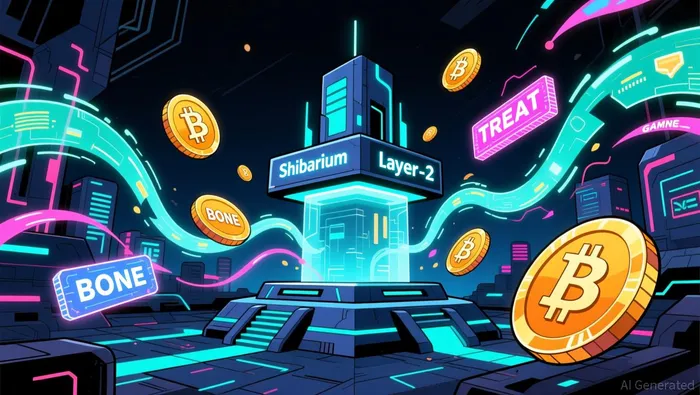
Shiba Inu (SHIB) operates as an Ethereum-based ERC-20 token that has expanded from a community-driven meme asset into a broader blockchain ecosystem . The project’s strategic goal is to transform its community into a vertically integrated infrastructure involving decentralized finance (DeFi), gaming, and governance . This transformation is anchored around the Shibarium layer-2 network, which aims to provide a low-cost execution environment for dApps .
Market data indicates SHIB maintains a market capitalization near $3 billion with high liquidity, placing it among the top meme-oriented crypto assets . Unlike many projects with significant future dilution, nearly all of SHIB’s supply is already circulating, mitigating inflationary risks . The primary supply-reduction mechanism is token burning, driven by community campaigns and ecosystem activity . However, analysts note a recurring "price disconnect": while burn rates can show dramatic percentage increases, the absolute volume burned is often small relative to the 589 trillion token supply .
The ecosystem includes several utility tokens: BONE serves as the gasGAS-- token and governance asset for Shibarium, while LEASH and TREAT handle scarcity and incentives . Shibarium, launched in 2023, has processed over 1.5 billion transactions according to recent reports . Despite high transaction counts, verification of unique active users and sustained organic demand remains a key challenge .
Recent development focuses on four themes: scaling infrastructure, privacy via a partnership with ZamaZAMA-- for fully homomorphic encryption, application expansion in gaming and DeFi, and ecosystem coordination through tools like WHY Combinator . Partnerships with ChainlinkLINK-- for cross-chain functionality and AI gaming entities like Astra Nova highlight efforts to broaden utility beyond speculation . However, the project faces risks related to its pseudonymous leadership structure and the gap between ambitious roadmap announcements and verified product deployment .
Shiba Inu’s market structure is defined by opposing supply forces . A recent daily burn rate spike of 1,020% saw 20.82 million tokens routed to dead wallets . However, this metric is misleading in isolation; it represents a 98% collapse from longer-term averages, indicating the spike is a statistical anomaly rather than a sustained trend . Notably, August burn data revealed that major exchanges like Robinhood and Coinbase accounted for significant portions of token destruction . This highlights a shift from grassroots holder burns to exchange-mediated activity .
Conversely, exchange flow data presents a bearish near-term outlook . Approximately 145 billion SHIB moved toward exchanges, pushing netflow readings into negative territory . This influx coincides with a 42% drop in exchange outflows, signaling a cooling in the accumulation pattern where tokens typically move from exchanges to cold storage . The combination of high inflows and reduced outflows suggests increased liquidity available for selling .
On a structural level, the pool of SHIB held in large selling reserves has slowly drained from 87 trillion tokens . This thinning of overhead supply theoretically supports upward price movements by reducing sell-side pressure . However, this is a slow-moving metric that does not offset immediate flow dynamics . Technical analysis points to a 'bull flag' pattern with a target of $0.00001, but price action remains subdued near $0.000005 . Current models assign SHIB strong technical ratings but predict negative price drift, reflecting the tension between supportive structural supply shifts and cautious near-term flow trends .
How does SHIB compare to other meme assets in terms of utility and liquidity?
Dogecoin (DOGE) operates as a standalone Layer-1 proof-of-work blockchain focused on being "digital cash" for global payments . It follows an inflationary model, minting 10,000 DOGEDOGE-- per block with no maximum supply, which ensures steady circulation but raises long-term scarcity concerns . Its value proposition relies heavily on brand recognition, community support, and merchant adoption for tipping and microtransactions .
Shiba Inu (SHIB), by contrast, is an ERC-20 token on EthereumETH-- that has expanded into a comprehensive ecosystem via its Layer-2 network, Shibarium . SHIB employs a deflationary approach, utilizing token burns to reduce its massive circulating supply of approximately 589.55 trillion tokens . The project has built out a suite of utilities including ShibaSwap (DeFi), a metaverse, web3 games, and ShibOS (a Web2-to-Web3 bridge) .
Market dynamics in 2026 highlight a shift in investor sentiment . Both assets have suffered severe drawdowns from their 2021 peaks, with DOGE down over 90% and SHIB down approximately 95% . Capital has increasingly rotated from meme coins toward altcoins with real-world utility like XRPXRP--, ADA, and Solana . While DOGE remains the dominant memecoinMEME-- by market cap ($12.71 billion vs SHIB's $3.03 billion), investor confidence in the sector remains low .
Whales largely ignore both tokens as the market matures . The choice between the two now depends on whether an investor prioritizes DOGE's simplicity and liquidity or SHIB's potential for ecosystem-driven utility and long-term development . Success for SHIB hinges on delivering measurable adoption for Shibarium applications and maintaining security across its multi-layer architecture .

Blending traditional trading wisdom with cutting-edge cryptocurrency insights.
Latest Articles
Stay ahead of the market.
Get curated U.S. market news, insights and key dates delivered to your inbox.


AInvest
PRO
AInvest
PRO




Comments
No comments yet