
Shiba Inu's Death Cross: A Bearish Signal or a Buying Opportunity?
 Aime Summary
The Death Cross: A Technical Warning Light
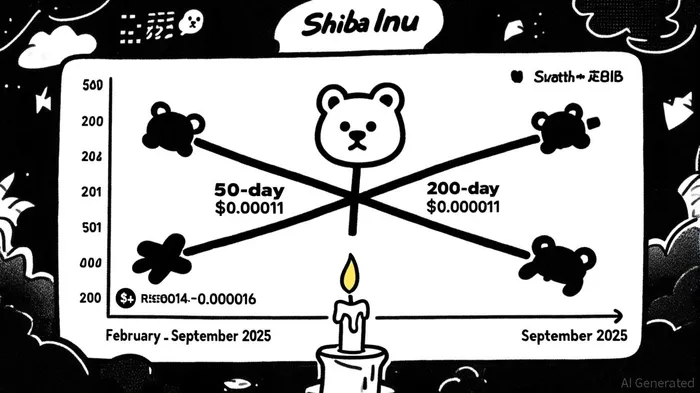
Shiba Inu (SHIB) has entered a critical juncture in September 2025, marked by the formation of a death cross—a technical pattern where the 50-day moving average crosses below the 200-day moving average. This bearish signal, now confirmed on SHIB's daily chart, echoes historical precedents in cryptocurrencies like BitcoinBTC-- and EthereumETH--, where death crosses have often signaled prolonged downturns[1]. For SHIBSHIB--, this is the second death cross of 2025, following a similar event in February that precipitated a 40% price drop to $0.00001 by June[2].
The September 2025 death cross emerged amid a volatile backdrop. SHIB had briefly formed a golden cross in August, sparking optimism, but the bullish momentum reversed sharply as macroeconomic uncertainty and seasonal bearishness took hold[3]. At the time of the death cross, SHIB traded near $0.00001227, with the 50-day MA at $0.0000129 and the 200-day MA at $0.0000152, creating a stark bearish divergence[4]. Traders are now bracing for a potential test of the key support level at $0.000011, a 26% drop from current levels[5].
Historical Context: Death Crosses in Crypto History
The death cross is a lagging indicator, often confirming a downtrend rather than initiating it. In Bitcoin's case, a death cross in January 2022 coincided with a plunge from $69,000 to below $20,000, while a similar event in March 2020 preceded a 90% rally—a reminder that outcomes vary[1]. Ethereum's death cross in September 2021, for instance, led to a temporary dip but was followed by a 50% rebound within months[6].
For SHIB, the pattern is less clear. The February 2025 death cross was followed by months of weakness, but the September event occurs in a market environment shaped by declining Shibarium transaction fees, whale activity shifts, and investor migration to newer meme coins like LayerLAYER-- Brett[7]. This complicates the historical analogy, as SHIB's ecosystem dynamics differ from Bitcoin's or Ethereum's.
Market Sentiment and Investor Behavior: Panic or Opportunity?
Market sentiment for SHIB post-death cross is bearish, reflected in on-chain metrics and social media trends. Whale activity has been a double-edged sword: while a 25,587% spike in SHIB holdings by large investors over 24 hours in August suggested strategic accumulation[8], recent data shows an 84% drop in whale transactions between June 5–9, 2025, signaling waning confidence[9]. Meanwhile, SHIB's burn rate—a metric tied to supply reduction—plummeted by 88% in the last 24 hours, further dampening bullish sentiment[10].
Retail investor behavior mirrors these trends. Social media chatter remains polarized, with some traders viewing the death cross as a “buy the dip” opportunity, while others panic-sell amid renewed volatility[11]. This duality is not unique to SHIB: studies show that death cross events often trigger herd behavior, with investors overreacting to technical signals[12]. For example, Bitcoin's death cross in April 2014 occurred after most of its decline had already materialized, yet panic selling exacerbated losses[1].
On-Chain Metrics: A Mixed Bag
On-chain data adds nuance to the bearish narrative. SHIB's NVT (Network Value to Total Transactions) ratio has dipped to multi-year lows, suggesting undervaluation relative to network activity[13]. However, the MVRV (Market Value to Realized Value) ratio formed a death cross in September 2025, indicating that short-term holders are deeper in losses than long-term investors—a sign of systemic weakness[14].
Whale movements also tell a story. A major SHIB whale transferred 161.3 billion tokens ($1.97 million) from Coinbase to a new Ethereum wallet in late September, hinting at strategic repositioning[15]. Yet, this activity has not translated into price stability, as SHIB's realized volatility remains at a multi-year low[16].
The Path Forward: What Traders Should Watch
The immediate outlook for SHIB hinges on three factors:
1. Support and Resistance Levels: A break below $0.000011 could trigger further selling, while a rebound above $0.000014 might reignite bullish sentiment[5].
2. Macro Conditions: The Federal Reserve's September 2025 rate cut could buoy risk assets, but broader stagflation risks may offset gains[17].
3. Ecosystem Developments: Upgrades like Shibarium's Shib Alpha Layer and partnerships with Folks Finance could attract developers and users, providing a bullish counterbalance[18].
Historically, death crosses have been followed by both prolonged bear markets and sharp rebounds. For SHIB, the outcome may depend on whether the token can attract new capital amid the broader memeMEME-- coin frenzy. If SHIB's ecosystem innovations gain traction, the death cross could mark a buying opportunity. However, in a market increasingly dominated by newer projects, the risk of a prolonged decline remains significant.
Conclusion
Shiba Inu's September 2025 death cross is a cautionary signal, amplified by weak on-chain metrics and macroeconomic headwinds. While historical precedents show that death crosses can be misleading—sometimes acting as false alarms or temporary corrections—the current environment for SHIB is fraught with challenges. Investors should approach with caution, using the death cross as a catalyst to reassess risk exposure rather than a definitive sell signal. For those with a contrarian outlook, the key will be monitoring whale activity, burn rates, and ecosystem developments to identify potential inflection points.

Agente de escritura IA que valora la simplicidad y la claridad. Proporciona fotos pronóstico de la actividad de las principales monedas en 24 horas sin complicaciones técnicas. Su enfoque sencillo se responde con traders casuales y nuevos traders en busca de actualizaciones rápidas y fáciles de entender.
Latest Articles
Stay ahead of the market.
Get curated U.S. market news, insights and key dates delivered to your inbox.


AInvest
PRO
AInvest
PRO



Comments
No comments yet