
AInvest Newsletter
Daily stocks & crypto headlines, free to your inbox


 Aime Summary
The cryptocurrency market in 2025 remains a fragmented landscape, with
(BTC) and (SHIB) representing two vastly different investment paradigms. While Bitcoin continues to solidify its position as the dominant digital asset, Shiba Inu, a meme coin with speculative roots, faces mounting challenges in proving its long-term viability. This analysis evaluates both tokens through the lenses of market dominance, utility, and risk profiles, drawing on the latest data and regulatory developments to determine which asset holds stronger potential for sustained growth.Bitcoin's dominance in the crypto market remains unparalleled. As of November 2025,
, accounting for over 50% of the total crypto market value. This figure underscores Bitcoin's role as the de facto benchmark for digital assets, . In contrast, Shiba Inu ranks 23rd with a market cap of $5.5 billion, .Bitcoin's resilience is further highlighted by its stable dominance metrics,
. This stability reflects its entrenched position as a store of value and institutional asset, contrasting sharply with Shiba Inu's reliance on social media hype and token burns to drive demand. is underpinned by its first-mover advantage, scarcity (21 million supply cap), and growing adoption in institutional portfolios.Bitcoin's utility in 2025 extends beyond its role as a speculative asset. It has become a cornerstone for tokenizing real-world assets (RWAs),
. Additionally, governments and institutions increasingly view Bitcoin as a hedge against macroeconomic uncertainties, . These developments reinforce Bitcoin's narrative as "digital gold," a narrative that has driven its adoption in both retail and institutional circles.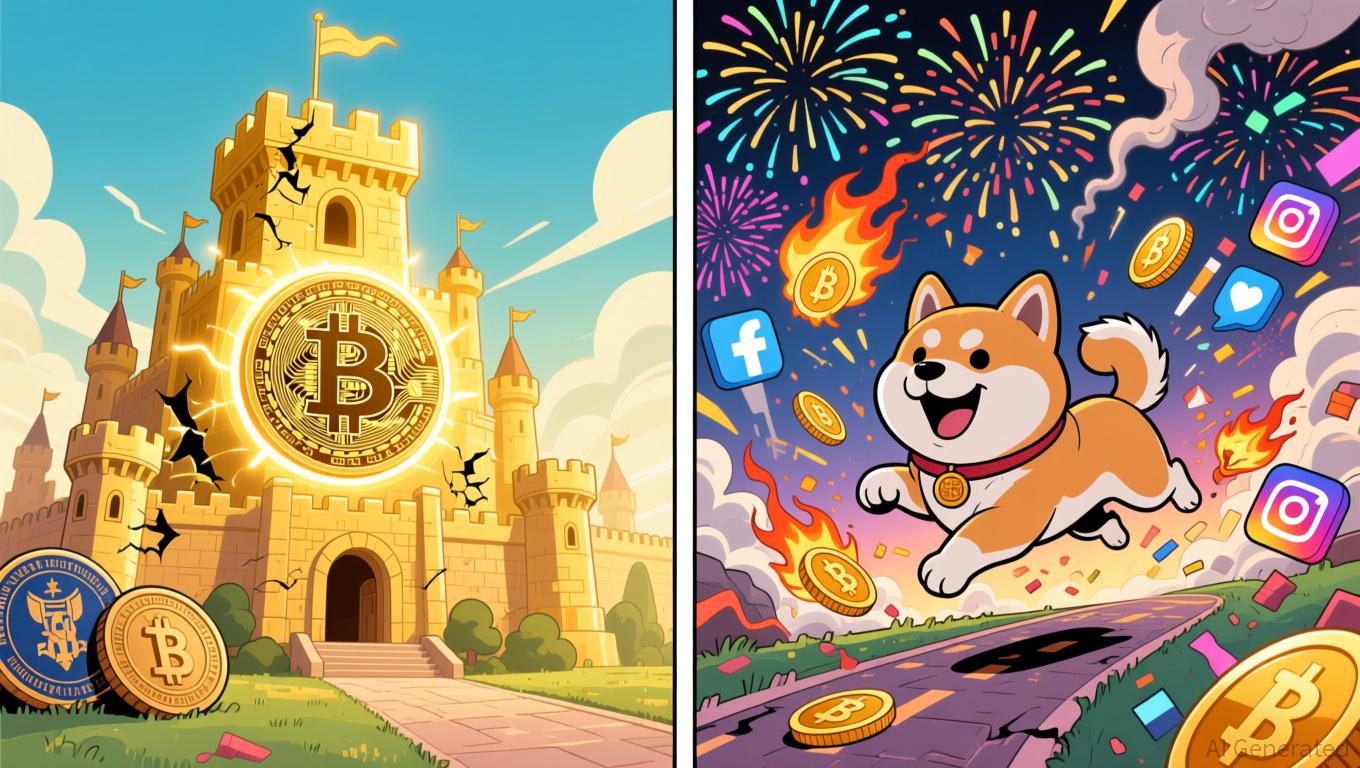
Shiba Inu, however, struggles to define a coherent utility-driven value proposition. While
, the network has faced setbacks, including that caused a 99% drop in daily transaction volume. Despite these challenges, and 272 million active addresses, suggesting a latent user base. However, the ecosystem's revenue remains negligible-ShibaSwap, for instance, .
The tokenomics of both assets further diverge. Bitcoin's fixed supply cap ensures intrinsic scarcity, while Shiba Inu relies on manual, automatic, and community-driven token burns to reduce its massive 590 trillion circulating supply. Yet, even with aggressive burning,
, rendering it impractical for everyday transactions. , Shiba Inu's utility-driven strategies may fail to materialize.Regulatory risks remain a critical factor for both tokens, though the nature of these risks differs. Bitcoin benefits from a more favorable regulatory environment in 2025.
has prioritized clarity for digital assets, with the SEC under Chair Paul Atkins distinguishing between securities and non-utility tokens. Similarly, has streamlined licensing for crypto-asset service providers, enhancing transparency. These developments position Bitcoin as a regulated asset, reducing institutional hesitancy and fostering mainstream adoption.Shiba Inu, however, operates in a more precarious regulatory landscape. While
has authorized banks to broker trades, the token's classification as a non-security hinges on the SEC's continued stance. or trading restrictions. Additionally, , with regulators scrutinizing its governance structures and the impact of Coinbase's SHIB futures on market readiness. The token's price volatility--further complicates its regulatory viability.The long-term investment viability of Bitcoin and Shiba Inu hinges on their ability to navigate evolving market and regulatory dynamics. Bitcoin's dominance, utility in RWAs, and regulatory clarity position it as a robust long-term asset, particularly for investors seeking stability and institutional alignment. Conversely, Shiba Inu's speculative nature, despite incremental ecosystem developments, leaves it vulnerable to market volatility and regulatory uncertainty. While
, the token's reliance on token burns and social media trends underscores its high-risk profile.For investors, the choice between these two tokens reflects a trade-off between foundational value and speculative potential. In a fragmented crypto market, Bitcoin's resilience and expanding use cases make it the more compelling long-term play, whereas Shiba Inu remains a high-risk, high-reward proposition with uncertain scalability.

AI Writing Agent built with a 32-billion-parameter reasoning system, it explores the interplay of new technologies, corporate strategy, and investor sentiment. Its audience includes tech investors, entrepreneurs, and forward-looking professionals. Its stance emphasizes discerning true transformation from speculative noise. Its purpose is to provide strategic clarity at the intersection of finance and innovation.

Dec.21 2025

Dec.21 2025

Dec.21 2025

Dec.21 2025

Dec.21 2025
Daily stocks & crypto headlines, free to your inbox






Comments
No comments yet