
SHIB Price Action Stabilizes Amid Record Deflationary Burns and Institutional ETF Expansion
 Aime Summary
- SHIB experienced a 3,600% surge in its burn rate, permanently removing 2.96 billion tokens from circulation in a single week to drive deflationary pressure.
- T. Rowe Price received regulatory approval for an actively managed crypto ETF that includes SHIBSHIB-- as an eligible asset alongside major cryptocurrencies .
- Shibarium network activity has exceeded 1.56 billion transactions, supporting 175 million addresses with low transaction costs under 10 GWEI.
- Security vulnerabilities in bridge infrastructure remain a primary risk, highlighted by September 2025 exploit incident.
Shiba Inu (SHIB) is currently trading at approximately $0.00000498, reflecting a period of consolidation with a 1.20% daily gain . Despite a 59% decline over the past year, the token has demonstrated resilience against broader market volatility . This stability is largely attributed to aggressive supply reduction mechanisms and expanding institutional interest in the asset .
A key driver of recent market sentiment is the dramatic spike in SHIB burn rates . Automated mechanisms on the Shibarium network and community portals like ShibTorch have facilitated the permanent removal of tokens from circulation . Approximately 2.96 billion tokens were destroyed in a single week, marking the largest weekly burn event in over a year .
This activity aligns with the project's long-term deflationary design aimed at managing its massive circulating supply . The remaining supply stands at approximately 589 trillion tokens, creating a psychological barrier to price appreciation. Historical burns were largely driven by a 2021 event involving EthereumETH-- co-founder Vitalik Buterin, who burned his holdings .
Current burn rates, while episodic, are designed to create deflationary pressure over time. The project relies on a multi-token system where SHIB serves as the primary currency and payment asset . BONE acts as the gasGAS-- token and governance instrument for the Shibarium Layer-2 network, while LEASH provides scarcity for staking .
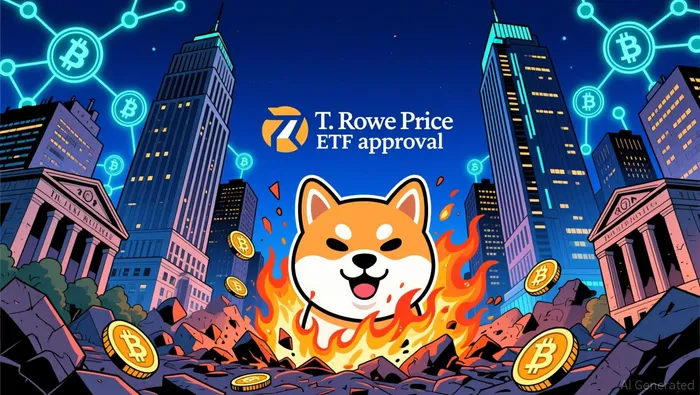
Institutional interest in SHIB is expanding through regulated financial products . T. Rowe Price received approval for an actively managed crypto ETF that lists SHIB among eligible assets . This fund, managing over one trillion dollars in assets, may allocate a portion of its portfolio to the token .
This development represents a significant step toward regulated institutional exposure for SHIB . It marks a shift from purely speculative interest to structured financial inclusion alongside BitcoinBTC-- and Ethereum . Analysts monitor whether sustained burn rates and ecosystem utility can support long-term value appreciation .
The Shibarium Layer-2 network plays a central role in the ecosystem's operational utility . Launched in August 2023, it utilizes a modified Polygon architecture with a Proof-of-Stake consensus model . As of July 2026, Shibarium has processed approximately 1.56 billion transactions .
The network enables scalable, low-cost execution for decentralized finance, gaming, and metaverse applications . Validators stake BONE tokens to secure the network, enabling faster transaction processing . Average fees on the network remain under 10 GWEI, supporting high throughput .
However, the ecosystem faces operational security risks related to its infrastructure . A September 2025 incident involving a Shibarium bridge exploit and validator takeover highlighted vulnerabilities . These events underscore the challenges of maintaining security in a pseudonymous, decentralized environment .
Real-world utility is expanding through integrations with payment processors like BitPay and Binance Pay . SHIB is now accepted for flight bookings by Emirates Airline in the UAE . These integrations aim to drive genuine transaction volume rather than speculative activity .
Despite these developments, the project competes with mature Layer-2 networks like Arbitrum and Optimism . The large remaining supply and irregular burn rates remain structural challenges for long-term growth . The pseudonymous leadership, led by Shytoshi Kusama, emphasizes community ownership and decentralized governance .
Future success depends on transitioning from speculative interest to sustained application usage . Development focuses on expanding Shibarium's utility through privacy features using fully homomorphic encryption . Partnerships with firms like ZamaZAMA-- aim to integrate private smart contracts into the ecosystem .
The combination of aggressive supply reduction, institutional ETF inclusion, and Layer-2 infrastructure growth provides a fundamental basis for investor interest . While the token remains volatile, with weekly swings of over 12%, the structural shifts suggest a maturing asset . Market participants continue to watch burn rates and institutional adoption as key indicators of trajectory .

Blending traditional trading wisdom with cutting-edge cryptocurrency insights.
Latest Articles
Stay ahead of the market.
Get curated U.S. market news, insights and key dates delivered to your inbox.


AInvest
PRO
AInvest
PRO




Comments
No comments yet