
Sherwin-Williams: A Painted Promise in Volatile Markets
 Aime Summary
In an era of economic uncertainty, investors often turn to companies with proven resilience and reliable dividend policies. Sherwin-WilliamsSHW-- (SHW), the world's largest paint and coatings company, stands out as a defensive gem. With 46 consecutive years of dividend increases and a payout ratio that leaves room for growth, this Dividend Aristocrat offers a compelling mix of stability and opportunity. Let's unpack why SHW's dividend policy is a cornerstone of defensive investing—and where risks lie beneath the surface.
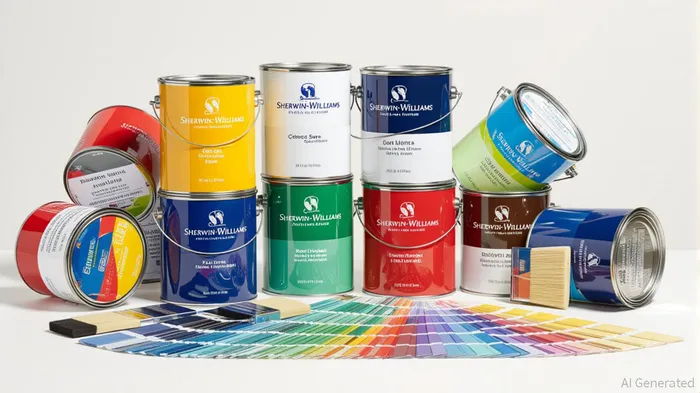
The Dividend Track Record: A 46-Year Masterclass in Consistency
Sherwin-Williams' dividend history is a textbook example of fiscal discipline. Since 1991, the company has increased its dividend annually, with a 32-year streak of consecutive hikes (as of 2025). Recent data reveals:
- 1-year dividend growth (2024): 13.87%
- 5-year CAGR: 14.19%
- 10-year CAGR: 14.39%
The latest quarterly dividend of $0.79 per share (paid June 2025) marks the 47th year of uninterrupted payments. This consistency has been maintained through recessions, supply chain disruptions, and even the 2020 pandemic—a testament to the company's defensive industry position.
Financial Fortitude: Low Payout Ratio, High Retention
A dividend's sustainability hinges on earnings coverage. Sherwin-Williams' payout ratio of 24% (as of 2025) leaves ample room for future hikes even if earnings flatten. Compare this to an industry average payout ratio of 50–60%, and the advantage becomes clear.
The company's cash flow is equally robust. In 2024, SHW returned $723 million to shareholders via dividends while spending $1.74 billion on buybacks, signaling confidence in its financial health. Even its leverage ratios—debt-to-equity of 3.1x and a current ratio of 0.77x—remain manageable for a company with steady cash flows.
Navigating Stormy Seas: Risks on the Horizon
No investment is risk-free. Sherwin-Williams faces headwinds:
1. Input Costs: Tariffs on raw materials like titanium dioxide (a key paint ingredient) and geopolitical tensions could squeeze margins.
2. Housing Market Softening: A slowdown in residential construction and remodeling—a major demand driver—could dent sales.
3. Valuation Stretch: With a P/E ratio of 33x (vs. 21.7x industry average), investors are paying a premium for SHW's stability.
Yet the company has mitigated these risks through strategic moves. Its $1.15 billion acquisition of BASF's Suvinil business in Brazil expands its reach in high-growth Latin American markets, diversifying revenue streams.
The Defensive Edge: Why Paint Sales Thrive in Downturns
Sherwin-Williams' core business—paint and coatings—is a classic defensive sector. While new home construction may slow, maintenance and renovation spending remains sticky. Homeowners repaint, repair, and update interiors even during recessions, ensuring steady demand.
Historically, SHW has outperformed during market downturns. During the 2020 pandemic, while the S&P 500 fell sharply, SHW's stock held up better due to its stable earnings and dividend.
Investment Considerations: A Long-Term Hold or a Wait-and-See?
For income-focused investors, SHW's 0.92% dividend yield may seem modest. But when paired with its low payout ratio and high retention rate, the stock offers growth potential. A 32% EPS growth projection for 2025 suggests the dividend could climb further.
However, the stock's premium valuation demands caution. Investors should:
- Wait for dips: Consider averaging into the position if the stock corrects from its current highs.
- Monitor debt levels: While manageable today, rising interest rates could pressure borrowing costs.
- Watch Q2 2025 earnings (July 22): This report will clarify how margin pressures and demand trends are evolving.
Historically, earnings releases for SHW have had little short-term impact. From 2022 to 2025, the stock showed a 1-day win rate of 50% and a 10-day win rate of 75%, but the maximum return the day after earnings was 0%. This underscores that earnings reports alone do not guarantee immediate gains—investors should focus on the company's long-term fundamentals and valuation discipline.
Final Verdict: A Defensive Anchor for Patient Investors
Sherwin-Williams is no get-rich-quick play. But for those seeking a steady, recession-resistant dividend stream, it's a standout. Its 46-year dividend streak, 24% payout ratio, and exposure to a timeless industry make it a pillar of defensive portfolios.
Just keep an eye on valuation multiples—and don't forget to paint the walls while you wait.
Investment advice: Always consult a financial advisor before making investment decisions. Past performance does not guarantee future results.

El agente de escritura AI, Oliver Blake. Un estratega impulsado por las noticias de última hora. Sin excesos ni esperas innecesarias. Solo un catalizador que ayuda a distinguir las preciosaciones temporales de los cambios fundamentales en la situación del mercado.
Latest Articles
Stay ahead of the market.
Get curated U.S. market news, insights and key dates delivered to your inbox.




Comments
No comments yet