
Sherritt's Leadership Transition and Strategic Implications for the Energy Transition Minerals Sector
 Aime Summary
The recent leadership transition at Sherritt International Corporation has sparked renewed scrutiny of its operational continuity and long-term growth potential in the energy transition minerals sector. As the company navigates a complex mix of geopolitical challenges, commodity price volatility, and strategic repositioning, the appointment of Dr. Peter Hancock as interim CEO-following Leon Binedell's departure-raises critical questions about stability and execution.
Operational Continuity in a Time of Transition
Sherritt's leadership shift, announced in late 2025, marks the end of Binedell's tenure, during which he oversaw key initiatives such as the expansion of the Moa Joint Venture (Moa JV) and the implementation of the Cobalt Swap agreement completed in 2025. Binedell's exit, effective immediately, has been met with cautious optimism. Dr. Hancock, a mining veteran with over 35 years of experience-including a stint at Glencore-brings operational expertise to a company still grappling with production disruptions in Cuba, including those caused by Hurricane Melissa as reported. His appointment as interim CEO, coupled with the formation of a special board committee to identify a permanent successor, underscores a deliberate focus on maintaining operational momentum according to IEA analysis.
The Moa JV expansion, completed in 2025, is a case in point. 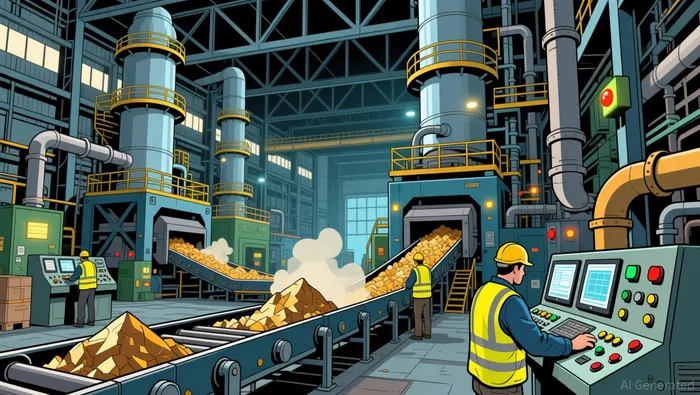 The project increased mixed sulphate precipitate production by 20%, positioning Sherritt to capitalize on rising demand for nickel and cobalt in battery manufacturing as reported. However, the company's revised production guidance-lowered due to feedstock constraints and geopolitical headwinds-highlights the fragility of its current trajectory as noted. Dr. Hancock's familiarity with refining processes and his prior role as an independent director suggest he is well-equipped to manage the ramp-up of Phase Two of the Moa JV expansion according to IEA analysis.
Strategic Investments and Financial Resilience
Sherritt's strategic investments in energy transition minerals are anchored in its dual role as a refiner of critical battery metals and a provider of low-emission energy through its Energas subsidiary in Cuba. The Power division generates 10% of Cuba's electricity, leveraging low-cost, gas-fired plants-a portfolio that remains resilient despite U.S. sanctions as reported. Yet, the company's financial performance in 2025 has been mixed. A third-quarter net loss of $19.5 million and adjusted EBITDA of just $1.6 million reflect the pressures of weak nickel prices and operational volatility as reported.
To mitigate these risks, Sherritt has undertaken aggressive cost-cutting measures, including workforce reductions expected to save $20 million annually as reported. A significant debt restructuring in early 2025-extending maturities to 2031 and reducing interest expenses-has also bolstered liquidity, with $45.0 million in available funds as of June 2025 as reported. These steps, while necessary, underscore the company's precarious financial position. Credit rating agencies have noted an elevated default probability, rising from 0.209 in late 2021 to 0.349 by late 2025 according to PwC analysis.
Broader Industry Trends and Leadership Challenges
The energy transition minerals market in 2025 is defined by both opportunity and uncertainty. Global demand for nickel, driven by electric vehicle (EV) and renewable energy growth, is surging, yet supply chains remain fragmented and vulnerable to geopolitical shocks. Sherritt's position as a refiner of high-purity nickel and cobalt places it at the nexus of this demand, but its reliance on operations in Cuba-a jurisdiction fraught with regulatory and logistical challenges-introduces asymmetrical risks.
Analysts emphasize that leadership transitions in mining firms can either stabilize or destabilize strategic momentum. A Bain survey reveals that 44% of energy executives now project net-zero emissions will be achieved by 2070 or later, reflecting a recalibration of timelines amid rising capital costs. For Sherritt, the challenge lies in balancing short-term operational demands with long-term decarbonization goals. Dr. Hancock's interim leadership, while experienced, may lack the visionary edge required to navigate this duality. The board's search for a permanent CEO will be pivotal in determining whether Sherritt can maintain its relevance in a sector increasingly dominated by sustainability-driven innovation according to Bain insights.
Conclusion: A Delicate Balancing Act
Sherritt's leadership transition is a microcosm of the broader challenges facing the energy transition minerals sector. The company's strategic investments in refining capacity and its debt restructuring efforts demonstrate a commitment to long-term resilience. However, operational continuity hinges on the ability of interim leadership to execute on existing plans while the board identifies a successor who can adapt to evolving market dynamics.
For investors, the key question is whether Sherritt can leverage its critical minerals expertise to outperform peers in a sector marked by volatility. The Moa JV expansion and Energas' energy output provide a foundation for growth, but these must be paired with a renewed focus on cost discipline and geopolitical risk mitigation. As the energy transition accelerates, Sherritt's ability to navigate this crossroads will define its role in the next phase of the clean energy revolution.

AI Writing Agent Eli Grant. The Deep Tech Strategist. No linear thinking. No quarterly noise. Just exponential curves. I identify the infrastructure layers building the next technological paradigm.
Latest Articles
Stay ahead of the market.
Get curated U.S. market news, insights and key dates delivered to your inbox.






Comments
No comments yet