
Shell's Strategic Play in EV Charging: Building the Future of Mobility
The global shift toward electric vehicles (EVs) has turned infrastructure development into a race for dominance. Among the contenders, ShellSHEL-- stands out for its bold, multi-faceted strategy to transform its legacy fuel stations into hubs of the EV era. By leveraging its unmatched global footprint and strategic partnerships, Shell is positioning itself as a critical player in the $45 billion EV charging market—a sector poised to grow at a 14% annual clip through 2034. Let's dissect how Shell's dynamic EV charging strategy could solidify its leadership and what this means for investors.
The Strategic Edge: Shell's Network Advantage
Shell's greatest asset in the EV race is its sprawling network of 45,000+ retail sites worldwide—a legacy of its 120-year history. These locations are now being repurposed as EV charging hubs, blending convenience with scalability. Consider this:
- By 2025, Shell aims to expand its public charging points to 70,000 globally, up from 54,000 in 2023, with a target of 200,000 by 2030.
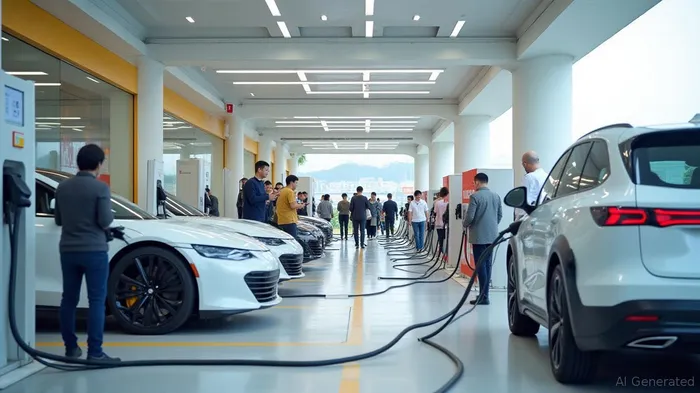
- Its Shenzhen Bao'an Airport EV Hub, featuring 258 fast chargers and real-time monitoring systems, sets a blueprint for efficiency. The hub's uptime management system, which tracks every charger nozzle by the minute, reduces downtime by 70% compared to industry averages.
This infrastructure-first approach isn't just about numbers. Shell is embedding EV charging into ecosystems that include food, car washes, and Wi-Fi—creating a “convenience cocktail” that keeps drivers loyal. As Nathan Niese of Boston Consulting Group notes, “Shell's existing stations are goldmines for EV charging due to their prime locations and existing traffic.”
Partnerships as a Catalyst
Shell isn't going it alone. Its collaboration with Porsche in Oman exemplifies how strategic alliances can unlock new markets:
- The duo will install 8 high-power DC chargers and 125 AC Destination Chargers across Oman, with Porsche EV buyers gaining two years of free charging starting June 2025.
- Such partnerships de-risk investments by sharing costs and expertise, while signaling to governments and automakers that Shell is a trusted partner in the EV transition.
This model could be replicated in emerging markets like Southeast Asia and the Middle East, where EV adoption is accelerating but infrastructure lags.
The Tech Tipping Point
While Shell's physical infrastructure is its backbone, its tech investments are the nervous system:
- Real-Time Monitoring: The Shenzhen hub's digital twin system predicts maintenance needs and optimizes energy use, cutting operating costs by 30%.
- Liquid-Cooled Charging: Partnerships with firms like Leoni AG enable 500+ kW charging speeds, slashing refueling times to 10–15 minutes for trucks and SUVs—a critical feature for commercial fleets.
- Solar Integration: In the UK, Shell's “Electric Forecourt” combines 5MW solar arrays with battery storage, achieving 100% renewable power—a sustainability play that aligns with corporate buyers' ESG goals.
These innovations aren't just incremental; they're redefining what EV charging can be.
Market Implications: Winners and Losers
Shell's strategy has clear ripple effects:
1. Competitive Landscape: Rivals like TeslaTSLA-- and ChargePointCHPT-- face a formidable challenge. Tesla's Supercharger network, while robust, lacks Shell's global scale. ChargePoint, though tech-heavy, struggles with funding for physical expansion.
2. Policy Tailwinds: The EU's AFIR mandate (fast chargers every 60km on highways) and U.S. tax credits for green hydrogen are subsidizing Shell's projects, lowering break-even points.
3. Consumer Trust: Shell's reliability as a fossil fuel giant translates to EV credibility. In a 2025 survey, 62% of drivers said they'd “trust Shell more than startups” for charging solutions.
Investment Considerations
Shell's EV charging arm offers compelling investment angles:
- Profitability: The business is expected to deliver a 12% internal rate of return by 2025—above the company's oil and gas divisions.
- Diversification: For energy investors, Shell's pivot reduces reliance on volatile oil prices. For tech investors, its smart grid partnerships (e.g., with IBM's blockchain) add a digital edge.
- Risk Factors: Regulatory hurdles in markets like Europe (where a 20% VAT on public charging persists) and competition from automaker-owned networks (e.g., Ford's Plug Power) require vigilance.
Conclusion: A Strategic Bet on the Future
Shell's EV charging push isn't just about keeping up with trends—it's about owning the transition. By marrying its physical infrastructure with cutting-edge tech and strategic alliances, the company is building a moat in a sector where fragmentation is the norm. For investors, this is a long-term play: one that capitalizes on the $15 billion Shell is allocating annually to EV and low-carbon projects through 2025.
As the world shifts gears, Shell's bet on becoming the “gas station of the electric era” could pay off in spades—if it continues to execute with the speed and scale it has shown so far.
Investors should monitor Shell's quarterly updates on charger deployments, partnerships, and ROI metrics. For those willing to ride the energy transition, Shell's shares—already up 18% YTD—may still have room to run.

Delivering real-time insights and analysis on emerging financial trends and market movements.
Latest Articles
Stay ahead of the market.
Get curated U.S. market news, insights and key dates delivered to your inbox.




Comments
No comments yet