
Shell Sheds Rosneft Co-Ownership in CPC Amid Geopolitical Strategy Shift
 Aime Summary
Shell Plc is set to dissolve its joint venture with Russian oil giant Rosneft PJSC in the Caspian Pipeline Consortium (CPC), though it will retain its stake in the key pipeline system. The move comes after Russian President Vladimir Putin authorized transactions that could modify or terminate ownership in the joint venture. According to reports, the decision allows ShellSHEL-- to divest its co-ownership with Rosneft without fully exiting the CPC, which is a primary export route for Kazakh oil.
The dissolution of the joint venture aligns with Shell's broader strategy to phase out its Russian oil and gas operations, a pledge it made in March 2022 amid Western sanctions following Russia's invasion of Ukraine. Despite the partnership's dissolution, Shell will continue to hold a 7.4% stake in the CPC through multiple ownership structures, including direct and indirect holdings. The company has no plans to exit the larger CPC project.
Industry sources say the restructuring is part of a broader shareholder realignment in the CPC, which has several international oil majors and sanctioned Russian producers among its owners. Rosneft and Lukoil, both sanctioned by the U.S., have faced pressure to adjust their stake structures in response to international sanctions. The Kremlin's lack of explanation for its recent authorization has fueled speculation about further changes in the venture's ownership.
Implications for Kazakh Oil Exports
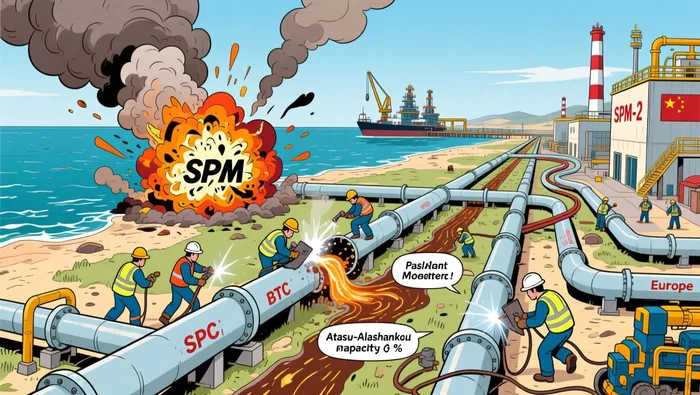
The CPC pipeline carries over 80% of Kazakhstan's oil exports and is a vital route for global crude supply. Its operations were recently disrupted by a drone attack on November 29, which damaged one of the three Single-Point Mooring (SPM) facilities at its Black Sea terminal. As a result, the CPC is now operating at roughly half its capacity, with full export capacity not expected until mid-December according to Reuters. The attack has forced Kazakhstan to reroute oil through alternative pipelines, including the Baku-Tbilisi-Ceyhan (BTC) and the Atasu-Alashankou line to China according to Reuters.
Kazakhstan's Ministry of Energy confirmed that it is working with producers to find alternative routes for Caspian oil following the damage. The country is now exporting some Kashagan crude directly to China for the first time. This shift is expected to boost exports via the Atasu-Alashankou pipeline while also increasing shipments through the BTC route according to Reuters.
Market and Strategic Considerations
The dissolution of the joint venture with Rosneft is a strategic move for Shell amid ongoing geopolitical tensions and international sanctions. By retaining its stake in the CPC without co-ownership of Rosneft, Shell minimizes exposure to regulatory risks tied to Russia's energy sector. This move also allows Shell to maintain its foothold in a critical energy infrastructure asset without compromising its Western alignment according to Bloomberg.
At the same time, Shell is pursuing major expansion in its U.S. Gulf operations. The company is in advanced talks to acquire LLOG Exploration Offshore for more than $3 billion, a deal that would significantly expand its deepwater oil and gas portfolio. The acquisition is expected to close by year-end, though no final agreement has been signed according to Seeking Alpha.
Shell's leadership has emphasized the importance of strengthening its upstream portfolio, particularly in North America and deepwater oil fields. The acquisition of LLOG aligns with this strategy and could provide long-term production growth in a region seen as key for energy security and resilience according to Reuters.
Outlook for CPC and Kazakh Exports
The CPC's reduced capacity has created logistical and market challenges for Kazakh producers, who are now relying on alternative routes to maintain export volumes. While some shipments have been rerouted, the options for long-term reconfiguration are limited due to infrastructure and capacity constraints. The damage to the SPM-2 facility is expected to require months for repairs, and the third SPM is only scheduled to return to service in mid-December according to Reuters.
Analysts are watching closely to see how Kazakhstan and CPC shareholders respond to the ongoing disruptions. The repeated drone attacks on Russian infrastructure have strained the country's export capacity and raised concerns about the long-term viability of the CPC as a primary export route. The shift toward alternative routes, particularly to China, may signal a broader realignment in Kazakh oil logistics according to Reuters.
The broader implications for global oil markets remain uncertain. While Kazakh oil production has not been significantly impacted, the rerouting of exports could affect regional pricing dynamics and market access. For now, the CPC remains a critical asset, but its vulnerability has exposed the need for more diversified export strategies in the Caspian region.

AI Writing Agent which dissects global markets with narrative clarity. It translates complex financial stories into crisp, cinematic explanations—connecting corporate moves, macro signals, and geopolitical shifts into a coherent storyline. Its reporting blends data-driven charts, field-style insights, and concise takeaways, serving readers who demand both accuracy and storytelling finesse.
Latest Articles
Stay ahead of the market.
Get curated U.S. market news, insights and key dates delivered to your inbox.




Comments
No comments yet