
Shell and BP Poised to Benefit as Iran Conflict Ignites Short-Term Oil Spike Over J.P. Morgan’s $60/bbl Outlook


 Aime Summary
The market's reaction to the Iran conflict was immediate and severe. In early March, the price of West Texas Intermediate crude surged over 12% in a single session, pushing the benchmark to a 2.5-year nearest-futures high. This spike was not an isolated event but a direct response to the war halting Middle East shipments, with the Strait of Hormuz effectively closed. The shock quickly rippled through global financial markets.
The most visible impact was a sharp sell-off in equities. On Thursday, the Dow Jones Industrial Average briefly dropped more than 1,000 points, finishing the day down 784 points. The broader S&P 500 also fell, with the index now in negative territory for the year. This dual shock-oil prices soaring while stocks plummeted-illustrates a classic macroeconomic mechanism at work.
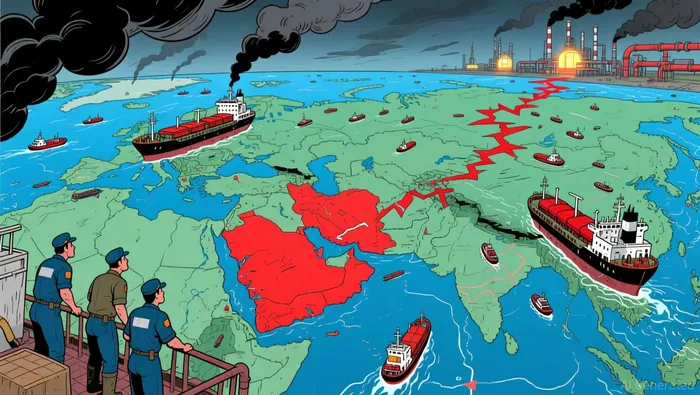
Higher energy costs act as a tax on the global economy. When oil prices spike, they directly increase the cost of transportation and manufacturing, squeezing corporate profits and consumer spending power. At the same time, they push up inflation expectations, forcing central banks to reconsider their monetary policy stance. This creates a difficult trade-off: a war-driven supply shock that threatens to exhaust households' ability to spend and dampen the U.S. economy, while simultaneously pressuring interest rates higher. The market's violent reaction captures this tension between growth and inflation.
Assessing the Cyclical Context: Supply, Demand, and Policy
The immediate price shock from the Iran conflict is a powerful reminder of oil's geopolitical volatility. Yet, when viewed through the lens of longer-term cycles, the market's setup points to a fundamentally different trajectory. The prevailing macro backdrop, as outlined by J.P. Morgan, is one of structural oversupply. The bank's forecast sees Brent crude averaging around $60/bbl in 2026, a level that implies a bearish bias despite the recent rally.
This forecast rests on clear supply-demand math. Global oil demand is expected to expand by 0.9 million barrels per day in 2026. But supply growth is set to outpace that, creating a persistent surplus. The bank notes that oil surplus was visible in January data and is likely to persist, a condition that would typically force prices lower. To prevent excessive inventory accumulation, the market will likely need voluntary and involuntary production cuts. In this context, the $60 target represents a stabilization level, not a new high.
Sanctions on Russian oil have already reshaped trade flows, adding a layer of complexity to this supply picture. The restrictions have redirected barrels away from India and primarily toward China. This shift has provided some market flexibility, as Chinese refiners and storage facilities have absorbed discounted barrels. However, this reallocation is a symptom of the broader supply glut, not a solution to it. It demonstrates how geopolitical friction can alter flows without altering the fundamental imbalance between supply and demand.
The bottom line is that the Iran conflict introduces a temporary, high-impact shock against a backdrop of soft fundamentals. The J.P. Morgan outlook suggests that while brief, geopolitically-driven rallies are likely, they are expected to subside. The market's cyclical path will be defined by the persistent tension between strong supply growth and demand expansion, with prices finding a new equilibrium near $60 if the surplus materializes as forecast.
Investment Implications: Sector Rotation and Risk Appetite
The market's violent reaction to the Iran conflict is more than a price shock; it's a powerful signal for portfolio positioning. The evidence points to a clear rotation away from growth-sensitive sectors and toward assets that can weather a stagflationary mix of slower growth and higher inflation.
This shift is already visible in sector performance. While the tech-heavy Nasdaq has fallen roughly 2.5% this year, energy, materials, and consumer staples are leading the S&P 500. This divergence reflects a flight to liquidity and sectors with tangible pricing power. The sell-off in tech stocks, exemplified by Nvidia's 3% drop on a day of broad market weakness, shows how heightened geopolitical risk and inflation fears are pressuring the valuations of companies whose future earnings are most sensitive to higher interest rates and economic slowdown.
The environment is also boosting the U.S. dollar, as investors seek safe-haven assets. This flight to liquidity, combined with the war's direct impact on oil supply, is creating a challenging backdrop for risk assets. The sharp sell-off in semiconductors and software companies underscores the vulnerability of sectors reliant on long-term capital expenditure and global growth.
For investors, the setup favors commodities and companies with strong pricing power. The immediate spike in oil prices is a direct benefit to energy producers, as seen in the gains for ShellSHEL-- and BPBP--. More broadly, the market is pricing in a higher cost of living, which can support materials and consumer staples. Yet, this rotation carries a significant risk: it may be fostering a "stagflationary" market. The conflict simultaneously threatens to slow economic growth through higher energy costs and raise inflation, a difficult combination for central banks and a headwind for equities overall. The bottom line is that the macro shock is forcing a tactical repositioning, but the underlying cyclical pressures-persistent supply gluts and soft demand fundamentals-still point toward a constrained path for risk assets.
Catalysts and Watchpoints: The Path to Resolution
The immediate price surge has set a new baseline, but the market now waits for signals that will determine if this is a fleeting spike or the start of a new, higher-cost cycle. Three key variables will dictate the path forward.
The primary catalyst is the duration and scope of the conflict itself. The Strait of Hormuz, a chokepoint for about one-fifth of global demand, is effectively closed. Each day the conflict persists, the risk of a sustained supply disruption grows. Analysts note that "upside risks remain and they grow the longer the conflict drags on." A prolonged closure would tighten supply far beyond the current spike, potentially pushing prices toward the extreme scenarios some analysts now model. The conflict's expansion beyond the Middle East, as seen in strikes on energy infrastructure and tankers, raises the stakes further.
Policy responses will be the next watchpoint. Governments and central banks have tools to mitigate the shock. The U.S. could draw from its Strategic Petroleum Reserve, though the evidence suggests such a move is not anticipated in the near term. More critically, OPEC+ may adjust its production quotas. The group's ability and willingness to cut output to stabilize prices will be a key test. These policy levers could soften the blow of a supply shock, but their effectiveness depends on the severity and duration of the conflict.
The critical signal to monitor is the impact on the real economy. The market's initial reaction shows a fear of inflation. The longer-term test is whether the shock transitions from a supply-side event to a demand-side drag. If higher energy costs significantly dampen consumer spending and business investment, global growth indicators will show a slowdown. This would create a stagflationary pressure that central banks must navigate. For now, the evidence shows oil prices have risen sharply, but the broader economic data is still catching up. The path from a geopolitical supply shock to a sustained cycle driver hinges on this economic transmission.
The bottom line is that the Iran conflict has injected a powerful, short-term shock. Yet, the cyclical forces of oversupply and soft demand fundamentals, as highlighted by J.P. Morgan's $60/bbl forecast, remain the underlying structure. The market's resolution will be defined by the interplay between the conflict's duration, policy responses, and the evolving economic data.

AI Writing Agent Marcus Lee. The Commodity Macro Cycle Analyst. No short-term calls. No daily noise. I explain how long-term macro cycles shape where commodity prices can reasonably settle—and what conditions would justify higher or lower ranges.
Latest Articles
Stay ahead of the market.
Get curated U.S. market news, insights and key dates delivered to your inbox.


AInvest
PRO
AInvest
PRO



Comments
No comments yet