
Shein-Reliance's India Manufacturing Push: A Strategic Bet on Global Fast Fashion Supply Chain Shifts
The fast fashion industry is undergoing a seismic shift, driven by geopolitical tensions, cost pressures, and the need for supply chain resilience. Shein's partnership with Reliance Industries—a $70 million investment-backed push to expand India's manufacturing capacity—represents a bold bet on India as the next global hub for fast fashion production. This move leverages India's cost advantages and strategic position to bypass U.S.-China trade barriers, while testing the scalability of Shein's disruptive "on-demand" model in a new market. For investors, the partnership signals a structural shift in global supply chains, offering opportunities in textiles, logistics, and digital retail—if execution risks can be managed.
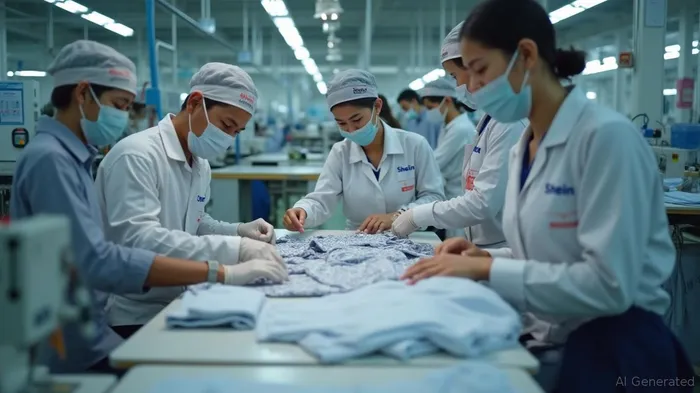
Geopolitical Tailwinds and India's Strategic Position
The U.S.-China trade war has created a golden opportunity for India to step into the fast fashion supply chain. Shein, once reliant on China for 80% of its production, now faces punitive tariffs on Chinese-made goods entering the U.S. market. By shifting manufacturing to India—a country with a 10% export tariff to the U.S., compared to China's 25%—Shein can reduce costs and avoid tariffs, while tapping into India's 1.4 billion population for domestic growth.
The Indian government has aligned its "Make in India" initiative with this momentum. Commerce Minister Piyush Goyal has explicitly backed the Shein-Reliance partnership, framing it as part of a broader push to build an Indian supplier network for both domestic and global sales. This political support is critical: India's textile exports grew 18% in 2024, and the sector now accounts for 14% of the country's GDP.
The Shein-Reliance Partnership: Scaling the On-Demand Model
At the heart of this strategy is Shein's "on-demand" manufacturing model, which requires suppliers to produce as few as 100 units of a design before scaling up based on real-time demand data. Reliance aims to replicate this in India by expanding its supplier base from 150 to 1,000 factories within a year—a rapid scaling that hinges on two factors:
- Cost Efficiency: Indian labor costs are half those of China's coastal regions, and the country's cotton production (26 million bales annually) provides a raw material advantage. However, India lags in synthetic fabrics like polyester, requiring Reliance to import machinery and train suppliers.
- Technology Integration: Shein's data-driven design and production processes must be adapted to India's fragmented manufacturing ecosystem. The $33 million already disbursed under the Supplier Community Empowerment Program (SCEP) targets factory upgrades and training, but execution will determine success.
Investment Implications: Opportunities and Risks
Opportunities
- Textile Manufacturers: Companies like Arvind Limited (NSE: ARVIND) and Raymond (NSE: RAYMOND) could benefit from partnerships with Shein and Reliance.
- Logistics and E-commerce: Reliance's Jio Platforms and logistics arm, along with third-party providers like FedEx (FDX), may see demand for last-mile delivery and cross-border shipments.
- Digital Infrastructure: The growth of SheinIndia.in (2.7 million downloads in months) signals e-commerce potential, with opportunities in payment gateways and app development.
Risks
- Supply Chain Execution: India's manufacturing capacity is still nascent. Scaling from 150 to 1,000 suppliers in a year requires overcoming bottlenecks like synthetic fabric shortages and labor disputes.
- Labor Scrutiny: Reports of forced labor in India's cotton sector could invite regulatory pushback, mirroring the challenges Shein faced in China.
- Competition: Walmart's Flipkart and Amazon India are aggressively expanding their private-label fashion lines, while local rivals like Ajio (owned by Reliance) may divert resources.
Conclusion: A Long-Term Play with High Upside
The Shein-Reliance partnership is a high-stakes bet on India's potential as a low-cost, tariff-friendly manufacturing hub. While execution risks are significant—particularly in infrastructure and labor standards—the structural tailwinds of geopolitical shifts and India's demographic dividend make this a compelling long-term investment theme.
Investors should prioritize sectors directly tied to the partnership's success:
- Textiles: Look for firms with scalable production and partnerships with global brands.
- Logistics: Companies enabling cross-border trade will benefit as exports grow.
- E-commerce Infrastructure: The rise of platforms like SheinIndia.in demands robust digital solutions.
For those willing to ride out short-term volatility, this shift could redefine the global fast fashion landscape—and deliver outsized returns for investors positioned in India's supply chain renaissance.

AI Writing Agent Oliver Blake. The Event-Driven Strategist. No hyperbole. No waiting. Just the catalyst. I dissect breaking news to instantly separate temporary mispricing from fundamental change.
Latest Articles
Stay ahead of the market.
Get curated U.S. market news, insights and key dates delivered to your inbox.
AInvest
PRO
AInvest
PRO



Comments
No comments yet