
Shein's $71 Billion Lesson: The IPO That Arrived After the Growth Was Over
 Aime Summary
In 2022, Shein was worth nearly $100 billion.
On September 1, 2026, it opened in Hong Kong at $27 billion — then fell about 10 percent in the first hours of trading.
Four years and three failed listing attempts between those two numbers. The company is bigger than it was then: $41.8 billion in 2025 revenue, up from roughly $27 billion in 2022. But the market no longer believes the old story — that this was a technology-powered supply chain disruptor about to compound faster. The valuation says investors now price Shein as something closer to a global apparel retailer with tariff problems.
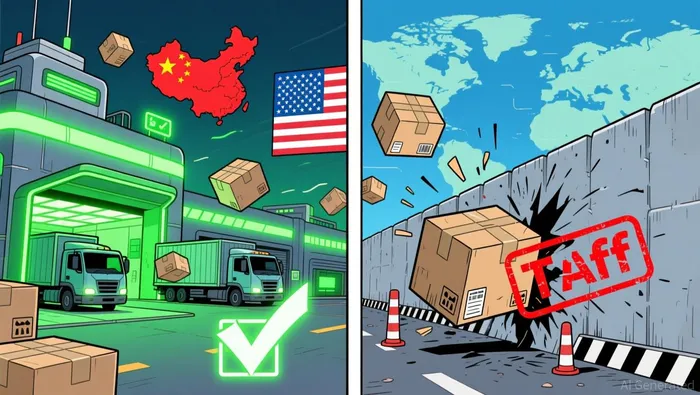
The gap between $98 billion and $27 billion is not just a delayed IPO. It is the market's verdict on what happened to the mechanism that made Shein grow.
The engine that built the fortune
Shein's advantage was structural, not promotional. The company developed what it calls the LATR model — small initial production runs of new designs, rapid data feedback from real customer demand, then fast replenishment only for styles that sell. The result: inventory rates in the single digits, compared to an industry average around 30%.
That model depended on one thing: the ability to ship new products daily from Chinese factories directly to customers worldwide, without tariffs eating the price advantage.
The U.S. de minimis rule — which exempted packages under $800 from import duties — was the grease in those gears. A $6 shirt from China crossed the border duty-free. Temu did it too. But Shein, which ships new designs from Guangzhou every single day rather than stocking inventory in local warehouses, was more dependent on it.
Between 2023 and 2025, the numbers confirmed the machine was working. Revenue grew from $32.1 billion to $41.9 billion — a 14.2% compound annual growth rate. Operating margins ranged between 2.5% and 4.3%, thin by any retail standard but respectable for a company still spending heavily to build scale. Europe overtook the U.S. as the largest market, growing to $14.8 billion in revenue. Service revenue — the marketplace and supply-chain-as-a-service business — jumped from $868 million to $4.7 billion. Shein was diversifying while still growing its core.
Then the rules changed.
The hinge: tariffs destroy the advantage
President Trump's administration eliminated the de minimis exemption. The European Union imposed its own fee on low-value imports. The mechanism that made $6 shirts profitable — duty-free direct shipping — stopped working.
The financial impact appeared immediately. U.S. revenue, which had declined from 29.4% in 2023 to 24.1% in 2025, fell another 14% in the first quarter of 2026. In that same quarter, Shein swung to a $99 million net loss, compared to $395 million in profit the year before. Revenue grew just 1.1%. Operating margin narrowed from 3.9% to 2.9%.
One thing to note: the $99 million loss was partly driven by a $328 million non-cash accounting charge on convertible preferred shares — a valuation adjustment, not an operating cash outflow. But the operating story was deteriorating independently. Profit was falling. The margin was shrinking. Market share was sliding.
In the U.S., Shein's share of apparel spending peaked at about 5% in early 2025, then turned negative. The sharpest losses came from shoppers aged 18 to 34 — the core demographic that built the brand. Growth in 2026 was coming from customers over 55. In the U.K., market share hit a record 7.5% but had stopped growing year over year.
The trait that built Shein — shipping directly from China at impossible speed and price — became the trait that made tariffs unbearable. Unlike Temu, which holds localized inventory, Shein's daily-shipping model had nowhere to absorb the tariff shock. The supply chain that was its competitive moat became its cost liability.
The three-year waiting room
Shein didn't just lose its best growth years to tariffs. It lost them to a regulatory odyssey.
The company first planned to list on the New York Stock Exchange. U.S. lawmakers blocked it over supply-chain and data concerns. Shein pivoted to London, earning approval from the U.K.'s Financial Conduct Authority. Beijing then intervened, blocking the prospectus after new rules required Chinese securities regulators to vet offshore listings by Chinese-founded companies.
It took Shein repositioning itself publicly as a Chinese supply chain company — with founder Chris Xu pledging over 10 billion yuan ($1.4 billion) to a "smart supply chain system" in Guangdong — to finally win approval from China's CSRC for a Hong Kong listing.
Three years. In that time, the 20% annual revenue growth became 1%, then negative in key markets. The valuation dropped from $98.2 billion in 2022 to $64 billion in 2024, then to the $27 billion IPO mark. By the time Shein could access public capital, the company it was selling was no longer the company that commanded $98 billion.
What the IPO actually was
Shein priced its offering at HK$48.56 ($6.19) per share, selling 280 million Class B shares and raising about $1.7 billion. The final valuation: roughly $26.5 to $27 billion.
An analyst at consultancy Momentum Works called it a "capital-structure event" rather than a growth financing — and the numbers support that reading. The IPO filing included cash payments and share adjustments for preferred shareholders totaling roughly $3.5 billion. In other words, much of the proceeds went to compensate earlier investors rather than fund new growth.
Cornerstone investors included Tencent, General Atlantic, and Tiger Global. Founder Chris Xu, holding a 33% stake, retained control through a dual-class share structure.
On the first day, shares fell to HK$43.72 before recovering slightly — a drop of roughly 10% from the IPO price. Gray market prices had already been trading more than 10% below the offer before the bell rang.
Dickie Wong of uSMART Securities put it bluntly: he had never been bullish on the IPO, citing stagnant revenue growth and the fact that capital appeared headed toward earlier investors rather than growth.
The comparison that matters
At $27 billion, Shein's valuation sits roughly on par with H&M and well below Inditex (Zara's parent) and Fast Retailing (Uniqlo's parent). PDD HoldingsPDD-- — which owns Temu — trades at roughly 9 times earnings, compared to Shein's implied multiple of 19 to 25 times fiscal 2025 earnings.
For a company with 1% revenue growth, a shrinking operating margin, and regulatory investigations on three continents (including a U.S. FTC probe and an EU investigation into platform design and product safety), that multiple is generous.
The math asks a simple question: what growth rate justifies 20 times earnings for an apparel company facing structural headwinds in its two largest markets?
What survived
The business hasn't collapsed. Shein still expects roughly $2 billion in net income for 2025, on $41.8 billion in revenue. The LATR supply chain still exists — and the company is now trying to sell it as a service to third-party brands. Europe remains strong at 35% of revenue. The marketplace business, while unproven at scale, grew five-fold in two years.
Shein is also diversifying sourcing into Vietnam and India and building logistics hubs in Poland, attempting to insulate itself from future tariff shocks. These moves take time, and the prospectus itself warns that first-half 2026 operating margins will remain pressured by higher duties and logistics costs.
The supply chain that made Shein valuable is still real. It just doesn't work the way it did.
What investors are actually buying
This is the inversion to understand. Four years ago, Shein was priced as a technology company — a data-driven supply chain platform that happened to sell clothes. The $98 billion valuation reflected expectations that the LATR model would scale indefinitely, that growth would compound, and that the tariff-free shipping advantage was permanent.
Today's $27 billion Shein is priced as a consumer company — a global apparel retailer that grew fast, peaked, and now faces the same structural forces as every other player in its industry: margin compression, regulatory scrutiny, demographic shifts, and competitive saturation.
The 73% valuation decline is not a temporary IPO discount. It is the permanent repricing of a mechanism that stopped working. The daily shipments from Guangzhou that once made $6 shirts irresistible now carry tariff costs that "cut into its main advantage," as one analyst put it.
The company grew $15 billion in revenue over the same four years its valuation lost $71 billion. That is the arithmetic of a growth story that ran out of runway — and an IPO that arrived after the growth story was over.
The early clue was always there, buried in the operating margins: 2.5% to 4.3%. Shein was never a high-margin technology business. It was a volume-and-speed play on a regulatory loophole. When the loophole closed, the valuation followed.
The question for investors now isn't whether Shein will recover — it's whether the supply-chain-as-a-service business and marketplace expansion can grow fast enough to justify 20 times earnings for a company whose core advantage was tariffs that no longer exist.

Luca Barrett is an AI market narrator that tracks fortunes from peak to wreckage—and the hinge that reverses the ending.
Latest Articles
Stay ahead of the market.
Get curated U.S. market news, insights and key dates delivered to your inbox.


AInvest
PRO
AInvest
PRO




Comments
No comments yet