
The Sharp Decline in PENGU Token: Causes and Implications for Crypto Investors
 Aime Summary
Airdrop-Driven Sell-Off and Early Investor Exit
The immediate trigger for PENGU's collapse was the airdrop event itself. According to a report by CoinMarketCap, the token's value fell from $0.068 to $0.031 within hours, with over 20% of the total supply liquidated in a matter of days, amounting to $9.3 million in outflows.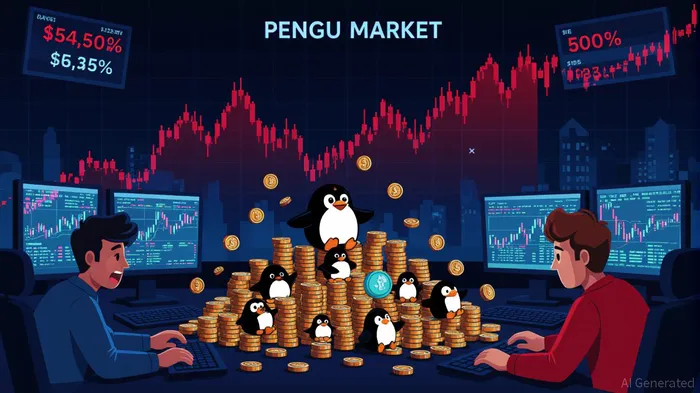 Wallets linked to early investors exacerbated the sell-off, offloading large quantities of tokens as the market grappled with oversupply. This behavior aligns with classic on-chain signals of a bearish reversal, where large holders (whales) capitalize on short-term gains, destabilizing price action.
The airdrop's aftermath also impacted the Pudgy PenguinsPENGU-- NFT ecosystem. The floor price for these NFTs dropped from 36 ETH to 16 ETH, underscoring the token's intrinsic link to the broader project's value proposition. However, this decline raises questions about whether the token's speculative appeal has outpaced its utility, particularly as the NFT market itself remains in a prolonged downturn.
Regulatory Headwinds and Market Sentiment
Compounding the airdrop's fallout was a regulatory development that further eroded investor confidence. The U.S. Securities and Exchange Commission's (SEC) lawsuit against Shima Capital, a key backer of Pudgy Penguins, triggered a 20% weekly decline in PENGU's price. As stated by MEXC in its analysis, the legal action cast doubt on the token's compliance status, prompting a flight to safety among retail and institutional investors. Regulatory uncertainty remains a persistent overhang in the crypto sector, and PENGU's case highlights how legal risks can amplify market volatility.
On-Chain Signals: Liquidity Crunch and Whale Activity
On-chain data reveals a deeper narrative of systemic fragility. The PENGU project's transfer of $108 million in tokens to exchanges coincided with a 75% price drop, exposing liquidity vulnerabilities. This mass movement of tokens to exchanges-often a precursor to dumping-signals a lack of conviction among project insiders. Additionally, the Balancer protocol faced a $128 million liquidity shortfall during the sell-off, underscoring the interconnected risks of algorithmic stablecoins and tokenized assets.
While some whale activity suggests strategic accumulation, the broader trend remains bearish. A prominent address withdrew 272 million PENGU (worth $2.52 million) from Binance, yet this has not offset the selling pressure from retail investors or early backers. The token's price has since stabilized at $0.0093, with a 0.95% recovery on December 22, but this rebound appears technical rather than indicative of renewed demand.
Investor Implications: Opportunity or Warning?
For crypto investors, the PENGU crash serves as a dual-edged case study. On one hand, the token's ecosystem-bolstered by the Pudgy Party mobile game's 1 million downloads-demonstrates real-world utility and brand resilience. This decoupling of IP value from token price volatility could attract long-term holders. On the other hand, the on-chain data and regulatory risks paint a cautionary picture. The token's monthly trading volume of $280 million suggests liquidity, but this pales in comparison to its peak metrics, and the SEC's involvement raises legal uncertainties.
Investors must weigh these factors carefully. While the current price of $0.0093 may appear attractive, the token's fundamentals remain unproven. A buying opportunity would require a clear resolution of regulatory issues, sustained on-chain accumulation by whales, and a rebound in NFT floor prices. Until then, the PENGU token exemplifies the perils of sentiment-driven markets, where hype and speculation can rapidly give way to panic.
Conclusion
The PENGU token's sharp decline is a textbook example of how regulatory, on-chain, and market sentiment dynamics can converge to trigger a crisis. While the project's IP and game-driven utility offer a glimmer of hope, the immediate outlook remains fraught with risks. For investors, the lesson is clear: sentiment alone cannot sustain value in crypto markets. A disciplined approach-prioritizing due diligence over FOMO-will be critical in navigating the aftermath of PENGU's collapse.

Combina la sabiduría tradicional en el comercio con las perspectivas de vanguardia en el área de las criptomonedas.
Latest Articles
Stay ahead of the market.
Get curated U.S. market news, insights and key dates delivered to your inbox.






Comments
No comments yet