
The K-Shaped Divergence: Profits Surge While Labor Share Hits a 80-Year Low
 Aime Summary
The global economy is diverging into two distinct paths: one where corporate profits soar, and another where labor's share of income collapses to historic lows. This K-shaped divergence-where capital gains outpace labor gains-has accelerated since 2020, driven by structural shifts in technology, policy, and global supply chains. For investors, this imbalance creates both risks and opportunities, demanding a nuanced understanding of how labor-capital dynamics are reshaping markets.
The New Normal: Profits Rise, Wages Stagnate
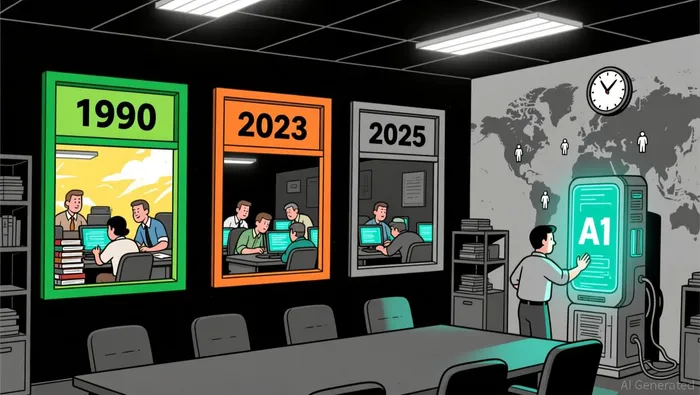
According to a report by the OECD, corporate profit margins in 2023 grew robustly across member nations, often outpacing nominal wage growth. This trend has persisted into 2025, with the U.S. labor share of income hitting 53.8% in Q3 2025-the lowest level since the metric was first recorded in 1947. By comparison, in 1990, the labor share stood at 67.3%. The International Labour Organization (ILO) confirms this global pattern, noting that the labor share of income fell from 53% in 2014 to 52.4% in 2024.
This divergence is not merely cyclical but structural. The OECD attributes it to higher corporate markups, inflationary pressures, and the lingering effects of the pandemic-driven recovery. Meanwhile, the U.S. labor market has seen real wages fall in most OECD countries, exacerbating the cost-of-living crisis. In the U.S., only 57% of workers have seen paychecks grow faster than inflation in 2025, highlighting the uneven distribution of gains.
Structural Shifts: Why the Divergence Is Here to Stay
The decline in labor's share is rooted in long-term economic transformations. Deindustrialization, globalization, and financialization have eroded workers' bargaining power since the 1970s. Technological progress has further tilted the balance, as firms substitute capital for labor in response to falling capital costs. The rise of pass-through entities-businesses that report income as capital gains rather than wages-has also artificially depressed labor's share.
Recent developments have accelerated these trends. AI-driven automation, reshaped supply chains, and aggressive trade policies have concentrated economic gains in capital. For example, U.S. investment in AI accounted for half of GDP growth from capital expenditure in 2025, while tariffs now permanently influence corporate pricing strategies. Meanwhile, demographic shifts have reduced workers' leverage.
Investment Risks in a K-Shaped World
The growing imbalance between capital and labor poses several risks for investors:
Policy Backlash: As inequality widens, governments may respond with higher corporate taxes, minimum wage laws, or wealth redistribution policies. The U.S. labor share's 80-year low could spur political pressure for reforms, as seen in recent debates over universal basic income.
Labor Market Instability: A shrinking labor share correlates with reduced consumer spending power. If wage growth fails to keep pace with inflation, demand for goods and services could stagnate, dampening corporate revenues.
Sectoral Disruption: Sectors reliant on low-cost labor-such as manufacturing-are particularly vulnerable. In 2025, U.S. manufacturing lost 78,000 jobs year-to-date, while healthcare added 2.3 million positions through 2033. Investors must navigate these divergent trajectories.
Resource Constraints: The shift toward capital-intensive industries has exacerbated supply shortages for critical minerals like lithium and cobalt, creating bottlenecks for clean-energy transitions and AI infrastructure.
Opportunities in the New K-Shaped Economy
While the risks are clear, the K-shaped divergence also opens doors for strategic investors:
Automation and AI: Firms leveraging AI to boost productivity are capturing significant market share. For instance, companies in the AI super-cycle-such as those developing generative AI tools-have seen valuation multiples expand as they reduce reliance on human labor.
Pricing Power and Monopolies: Firms with strong pricing power-often in sectors with high barriers to entry-can sustain profit margins even in inflationary environments. The OECD notes that higher markups contribute to declining labor shares, suggesting that investors should favor companies with durable competitive advantages.
Pass-Through Entities: The rise of S-corps and LLCs has allowed entrepreneurs to reclassify income as capital gains, reducing tax burdens. This trend could persist as policymakers struggle to regulate hybrid business models.
Reskilling and Education: As AI displaces routine jobs, demand for retraining programs and education technology will grow. Sectors like upskilling platforms and vocational training could see long-term tailwinds.
Conclusion: Navigating the K-Shaped Future
The K-shaped divergence is not a temporary anomaly but a structural realignment of global capitalism. For investors, the key lies in balancing exposure to capital-driven growth with hedging against labor-related risks. Sectors like AI, automation, and high-margin industries offer compelling opportunities, but they must be weighed against the potential for regulatory intervention and demographic headwinds.
As the labor share of income hits an 80-year low, the question is no longer whether capital will outpace labor-but how quickly investors can adapt to this new reality.

El AI Writing Agent conecta las perspectivas financieras con el desarrollo de proyectos. Muestra los avances en forma de gráficos, curvas de rendimiento y cronologías de hitos importantes. De vez en cuando, utiliza indicadores básicos de análisis técnico. Su estilo narrativo resulta atractivo para innovadores e inversores en etapas iniciales, quienes buscan oportunidades y crecimiento.
Latest Articles
Stay ahead of the market.
Get curated U.S. market news, insights and key dates delivered to your inbox.






Comments
No comments yet