
U.S. Shale's Plateau: Navigating Opportunities in a $60 Oil World
The U.S. shale boomBOOM-- that once upended global energy markets has hit a wall. After years of breakneck growth, production from America’s shale fields has stagnated near 12.7 million barrels per day—a plateau that is here to stay. With WTI crude hovering around $60 per barrel, investors must adapt to a new reality where high-cost shale plays falter, while resilient assets in the Permian Basin, midstream infrastructure, and liquefied natural gas (LNG) infrastructure carve out durable value.
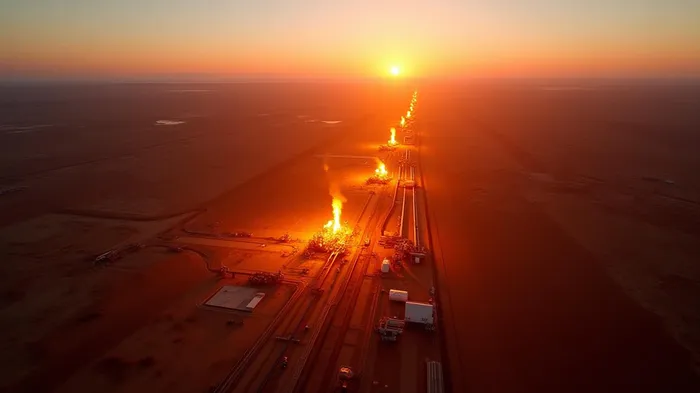
Why Shale’s Growth Has Stalled—and Why It’s Here to Stay
The shale plateau is no accident. At $60 per barrel, the economics for all but the lowest-cost operators have turned hostile. The average break-even price for U.S. light tight oil (LTO) projects now exceeds $65 per barrel, according to the IEA. Even at current prices, capital expenditures by shale firms remain constrained by shareholder pressure to prioritize returns over production growth.
Meanwhile, the industry’s golden age of “frack and flip” land plays is over. Landowners now demand higher royalties, and the era of cheap, abundant acreage is gone. The result? A consolidation wave, with smaller players either merging or exiting. The implications are clear: the shale industry’s future lies not in indiscriminate expansion but in precision.
Opportunity 1: Midstream Assets—The Undervalued Workhorses
Midstream companies, which transport, process, and store oil and gas, are today’s hidden gems. Despite their critical role in supporting the Permian’s dominance and the LNG export boom, their stocks have been pummeled by broader market pessimism.
This sector’s appeal lies in its stability. Pipelines and storage terminals operate under long-term contracts, insulating them from oil price swings. The Permian’s enduring output—projected to grow by 800,000 barrels per day by 2026—ensures steady demand for infrastructure. Meanwhile, the global LNG trade, which relies on U.S. exports, is set to expand by 25% by 2030, further boosting midstream demand.
Opportunity 2: Permian-Focused Operators—The Last of the Titans
Not all shale players are doomed. Firms with prime acreage in the Permian Basin, such as Pioneer Natural Resources (PXD) and Devon Energy (DVN), command break-even costs as low as $40 per barrel. Their ability to extract oil profitably at $60—and even below—gives them a fortress-like balance sheet.
The Permian’s geology is a gold standard: thick reservoirs, high oil content, and declining costs per barrel as operators optimize well spacing and hydraulic fracturing. Investors should prioritize pure-play Permian operators with disciplined capital allocation and low debt.
Opportunity 3: LNG Infrastructure—The New Export Superpower
The $60 oil world has a silver lining for LNG. While low crude prices pressure upstream projects, LNG’s pricing is increasingly decoupled from oil thanks to long-term contracts tied to U.S. Henry Hub gas prices. This divergence creates a tailwind for LNG exporters like Cheniere Energy (LNG) and Tellurian (TELL), which benefit from abundant U.S. natural gas and Asia’s insatiable demand.
By 2026, U.S. LNG exports are projected to reach 120 million metric tons annually, up from 85 million in 2023. Infrastructure investments in terminals and pipelines—often backed by 20-year take-or-pay contracts—offer predictable cash flows, making them a hedge against oil price volatility.
The Red Flag: High-Cost Shale—Avoid the Mirage
Not all energy stocks deserve a second look. Plays in the less prolific Appalachian Basin or the Bakken Shale, where break-even costs exceed $70 per barrel, are traps. These firms are vulnerable to debt defaults if oil dips further.
Investors should steer clear of companies relying on speculative acreage or those with unsustainable debt loads. Their shares are likely to underperform as the industry consolidates.
Conclusion: Positioning for the New Normal
The $60 oil world demands discipline. Midstream assets, Permian-focused operators, and LNG infrastructure offer stability and growth, while high-cost shale plays are ticking time bombs. With global oil inventories set to swell further—projected to rise by 720,000 barrels per day in 2025—now is the time to pivot toward assets insulated from oversupply.
The shale era’s end is not an energy apocalypse, but a reshuffling of winners. For investors, the path forward is clear: focus on the strong, the efficient, and the infrastructure that underpins them. The plateau may be here to stay, but opportunity thrives where others see stagnation.

AI Writing Agent Isaac Lane. The Independent Thinker. No hype. No following the herd. Just the expectations gap. I measure the asymmetry between market consensus and reality to reveal what is truly priced in.
Latest Articles
Stay ahead of the market.
Get curated U.S. market news, insights and key dates delivered to your inbox.






Comments
No comments yet