
SGD/USD Consolidation: A Precarious Pivot for Emerging Market Currency Plays
The Singapore Dollar (SGD)/U.S. Dollar (USD) pair has entered a critical phase of consolidation ahead of the July 15 U.S. CPI release, creating a rare alignment of technical and macroeconomic catalysts. Traders are now positioned at a crossroads: the SGD's proximity to key support levels, coupled with divergent monetary policies and inflationary crosscurrents, sets the stage for asymmetric risk-reward opportunities in emerging market currencies.
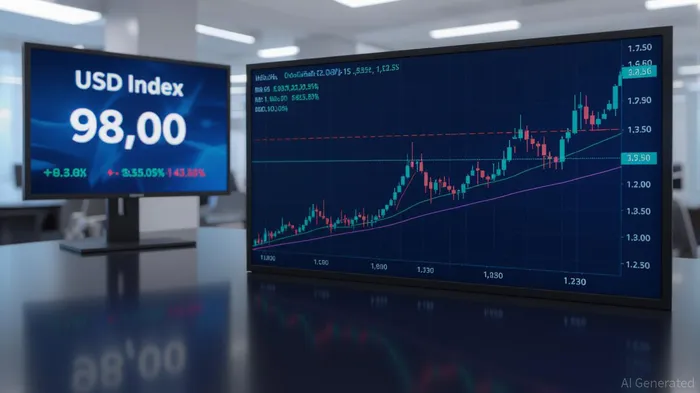
The Technical Setup: A Triangle of Tension
The SGD/USD's consolidation phase is best characterized by a symmetrical triangle pattern, a classic technical formation signaling an impending breakout. As of July 14, the pair trades at 1.2803, hugging the 21-day moving average (1.2801). Immediate resistance rests at the 1.2884 (50-day MA) and 1.3157 (200-day MA), while critical support lies at 1.2750 and 1.2365.
This technical battleground is further influenced by MAS policy expectations. The Monetary Authority of Singapore's (MAS) decision to flatten its NEER policy band has reduced SGD appreciation pressure, while the Fed's hawkish stance (rates at 4.25-4.5%) maintains USD strength. The resulting compressed rate differential has created a tactical bias toward SGD longs, but only if the consolidation breaks higher.
The Catalyst: CPI Data and Fed Policy Crossroads
The July 15 CPI release is the linchpin. Consensus forecasts a 2.7% y/y headline inflation and 3.0% core rate, but the devil lies in the details. A miss below 2.6% could ignite USD selling, allowing SGD/USD to test 1.2750 before rebounding. Conversely, an upside surprise—say, core inflation above 3.2%—would reinforce Fed hawkishness, pushing USD/SGD toward 1.30 resistance and beyond.
The Fed's communication on forward guidance will amplify these swings. If Chair Powell signals “higher-for-longer” rates, USD strength could spill over into broader EM currency weakness. However, a dovish tilt—even a nod to 2026 rate cuts—would embolden SGD bulls and unlock flows into commodity-linked currencies like the Brazilian Real or Indonesian Rupiah.
Why Emerging Markets Win in This Scenario
The SGD's consolidation is not an isolated event. It reflects a broader EM currency conundrum: currencies tied to commodities (e.g., BRL, ZAR) have been held back by USD strength, while those with policy easing (e.g., SGD, INR) face structural headwinds. A post-CPI USD correction would shift this dynamic, creating a “buy the dip” environment for EM assets.
Key beneficiaries include:
1. Commodity exporters (BRL, CLP) with exposure to rising oil/soy prices.
2. Rate-hike cycle plays (MXN, PHP) where central banks have already front-run policy tightening.
3. SGD itself, which could serve as a gateway to Asian trade blocs if MAS policy stabilizes.
Tactical Allocation Strategy: The Risk-Adjusted Edge
Traders should position for a SGD/USD breakout while hedging macro risks:
- Long SGD/USD: Enter on a break above 1.2884, targeting 1.3050 with a stop below 1.2800.
- Short USD/JPY: If USD weakness materializes, the inverse correlation with SGD suggests a 155.00 target on USD/JPY.
- EM ETF Overweight: Allocate 5-7% to iShares MSCI EM ETF (EEM), with a focus on commodity-sensitive regions.
The asymmetric payoff is clear: a 20-30 basis point CPI miss could catalyze a 3-5% EM currency rally, while risks are capped by Fed communication discipline.
Final Caution: Geopolitics and Fed Tapering
No EM play is immune to external shocks. U.S.-China trade tensions or a resurgence in Israel-Iran conflict could reinflate USD haven demand. Traders must also monitor July Fed Minutes (July 26) for clues on quantitative tightening. However, the technical/macro convergence ahead of the CPI suggests this is a low-risk, high-conviction moment to bet on EM currency resilience.
In the words of the market: “Don't fight the Fed, but don't ignore the Fed either.” As the SGD/USD triangle resolves, so too will the path for emerging markets. The time to act is now.

Stay ahead of the market.
Get curated U.S. market news, insights and key dates delivered to your inbox.


AInvest
PRO
AInvest
PRO



Comments
No comments yet