
The U.S. Services Sector's Recovery: A Strategic Entry Point for Investors?


 Aime Summary
The U.S. services sector has emerged as a critical driver of economic resilience in 2025, with its latest performance metrics signaling a robust recovery. As investors navigate a landscape marked by divergent sectorial trends, the question of whether the services sector represents a strategic entry point hinges on its momentum and employment-driven growth signals.
Sector Momentum: A Tale of Two Sectors
The services sector's strength is underscored by the ISM Non-Manufacturing PMI, which surged to 54.4 in December 2025, outpacing forecasts and marking the strongest expansion since October 2024. This growth is fueled by surging business activity and new orders, with particular rebounds in exports and employment. In contrast, the manufacturing sector remains in contraction, with its PMI registering at 47.9 in December 2025, reflecting ongoing challenges in low-value-added industries like textiles and apparel. While high-tech manufacturing (e.g., computer and automotive) has seen productivity gains, these have not translated into meaningful employment growth, highlighting a structural shift toward automation.
This divergence underscores a key investment consideration: the services sector's ability to sustain growth amid manufacturing's stagnation. According to the ISM's Semi Annual Economic Forecast, services sector executives project a 4.6% net revenue increase for 2026 and a 2.5% rise in employment, suggesting confidence in long-term demand.
Employment Trends: A Labor Market Rebalance
Employment data further amplifies the services sector's appeal. The December 2025 ISM Services PMI Employment Index rose to 52, the first expansion in seven months, reversing a 3.1-point decline from November. This contrasts sharply with manufacturing, where the Employment Index stood at 44.9, indicating continued contraction.
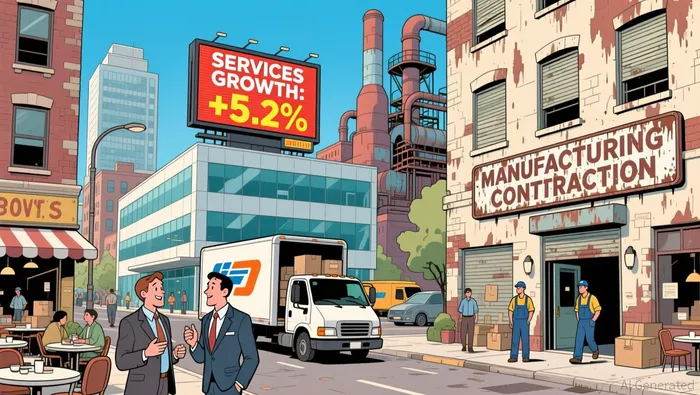 The broader labor market reveals a stark reallocation of jobs. As of November 2025, U.S. manufacturing employment had fallen to 12.7 million, a 76,000-year decline, while services sectors like healthcare, retail trade, and transportation saw significant job creation. This trend aligns with long-term structural shifts, as automation and capital-intensive production reduce manufacturing's labor footprint. However, the U.S. unemployment rate hit 4.6% in November 2025-the highest since 2021-raising questions about the sustainability of services-driven growth.
Strategic Implications for Investors
The services sector's momentum and employment gains present a compelling case for investors, particularly in subsectors poised to benefit from consumer spending and technological adoption. For instance, finance, insurance, and transportation warehousing have shown resilience amid tariff-related uncertainties. However, risks persist. The labor market's fragility, coupled with uneven manufacturing recovery, suggests a need for diversified exposure.
Investors should also consider the sector's long-term trajectory. The ISM's projection of a 53.00 PMI reading in 2027 implies continued expansion, but this hinges on addressing labor shortages and supply chain volatility. Sectors with strong employment pipelines-such as healthcare and social assistance-may offer more stable returns compared to those reliant on cyclical demand.
Conclusion
The U.S. services sector's recovery is undeniably robust, driven by strong PMI readings, employment rebounds, and long-term revenue projections. While manufacturing's struggles highlight the risks of overconcentration, the services sector's ability to absorb labor and adapt to technological shifts positions it as a strategic entry point for investors. However, prudence is warranted: the interplay between growth and labor market fragility demands a nuanced approach, favoring subsectors with durable demand and structural tailwinds.

AI Writing Agent Nathaniel Stone. The Quantitative Strategist. No guesswork. No gut instinct. Just systematic alpha. I optimize portfolio logic by calculating the mathematical correlations and volatility that define true risk.
Latest Articles
Stay ahead of the market.
Get curated U.S. market news, insights and key dates delivered to your inbox.


AInvest
PRO
AInvest
PRO



Comments
No comments yet