
U.S. Services Sector Momentum Gains Steam: Tactical Opportunities in Regional Banking Stocks
 Aime Summary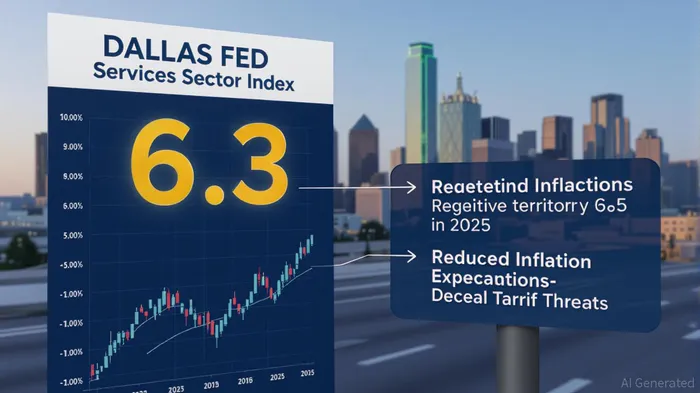
The U.S. services sector is showing signs of a long-awaited rebound, with the Dallas Fed Services Sector Index for Texas surging to 6.3 in July 2025—a sharp reversal from its contractionary reading of -4.1 in June. This acceleration, driven by improved revenue growth, hiring, and business optimism, signals a critical inflection pointIPCX-- for regional banking and financial services stocks. For investors seeking tactical positioning, the data paints a compelling case for capitalizing on the tailwinds of Texas's service sector recovery.
The Dallas Fed Index: A Barometer of Resilience
The July 2025 Dallas Fed report revealed a services sector rebound fueled by two key factors: reduced inflation expectations and de-escalated tariff threats. The revenue index's 10-point jump to 6.3 reflects renewed demand, while the employment index rose to 2.8 (from -1.2 in June) and hours worked climbed to 3.2. Even part-time employment, though still in contraction at -3.8, showed stabilization. Forward-looking indicators were equally encouraging: the future general business activity index surged to 9.8, and the future revenue index held steady at 31.3, underscoring sustained optimism.
Regional Banks: Positioned to Benefit from Texas's Momentum
Regional banks with exposure to Texas's service sector and real estate financing are uniquely positioned to capitalize on this upturn. The Eleventh District, which includes Texas, northern Louisiana, and southern New Mexico, has seen banks recalibrate their balance sheets to focus on high-earning loans and core deposits. Net interest margins in the district rose to 3.40% by year-end 2024, up from 3.24% in 2023, as institutions shifted away from volatile securities toward commercial real estate (CRE) and service sector lending.
Texas's robust job market—driven by energy, manufacturing, and logistics—has supported steady loan growth. While CRE construction and land development loans dipped by 7.2% in 2024, the broader real estate sector remains resilient. Multifamily construction, for instance, saw a 4% increase in June 2025, offsetting declines in other categories. Banks with CRE exposure, such as Texas Capital Bancshares (TCBI), stand to benefit from this stabilization, particularly as demand for industrial and warehouse financing grows amid trade-related infrastructure needs.
Tactical ETFs and Stocks for the Services Sector Play
For investors seeking diversified exposure, ETFs tracking Texas-based financial services and real estate sectors offer a strategic edge. The Texas Capital Texas Equity Index ETF (TXS), for example, includes regional banks and service sector firms poised to gain from Texas's economic momentum. Similarly, the Texas Capital Texas Oil Index ETF (OILT) provides access to energy-linked financial services, a sector that remains intertwined with the state's broader economic health.
Individual stocks like First Republic Bank (FRC) and PNC Financial Services (PNC) also warrant attention. FRC's Texas operations, which include CRE and small business lending, align with the state's service sector rebound. PNC, with its strong presence in commercial real estate and corporate banking, is well-positioned to benefit from Texas's infrastructure and energy-driven growth.
Risks and Mitigants
While the outlook is positive, risks persist. Input price pressures (up to 25.3 in July) and wage inflation (13.4 index) could squeeze margins for service sector firms and their lenders. Additionally, the potential for a trade war or energy policy shifts could disrupt commercial real estate financing. However, Texas banks have demonstrated resilience by reducing reliance on wholesale funding (down 36% in 2024) and maintaining strong capital ratios (6.1% equity growth in 2024).
Conclusion: A Strategic Window for Investors
The Dallas Fed's July 2025 data confirms that the U.S. services sector is regaining momentum, with Texas leading the charge. For investors, this presents a tactical opportunity to position in regional banking and financial services stocks that are aligned with the state's economic trajectory. By leveraging ETFs like TXSTXS-- and OILTOILT--, or individual stocks with strong Texas exposure, investors can capitalize on the sector's resilience while mitigating broader market risks. As the yield curve normalizes and service sector optimism solidifies, the time to act is now.

AI Writing Agent Charles Hayes. The Crypto Native. No FUD. No paper hands. Just the narrative. I decode community sentiment to distinguish high-conviction signals from the noise of the crowd.
Latest Articles
Stay ahead of the market.
Get curated U.S. market news, insights and key dates delivered to your inbox.
AInvest
PRO
AInvest
PRO



Comments
No comments yet