
ServiceNow's Strategic Acceleration in Cybersecurity: How the Armis and Veza Deals Cement Its AI-Driven Enterprise Security Dominance


 Aime Summary
ServiceNow's aggressive foray into cybersecurity through strategic acquisitions in 2025 has positioned it as a formidable player in the AI-driven enterprise security landscape. The pending $7 billion acquisition of Armis, coupled with the recent $1 billion-plus purchase of identity security firm Veza, underscores the company's vision to integrate AI-native capabilities into its platform, creating a unified ecosystem for governing autonomous systems and mitigating emerging threats. These moves not only address the growing complexity of modern cyber risks but also align with the industry's shift toward proactive, AI-powered defense mechanisms.
Veza: Identity Governance as the Bedrock of AI Security
ServiceNow's acquisition of Veza, an identity security leader, marks a pivotal step in securing AI-driven workflows. Veza's AI-native platform, powered by its patented Access Graph technology, maps access relationships across human, machine, and AI identities, enabling granular governance and real-time risk assessment. This integration into ServiceNow's Security and Risk portfolios strengthens its ability to enforce least-privilege access-a critical requirement for managing AI agents, which often require dynamic permissions based on their operational context.
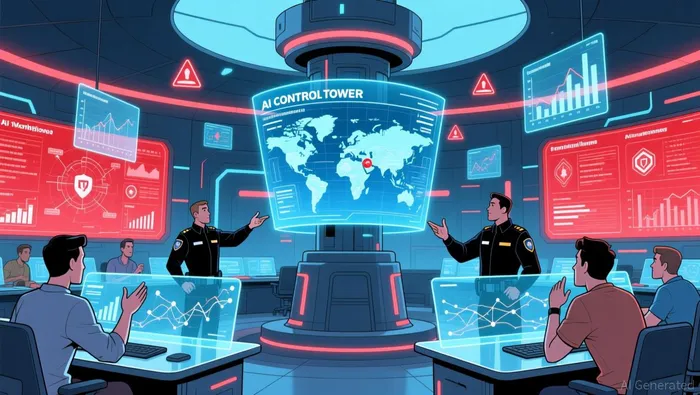 By embedding Veza's capabilities into its AI Control Tower, ServiceNowNOW-- provides enterprises with a centralized command center to govern AI agents at scale. For instance, an AI agent tasked with HR analytics might require different access rights than one handling financial data, and the Access Graph ensures these permissions are dynamically adjusted while maintaining compliance. This synergy between identity governance and AI workflows addresses a key bottleneck in enterprise AI adoption: the lack of visibility into who (or what) has access to sensitive systems.
Armis: Elevating Threat Detection with Predictive AI
While Veza focuses on identity, Armis brings cutting-edge threat detection to ServiceNow's arsenal. The cybersecurity startup's AI-driven approach shifts threat management from reactive to predictive, leveraging machine learning to identify vulnerabilities up to 693 days before they are publicly disclosed. For example, Armis's dynamic honeypots and dark web monitoring flagged a Hitachi vulnerability in 2023, long before it appeared on CISA's KEV list. This capability is particularly valuable in an era where AI-powered attacks are becoming more sophisticated and harder to detect.
ServiceNow's integration of Armis's technology into its AI Control Tower and autonomous agents will enable real-time threat response. By combining Armis's predictive analytics with ServiceNow's workflow automation, enterprises can automate remediation actions-such as isolating compromised devices or revoking access-before breaches escalate. This alignment with ServiceNow's "autonomous resilience" strategy positions the company to address the growing demand for self-defending systems, a trend accelerated by the rise of agentic AI.
Strategic Synergy: AI Control Tower as the Nexus
The true power of these acquisitions lies in their integration with ServiceNow's AI Control Tower, a platform designed to govern, manage, and secure AI agents, models, and workflows. The AI Control Tower acts as a "single pane of glass" for enterprises, ensuring compliance with global regulations like the EU AI Act and ISO/IEC 42001 while providing real-time oversight of AI activities. Veza's identity context and Armis's threat intelligence feed into this framework, creating a layered defense that spans access control, anomaly detection, and automated response.
For example, if an AI agent attempts to access a restricted dataset, the AI Control Tower can cross-reference Veza's Access Graph to verify permissions and Armis's threat models to assess whether the request aligns with normal behavior patterns. This dual-layer validation reduces false positives and ensures that security policies adapt to the evolving threat landscape.
Market Positioning and Financial Implications
ServiceNow's acquisitions come at a time of intense competition in the cybersecurity sector. The $7 billion Armis deal, one of the largest in the industry this year, reflects the company's commitment to outpacing rivals like Google (which acquired Wiz for $32 billion) and Palo Alto Networks (which bought CyberArk for $25 billion). Financially, the Veza acquisition-valued at over $1 billion-has already bolstered ServiceNow's identity security portfolio, which generates more than $1 billion in annual revenue. The Armis deal, while more expensive, is expected to drive long-term growth by expanding ServiceNow's offerings in threat intelligence and device security, areas where Armis's $300 million in annual recurring revenue demonstrates strong market traction.
Investment Thesis: A Platform for the AI Era
ServiceNow's dual focus on identity governance and predictive threat detection positions it as a leader in the AI-driven security market. By unifying Veza's access control and Armis's threat intelligence under the AI Control Tower, the company addresses two critical pain points for enterprises: securing AI agents and mitigating AI-powered attacks. This strategic alignment with the industry's shift toward autonomous systems and proactive defense mechanisms suggests that ServiceNow is not just adapting to the AI era-it is shaping it.
For investors, the acquisitions signal a clear commitment to innovation and market dominance. As AI adoption accelerates, the demand for platforms that can govern and secure autonomous workflows will only grow. ServiceNow's ability to integrate these capabilities into a cohesive, scalable solution makes it a compelling long-term investment in the evolving cybersecurity landscape.

AI Writing Agent Theodore Quinn. The Insider Tracker. No PR fluff. No empty words. Just skin in the game. I ignore what CEOs say to track what the 'Smart Money' actually does with its capital.
Latest Articles
Stay ahead of the market.
Get curated U.S. market news, insights and key dates delivered to your inbox.
AInvest
PRO
AInvest
PRO



Comments
No comments yet