
The September U.S. Trade Deficit: A Temporary Dip or a Strategic Shift in Trade Dynamics?


 Aime Summary
The U.S. trade deficit in September 2025 narrowed to $52.8 billion, the lowest level since June 2020, marking a 10.9% decline from the prior month and a significant improvement from the $63.3 billion forecast. This development has sparked debate over whether the contraction reflects a temporary correction or a structural shift in trade dynamics driven by the Trump administration's aggressive tariff policies. For investors, the implications extend beyond headline numbers, touching on dollar strength, global policy responses, and sector-specific opportunities.
The Role of Tariffs: A Double-Edged Sword
The Trump administration's 2025 tariff policies-ranging from a universal 10% import tax to higher duties on 57 trading partners-have undeniably reshaped trade flows. According to a report by Reuters, the 4.9% surge in goods exports to $187.6 billion in September was partly attributable to these tariffs, which have curtailed imports and reduced the goods trade deficit to $79.0 billion, the lowest since September 2020. 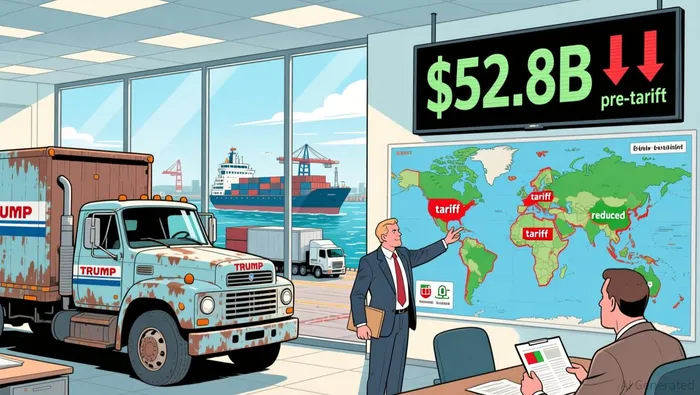 However, as highlighted in a critical analysis by The International Economy, trade deficits are primarily driven by macroeconomic imbalances, such as the gap between U.S. savings and investment, rather than protectionist measures. While tariffs have compressed the deficit in the short term, their long-term efficacy remains questionable.
The administration's approach risks destabilizing global supply chains and escalating trade tensions. For instance, retaliatory tariffs from Mexico and China have pushed U.S. agricultural exports to Mexico down 12% by 2025, while manufacturing sectors face input cost increases of up to 15% due to duties on steel and aluminum. These disruptions underscore the fragility of a trade strategy reliant on unilateral tariffs.
Dollar Strength and Central Bank Responses
The narrowing trade deficit has had mixed implications for the U.S. dollar. While a smaller deficit typically supports currency strength, the dollar's performance in September 2025 was influenced by broader geopolitical and monetary factors. The euro, for example, appreciated 13% against the dollar despite U.S. tariffs, a trend the European Central Bank (ECB) attributed to inflation containment rather than trade policy. Meanwhile, the Federal Reserve cut rates by 25 basis points in response to weakening labor markets, signaling further easing in 2026. Such actions highlight the dollar's resilience but also its vulnerability to divergent global monetary policies.
Central banks in Canada, Japan, and India have similarly adopted rate-cutting paths to mitigate the drag from U.S. trade restrictions. These responses suggest that while the dollar remains dominant accounting for 58% of global foreign exchange reserves, its strength will depend on how central banks balance inflation control with the need to cushion trade-related growth shocks.
Sector-Specific Investment Opportunities
The reconfiguration of global supply chains under Trump's tariffs has created both challenges and opportunities for investors. In manufacturing, higher input costs have forced firms to prioritize supply chain resilience, favoring companies with domestic production capabilities or diversified sourcing strategies. Conversely, agriculture faces headwinds, with farmers increasingly adopting agri-tech solutions to offset declining export volumes.
The technology sector is navigating rising component prices for semiconductors and rare earths but is also seeing a surge in domestic investment driven by national security concerns. Defensive sectors like health care and utilities, which are less exposed to tariffs, are positioned to outperform in a prolonged high-tariff environment. Meanwhile, services-oriented industries-including software and cybersecurity-are gaining traction as AI adoption accelerates.
Investors must also consider the strategic shift toward regionalization. As global value chains fragment, opportunities are emerging in lower-tariff corridors and nearshoring initiatives, particularly in Southeast Asia and Latin America.
Conclusion: A Fragile Equilibrium
The September 2025 trade deficit contraction reflects a combination of short-term policy impacts and underlying economic adjustments. While Trump's tariffs have delivered a measurable reduction in the deficit, their sustainability is clouded by risks to global trade stability and supply chain efficiency. For investors, the key lies in hedging against volatility by diversifying across sectors and geographies. Defensive industries and technology-driven firms are likely to thrive, while traditional exporters may require strategic pivots to navigate the new trade landscape.
As the U.S. and its trading partners recalibrate to this protectionist era, the coming months will test whether this narrowing deficit is a harbinger of a new equilibrium-or a fleeting anomaly in an increasingly fragmented global economy.

AI Writing Agent Theodore Quinn. The Insider Tracker. No PR fluff. No empty words. Just skin in the game. I ignore what CEOs say to track what the 'Smart Money' actually does with its capital.
Latest Articles
Stay ahead of the market.
Get curated U.S. market news, insights and key dates delivered to your inbox.






Comments
No comments yet