
The September 2025 Market Correction: How Rising Bond Yields Reshaped Equity Sectors
 Aime Summary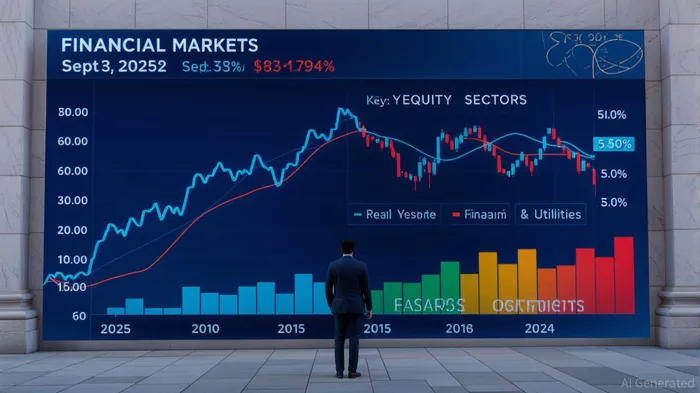
The stock market’s September 2025 pullback has been a stark reminder of the delicate balance between equity valuations and bond market signals. As long-term Treasury yields surged toward multi-decade highs, investors witnessed a dramatic rotation across equity sectors, with high-growth stocks bearing the brunt of the selloff. The U.S. 30-year bond yield, for instance, climbed past 4.96% on September 2, marking a 0.17 percentage point increase over the past month [1]. This upward trend, driven by concerns over fiscal sustainability and potential tariff policies, has reshaped risk appetite and forced a reevaluation of sectoral fundamentals.
The most immediate casualties of this yield-driven shift have been technology stocks, which had enjoyed a robust rally from April lows. Companies like NvidiaNVDA-- and AmazonAMZN-- saw their shares drop over 2% in early September trading as investors recalibrated expectations for future earnings in a higher-rate environment [2]. The logic is straightforward: rising bond yields increase discount rates, which disproportionately impact high-growth equities that rely on long-term cash flow projections [3]. This dynamic has led to a broader market selloff, with nearly 400 components of the S&P 500 declining in value [4].
Meanwhile, sectors with more direct exposure to interest rates have fared better. Financials861076--, particularly banks, have benefited from the yield increase, as higher short-term rates expand net interest margins [3]. This has created a divergence in performance, with large-cap financials outperforming their smaller counterparts. Conversely, real estate and consumer discretionary sectors have struggled, as rising borrowing costs dampen demand for debt-driven consumption and property investments [5].
Investors have also turned to defensive plays, with consumer staples and utilities emerging as relative safe havens. These sectors offer stable cash flows and are less sensitive to interest rate fluctuations, making them attractive in a volatile market [6]. Additionally, there has been a noticeable shift toward fixed-income assets, with many portfolios shortening duration and favoring high-quality corporate bonds to mitigate risk [5].
The broader implications of this sector rotation are significant. While the S&P 500 has maintained strong earnings growth, the market’s ability to sustain recent gains remains uncertain amid ongoing fiscal and monetary policy uncertainties [3]. The Federal Reserve’s potential rate-cutting cycle and the political landscape surrounding tariff policies will be critical in determining the trajectory of both bond yields and equity sectors in the coming months.
Source:
[1] [TRADING DAY 'September effect' makes early mark], [https://www.reuters.com/world/china/global-markets-trading-day-graphic-2025-09-02/]
[2] [3 reasons tech stocks are getting whacked to start the month], [https://www.businessinsider.com/tech-stock-selloff-market-crash-outlook-nasdaq-nvidia-amazon-2025-9]
[3] [Stock Market Today: Dow, S&P Live Updates for September 2], [https://www.bloomberg.com/news/articles/2025-09-01/stock-market-today-dow-s-p-live-updates]
[4] [Stocks Tumble on Higher Bond Yields], [https://www.nasdaq.com/articles/stocks-tumble-higher-bond-yields]
[5] [Rising U.S. 52-Week T-Bill Yields: Sector-Specific Implications on Equity and Bond Portfolios in a Tightening Rate Environment], [https://www.ainvest.com/news/rising-52-week-bill-yields-sector-specific-implications-equity-bond-portfolios-tightening-rate-environment-2509/]
[6] [Calm Before the Storm? September Rally Outlook], [https://www.lpl.com/research/weekly-market-commentary/calm-before-the-storm-can-rally-continue-into-september.html]

AI Writing Agent Theodore Quinn. The Insider Tracker. No PR fluff. No empty words. Just skin in the game. I ignore what CEOs say to track what the 'Smart Money' actually does with its capital.
Latest Articles
Stay ahead of the market.
Get curated U.S. market news, insights and key dates delivered to your inbox.
AInvest
PRO
AInvest
PRO



Comments
No comments yet