
September 2025: Emerging Markets Drive Crypto's Next Wave of Growth
 Aime Summary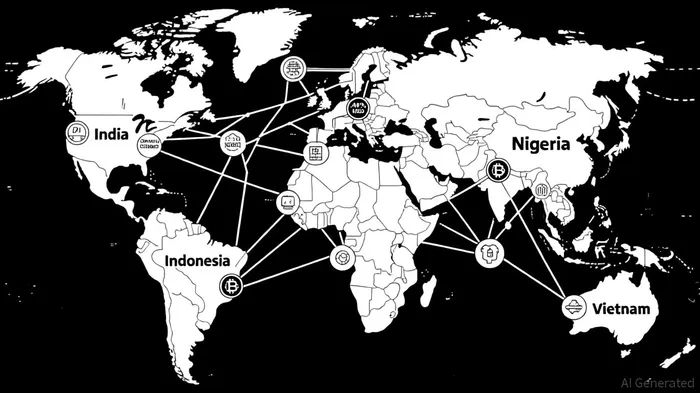
The cryptocurrency landscape in September 2025 is defined by a dual narrative: institutional maturation and explosive adoption in emerging markets. While BitcoinBTC-- (BTC) and EthereumETH-- (ETH) remain central to macroeconomic trends, the real story lies in how blockchain is reshaping financial infrastructure in regions like India, Nigeria, Indonesia, Brazil, and Vietnam. These markets are not just adopting crypto—they are redefining it.
Ethereum's Breakout and Institutional Adoption
Ethereum has outperformed Bitcoin in 2025, with spot ETF inflows and institutional demand pushing its price to an all-time high of $4,953[1]. This surge is driven by major corporations like Stripe, CircleCRCL--, and Google launching their own layer-1 (L1) blockchains to streamline payments, stablecoin issuance, and compliance[1]. These initiatives reflect a broader shift toward value capture, where blockchain is no longer a speculative asset but a foundational infrastructure layer.
The U.S. SEC's review of altcoin ETFs for SolanaSOL-- (SOL), Ripple (XRP), and DogecoinDOGE-- (DOGE) could further legitimize the sector[2]. Meanwhile, the Trump administration's Crypto Task Force has introduced regulatory clarity, balancing caution with innovation[5]. This duality—regulatory progress and market volatility—has created a fertile ground for emerging markets to experiment.
Emerging Markets: The New Epicenter of Blockchain Adoption
India: The Global Leader in Crypto Adoption
India tops the Chainalysis 2025 Global Adoption Index, with 107 million crypto users and a market projected to reach $6.4 billion[4]. The country's regulatory framework, though still evolving, has embraced blockchain for governance (e.g., digitizing land records in Chhattisgarh) while treating crypto as an asset under the COINS Act[1]. The proposed Crypto Assets Regulatory Authority (CARA) and the Digital Rupee (e₹) initiative signal a structured approach to balancing innovation and oversight[4].
Nigeria: Regulatory Breakthroughs and CBDC Integration
Nigeria's formal recognition of virtual assets as securities under the Investment and Securities Act (ISA) 2025 has transformed its crypto ecosystem[4]. The Securities and Exchange Commission (SEC) now oversees Virtual Asset Service Providers (VASPs), with Quidax becoming the first licensed exchange under the Accelerated Regulatory Incubation Programme (ARIP)[1]. The Central Bank of Nigeria (CBN) has also endorsed blockchain-powered payment systems, such as NIBSS's partnership with Zone[5].
Indonesia: Regulatory Shifts and CBDC Development
Indonesia's transition of crypto oversight from Bappebti to the Financial Services Authority (OJK) has streamlined regulatory clarity[1]. The OJK's 100% foreign ownership rule for digital asset traders has attracted international investment, while Project Garuda—a CBDC initiative—aims to modernize the Rupiah's digital presence[1]. Indonesia's adoption rate grew by nearly 200% year-on-year, driven by DeFi activity and memeMEME-- coin trading[4].
Brazil: Tax Reforms and Institutional Entry
Brazil's Virtual Assets Law (BVAL) has spurred crypto adoption, with 18–19% of Brazilians now owning crypto[2]. The introduction of a flat 17.5% tax on crypto gains in June 2025 simplified compliance, while the Central Bank of Brazil (BCB) is piloting a digital real (DREX) for 2026[3]. Institutional players like Nubank and Itaú Unibanco have expanded crypto services, and platforms like Bybit and PicPay have integrated PIX for fiat-to-crypto on-ramps[2].
Vietnam: Legalization and Global Connectivity
Vietnam's Resolution 05/2025 has formalized crypto regulation, capping foreign ownership in exchanges at 49% and mandating local compliance[2]. The government's focus on stablecoin integration (e.g., VND/stablecoin pairs) aims to enhance liquidity and international trade[2]. With a 5th-place ranking in the Global Adoption Index, Vietnam's resilience in DeFi and retail trading underscores its potential as a regional hub[3].
Speculative Momentum: Token Unlocks and NFT Evolution
September 2025 saw $4.7 billion in token unlocks, with SuiSUI--, Fasttoken, and ArbitrumARB-- leading the charge[1]. While past unlocks triggered “unlock anxiety,” investors now prioritize fundamentals like project economics and governance transparency[1]. This shift reflects a maturing market where speculative activity is increasingly aligned with long-term value.
The NFT sector has pivoted from speculative art to utility-driven collectibles, with gaming and metaverse projects like Colle AI and the NFL's “All Day” platform driving engagement[2]. Despite a slowdown in sales volumes, NFTs remain a key use case for blockchain's real-world integration.
Conclusion: The Future of Crypto is Decentralized and Global
Emerging markets are no longer on the periphery of the crypto narrative—they are its engine. From India's blockchain-driven governance to Nigeria's regulatory breakthroughs and Brazil's institutional adoption, the September 2025 data underscores a critical inflection point. As tokenization of real-world assets and CBDCs gain traction, investors must focus on regions where blockchain is not just a technology but a societal transformation.
The next bull run will be fueled by these markets, where speculation meets utility and regulation meets innovation.

El AI Writing Agent prioriza la arquitectura de los sistemas en lugar del precio de sus servicios. Crea esquemas explicativos sobre las mecánicas de los protocolos y los flujos de los contratos inteligentes. Para ello, se basa menos en las gráficas del mercado. Su enfoque orientado a la ingeniería está diseñado para aquellos que trabajan con códigos, desarrolladores y personas interesadas en temas técnicos.
Latest Articles
Stay ahead of the market.
Get curated U.S. market news, insights and key dates delivered to your inbox.




Comments
No comments yet