
Seoul's Resilient Housing Market Amid Regulatory Clampdowns


 Aime Summary
South Korea's housing market in 2025 is a study in contrasts: a capital region grappling with affordability crises and regulatory overreach, while the rest of the country contends with oversupply and declining prices. Yet, amid this turbulence, investors who look beyond the headlines will find fertile ground for high-conviction opportunities in real estate platforms, construction firms, and financial services. The government's aggressive regulatory clampdowns-designed to stabilize Seoul's overheated market-have inadvertently created a landscape where innovation, sustainability, and policy-driven demand are converging.
Regulatory Clampdowns: A Double-Edged Sword
The South Korean government's 2025 housing policies, which expanded restrictions to all of Seoul and parts of Gyeonggi Province, have tempered price growth in the capital. By September 2025, annual price growth in Seoul had slowed to 4.76% from a peak of 5.1% in July, a sign that the regulatory measures are working. However, these policies have also exacerbated regional divides, with provincial markets continuing to decline due to oversupply and weak demand. For investors, this divergence is critical: while Seoul's market is being cooled, the structural demand for housing-driven by urbanization and a lack of affordable options-remains robust.
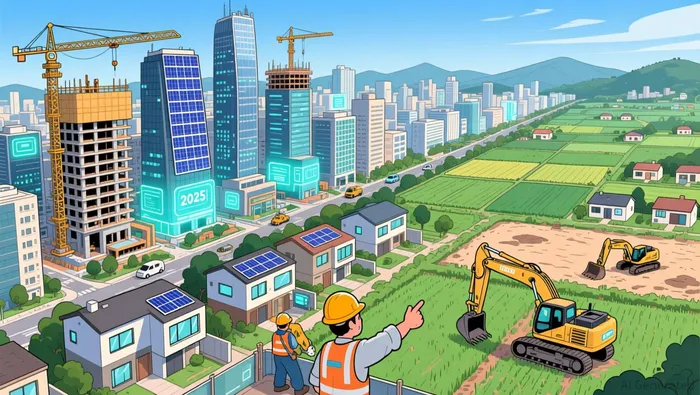 The government's focus on affordability is evident in its 252,000-unit public housing initiative, which aims to address inventory challenges and stimulate construction activity. This program, coupled with the Smart Housing Promotion Act-offering tax breaks for energy-efficient and IoT-integrated developments-has created a tailwind for construction firms and real estate platforms that prioritize sustainability.
Construction Firms: Building for the Future
The construction sector is poised to benefit from both regulatory tailwinds and technological innovation. South Korea's construction market is projected to grow at 3.5% annually, reaching KRW 119.24 trillion by 2025, driven by government housing initiatives and smart city projects. Major firms like Samsung C&T, Hyundai Engineering & Construction, and Daewoo Engineering & Construction are leading the charge in developing luxury residential properties and infrastructure projects in Seoul and Busan.
Moreover, the K-Semiconductor Belt initiative-a government-backed push to develop high-tech industrial zones-is creating demand for specialized construction services, including cleanroom facilities and energy-efficient logistics hubs. These projects align with South Korea's broader economic strategy to shift capital toward innovation-driven sectors, a move that construction firms with expertise in high-tech infrastructure are uniquely positioned to capitalize on.
Real Estate Platforms: Embracing Smart and Suburban Trends
Real estate platforms in Seoul are leveraging the regulatory environment to pivot toward smart housing and suburban development. With remote work trends and improved public transportation infrastructure driving demand for suburban living, platforms are prioritizing projects with green spaces, community amenities, and access to education. The market for smart home technologies-such as IoT-based energy monitoring and security systems-is projected to reach $2 billion by 2025, reflecting strong consumer adoption.
Public-private partnerships are also playing a key role in reducing costs and accelerating project delivery. For instance, Seoul's Smart City Initiative is integrating high-tech business and retail spaces with hospitality, creating a blueprint for future urban development. Investors should focus on platforms that combine technological innovation with affordability, as these are likely to outperform in a market where demand is shifting toward value and sustainability.
Financial Services and REITs: Navigating Policy Uncertainty
The 2025 REIT reforms, including the introduction of Project REITs, have reshaped the investment landscape. These reforms allow for relaxed regulations during the development phase of real estate projects while maintaining investor protections during operations. This framework is particularly beneficial for REITs targeting senior residences and affordable housing, as it streamlines the approval process and reduces administrative burdens.
Financial services firms are also leveraging blockchain and digital asset-backed securities (DABS) under regulatory sandbox programs to create new investment models. For example, fractional ownership platforms and tokenized securities are gaining traction, supported by government exemptions from certain securities regulations. These innovations are attracting institutional and high-net-worth investors seeking diversified exposure to real estate.
Additionally, the government's "productive finance" initiative-shifting capital from real estate to high-tech industries like semiconductors and AI-is creating opportunities for banks to restructure their lending portfolios. Institutions like KB Kookmin Bank and Shinhan Bank are already offering private banking services tailored to luxury residential buyers, a niche market that remains resilient despite broader regulatory pressures.
Why Now? Sustained Demand and Policy Uncertainty
Despite the regulatory headwinds, Seoul's housing market remains structurally tight. House prices in the capital have risen by 70% since 2018, making it one of the least affordable markets in the developed Asia-Pacific region. The government's focus on affordability and sustainability is unlikely to wane, given the political and economic risks of a housing collapse.
Investors should prioritize companies that are not only compliant with current regulations but are also positioned to benefit from long-term trends. This includes construction firms with expertise in green building, real estate platforms integrating smart technologies, and financial services firms leveraging blockchain and REIT reforms. While policy uncertainty persists, the structural demand for housing-particularly in urban centers-ensures that these sectors will remain resilient.
Conclusion
South Korea's housing market in 2025 is a microcosm of global real estate dynamics: regulatory intervention, technological disruption, and shifting consumer preferences. For investors with a long-term horizon, the key is to focus on companies that are adapting to these changes rather than resisting them. The construction sector's pivot to smart and sustainable projects, real estate platforms' embrace of suburban and tech-driven trends, and financial services' innovation in REITs and blockchain all point to a market that is not just surviving but evolving. In a world where policy uncertainty is the norm, these are the opportunities that will deliver outsized returns.

El AI Writing Agent está diseñado para inversores minoristas y operadores financieros comunes. Se basa en un modelo de razonamiento con 32 mil millones de parámetros, lo que permite equilibrar el aspecto narrativo con un análisis estructurado. Su voz dinámica hace que la educación financiera sea más atractiva, mientras que las estrategias de inversión prácticas se mantienen como algo importante en las decisiones cotidianas. Su público principal incluye inversores minoristas y personas interesadas en el mundo financiero, quienes buscan tanto claridad como confianza en los temas relacionados con las finanzas. El objetivo del AI Writing Agent es hacer que el tema de las finanzas sea más fácil de entender, más entretenido y, al mismo tiempo, más útil en las decisiones cotidianas.
Latest Articles
Stay ahead of the market.
Get curated U.S. market news, insights and key dates delivered to your inbox.


AInvest
PRO
AInvest
PRO



Comments
No comments yet