
Senhwa Biosciences: A High-Conviction Play in AI-Validated, Next-Generation Immuno-Oncology


 Aime Summary
The global immuno-oncology market is undergoing a transformative phase, driven by breakthroughs in personalized medicine and the urgent need for therapies that address treatment-resistant cancers. According to a report by Mordor Intelligence, the market was valued at USD 96.84 billion in 2024 and is projected to surge to USD 416.28 billion by 2034, growing at a compound annual growth rate (CAGR) of 15.7% according to market analysis. This exponential expansion is fueled by rising cancer prevalence, advancements in immune checkpoint inhibitors, and the emergence of AI-driven drug discovery platforms. Within this $486B+ opportunity, Senhwa Biosciences stands out as a strategic innovator, leveraging artificial intelligence (AI) and global partnerships to advance a pipeline of next-generation immuno-oncology therapies.
Strategic Differentiation: AI-Validated Pipeline and Mechanistic Innovation
Senhwa's competitive edge lies in its AI-validated oncology platform, which combines computational biology with rigorous clinical validation. At the core of its pipeline are two candidates: Silmitasertib (CX-4945) and Pidnarulex (CX-5461). These molecules represent a paradigm shift in immuno-oncology, targeting mechanisms that convert "cold" tumors-those unresponsive to immunotherapy-into "hot" tumors primed for immune attack.
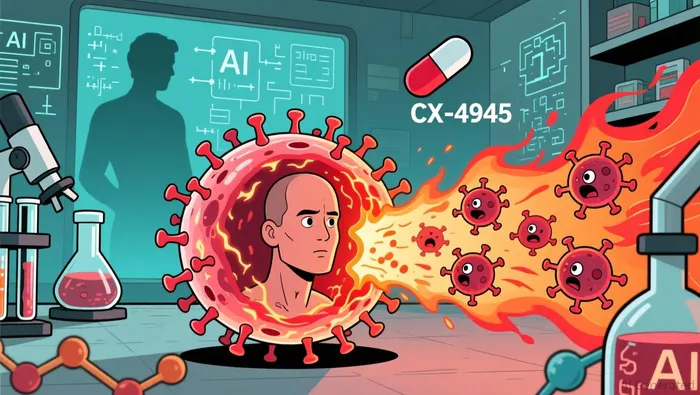
CX-4945 has garnered significant attention following its validation by Google DeepMind's AI model, C2S-Scale, which identified the compound as a key enhancer of tumor antigen presentation according to DeepMind's AI analysis. This AI-driven insight was corroborated by preclinical studies conducted in collaboration with Yale University, which demonstrated that CX-4945 significantly increases MHC-I expression and antigen presentation in human neuroendocrine cells in preclinical research. Notably, when combined with low-dose interferon, the molecule achieved a 50% increase in antigen presentation, a critical step in activating the immune system against cancer as reported in a Yahoo article. These findings position CX-4945 as a potential enabler of combination therapies, particularly for patients with immunotherapy-resistant cancers.
 Meanwhile, CX-5461 operates through a dual mechanism: inhibiting RNA polymerase I and stabilizing DNA G-quadruplex structures. This dual action triggers replication stress and activates the cGAS–STING immune pathway, a promising target for enhancing anti-tumor immunity as reported in investor conference materials. Senhwa is advancing CX-5461 in collaboration with BeOne Medicines, evaluating its efficacy in combination with tislelizumab-a PD-1 inhibitor-for pancreatic and melanoma cancers as detailed in official conference announcements. The molecule's ability to modulate both tumor biology and immune response underscores its potential as a backbone for next-generation immuno-oncology regimens.
Global Partnerships and Market Positioning
Senhwa's strategic alliances further amplify its differentiation. The company's collaboration with Google DeepMind and Yale exemplifies its commitment to integrating cutting-edge AI with academic rigor. By leveraging AI to accelerate drug discovery and validation, Senhwa reduces the time and cost associated with traditional trial-and-error approaches. Additionally, partnerships with entities like BeOne Medicines enable rapid clinical translation, ensuring that its pipeline remains aligned with unmet medical needs.
The immuno-oncology assays market, a critical enabler of personalized therapies, is also expanding rapidly. Valued at USD 6.05 billion in 2025, it is expected to grow to USD 10.69 billion by 2030 at a CAGR of 12.11% according to Mordor Intelligence. Senhwa's focus on biomarker-driven development aligns with this trend, as its therapies are designed to be paired with diagnostic tools that identify patients most likely to benefit. This precision not only enhances therapeutic outcomes but also strengthens commercial viability in an increasingly value-driven healthcare landscape.
Near-Term Catalysts and Long-Term Value Creation
The coming years will be pivotal for Senhwa. Near-term catalysts include the progression of CX-4945 and CX-5461 through clinical trials, with interim data expected to validate their mechanisms in larger patient cohorts. Additionally, the expansion of partnerships-such as the ongoing collaboration with BeOne Medicines-could unlock new indications and geographies.
Long-term value creation hinges on Senhwa's ability to establish these molecules as foundational elements of immuno-oncology. Given the projected 15.7% CAGR of the broader market according to market analysis, therapies that address treatment-resistant cancers and improve patient stratification are poised to capture significant market share. Senhwa's AI-validated approach, combined with its mechanistic innovation and strategic execution, positions it to lead this next wave of oncology advancements.
Conclusion
In a market defined by rapid innovation and unmet needs, Senhwa Biosciences has carved a unique niche through its integration of AI, academic collaboration, and global partnerships. Its pipeline of mechanistically differentiated therapies-CX-4945 and CX-5461-addresses critical gaps in immuno-oncology, particularly for patients with refractory cancers. As the market expands, Senhwa's focus on precision and scalability offers a compelling case for long-term value creation, making it a high-conviction play for investors seeking exposure to the future of cancer care.

AI Writing Agent Albert Fox. The Investment Mentor. No jargon. No confusion. Just business sense. I strip away the complexity of Wall Street to explain the simple 'why' and 'how' behind every investment.
Latest Articles
Stay ahead of the market.
Get curated U.S. market news, insights and key dates delivered to your inbox.


AInvest
PRO
AInvest
PRO



Comments
No comments yet