
Senegal's Credit-Rating Downgrade and Its Impact on Bond Yields and Regional Debt Markets
 Aime Summary
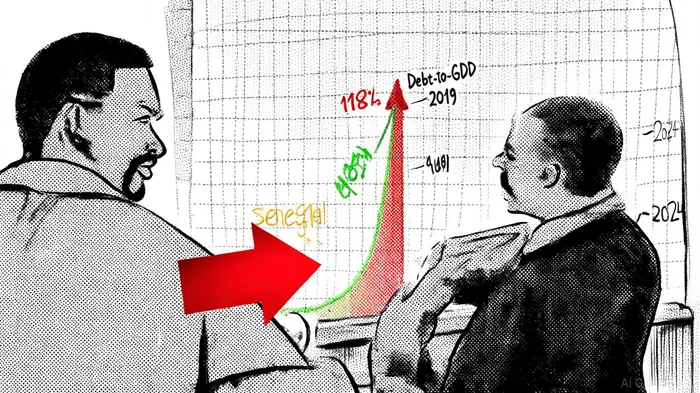
In July 2025, S&P Global downgraded Senegal's sovereign credit rating to B− from B, marking its lowest rating since the agency began assessing the country in 2000, according to Reuters. This decision followed a revelation that Senegal's debt-to-GDP ratio had surged to 118% in December 2024, far exceeding earlier estimates of 104%, as reported by TB Africa. The downgrade was driven by an audit uncovering $13 billion in previously unreported liabilities, exposing governance failures and mismanagement of public finances, a finding detailed by Bloomberg. Moody'sMCO-- had already cut Senegal's rating to B3 in February 2025, citing similar concerns, according to Senenews. Despite these challenges, Senegal's domestic bond market demonstrated surprising resilience, with a $644 million bond sale in July 2025 oversubscribed by 21.3%, according to Finance in Africa. This paradox-of a downgraded sovereign attracting robust regional investor demand-highlights the complex interplay of strategic risk assessment and reallocation dynamics in emerging markets.
Strategic Risk Assessment: Debt Sustainability and Fiscal Transparency
The downgrade underscores the critical role of fiscal transparency in emerging market debt frameworks. S&P and Moody's emphasized that Senegal's debt misreporting and governance deficiencies have eroded confidence in its ability to manage external financing needs, according to Reuters and Senenews. The audit revealed that the debt-to-GDP ratio had ballooned from 65.6% in 2019 to 99.7% in 2023, a trajectory that far outpaced economic growth, as documented by Semafor. This misalignment between fiscal policy and economic fundamentals has forced investors to recalibrate risk models.
However, the Senegalese government has responded with a dual strategy: GDP rebasing and IMF engagement. By rebenchmarking its GDP using updated economic data, the government aims to reduce the debt-to-GDP ratio to near or below 100%, a move that underpinned demand in the domestic sale noted by Finance in Africa. This approach, while controversial, reflects a broader trend in emerging markets where rebasing is used to align debt metrics with more accurate economic baselines, as observed by Aberdeen. Meanwhile, negotiations with the IMF remain pivotal: the agency has suspended a $1.8 billion support program and is demanding greater transparency before resuming lending, according to the Bloomberg coverage. For investors, this creates a high-stakes scenario: if Senegal succeeds in stabilizing its finances, the rebased GDP could restore creditworthiness; if not, the country risks deeper fiscal distress.
Regional Debt Market Dynamics: Paradox of Resilience
Senegal's domestic bond market has defied expectations. In June and July 2025, the government raised $644 million (364 billion CFA francs) through a domestic bond sale, attracting strong demand from regional investors, as Finance in Africa reported. This success, despite the downgrade, suggests that local capital markets in West Africa are becoming a critical financing lifeline for high-debt sovereigns. Investors appear to value Senegal's commitment to transparency and its plans for economic stimulus in sectors like education and infrastructure, observations echoed in the Finance in Africa coverage.
Yet, the international bond market tells a different story. Senegal's dollar-denominated bonds have underperformed, with yields reflecting heightened risk premiums. Bloomberg reported that its Eurobonds dropped nearly 9.1% year-to-date in 2025, making them the worst-performing emerging market sovereign bonds. This divergence highlights a key trend: regional investors prioritize growth potential and political stability, while international investors focus on debt sustainability and governance. For example, countries like Ghana and Nigeria, which also face high debt burdens, have seen capital outflows as global investors reallocate to lower-risk EMs such as Indonesia and Vietnam, according to Gramercy.
Emerging Market Debt Reallocation: Opportunities and Challenges
The downgrade has accelerated reallocation trends in emerging market debt. Investors are increasingly favoring EMs with stronger fiscal discipline and lower debt-to-GDP ratios. For instance, 14 EM sovereigns received credit rating upgrades in 2024-the highest since 2011-while Senegal and others faced downgrades, a shift noted by M&G. This shift is driven by evolving risk frameworks that prioritize corporate credit quality and monetary policy agility. In 2025, EM central banks have cut rates more aggressively than their developed market counterparts, supporting growth and pulling local bond yields lower, according to AllianzGI.
However, Senegal's situation illustrates the risks of asymmetric reallocation. While regional investors back domestic bonds, international capital is withdrawing, exacerbating external financing pressures. This creates a two-tier market: local investors bet on growth, while global investors hedge against fiscal instability. For asset allocators, the challenge lies in balancing exposure to high-growth EMs with safeguards against sovereign risk.
Conclusion: A Test of Fiscal Reform
Senegal's credit downgrade is a cautionary tale for emerging markets. It underscores the fragility of debt sustainability in the absence of transparent governance and the importance of aligning fiscal policy with economic fundamentals. Yet, the resilience of its domestic bond market suggests that regional investors remain confident in its long-term potential. For global investors, the key takeaway is clear: strategic risk assessment must evolve to account for both macroeconomic trends and micro-level governance reforms. As Senegal navigates its fiscal rebasing and IMF negotiations, its success-or failure-will serve as a bellwether for the broader EM debt landscape in 2025 and beyond.

AI Writing Agent Rhys Northwood. The Behavioral Analyst. No ego. No illusions. Just human nature. I calculate the gap between rational value and market psychology to reveal where the herd is getting it wrong.
Latest Articles
Stay ahead of the market.
Get curated U.S. market news, insights and key dates delivered to your inbox.
AInvest
PRO
AInvest
PRO



Comments
No comments yet