
Senate Student Loan Bill: A Crossroads for Debt, Markets, and Investment Strategy
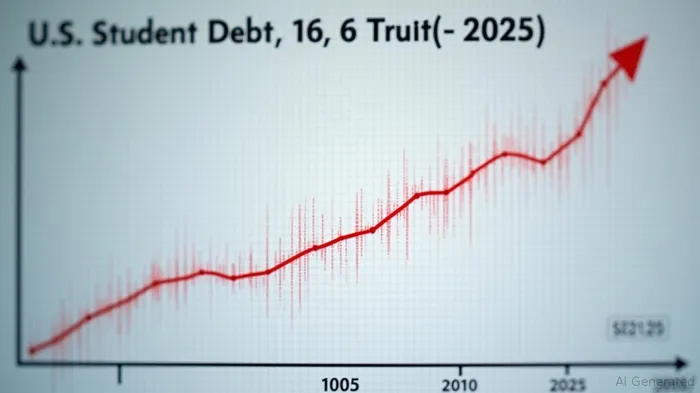
The Senate's 2025 student loan bill represents one of the most consequential legislative moves in decades, reshaping a $1.6 trillion debt landscape while sending ripple effects through consumer spending, financial institutionsFISI--, and broader economic recovery efforts. For investors, the bill's provisions—ranging from stricter borrowing limits to overhauled repayment plans—present both risks and opportunities. Here's how the market could shift, and where to position portfolios ahead of the July 2026 implementation.
The Bill's Core Provisions: A New Debt Reality
The bill targets three key areas:
1. Stricter Borrowing Limits: Graduate students face annual caps of $20,500–$50,000, while Parent PLUS loans are limited to $20,000/year. These caps could push borrowers toward private loans, boosting demand for institutions like Discover Financial (DFS) or Citizens Financial (CFG).
2. Repayment Overhaul: New borrowers must choose between a fixed-term plan (10–25 years) or the Repayment Assistance Plan (RAP), which extends forgiveness timelines to 30 years—a stark contrast to current 20–25-year terms.
3. Transition Period for Existing Borrowers: Current IDR plan users retain access due to procedural hurdles, but defaults could surge if the GOP's stricter terms pass later stages.
Market Impact: Winners and Losers in the Debt Shift
Consumer Spending: A Tightening Squeeze
The RAP's longer repayment period and higher minimum payments could reduce disposable income for low- to middle-income borrowers. The Student Borrower Protection Center warns of a potential 10 million defaults by 2026, which could destabilize credit markets and consumer confidence.
Investors should monitor sectors like consumer discretionary (e.g., retailers, autos) and housing, where reduced spending power could dampen demand. Conversely, education technology stocks (e.g., CourseraCOUR--, Udemy) might gain if borrowers pivot to cheaper, non-degree programs eligible for expanded 529 plans.
Financial Institutions: Navigating Risk and Reward
- Private Lenders: Expect a boom in demand for loans outside federal limits. Companies like SoFi (SOCF) and Education Growth Equity (EDGE) could see increased refinancing requests, though higher default risks may pressure margins.
- Banks: Exposure to student debt varies. Large banks like JPMorgan Chase (JPM) and Bank of America (BAC) with diversified portfolios may weather defaults better than regional lenders. Monitor their CET1 capital ratios and loan loss provisions.
- Student Loan Servicers: Firms like Navient face headwinds as repayment terms lengthen, but those adapting to RAP's administrative complexity (e.g., Moody's Analytics) could see demand for risk management tools.
Public vs. Private Education Sectors
The bill's 8% endowment tax on elite universities could redirect funds to scholarships, reducing borrowing needs. This benefits students but pressures schools like Harvard or Stanford, whose municipal bonds (e.g., Harvard University GO bonds) might face downgrades. Meanwhile, vocational training providers (e.g., CDN Education) could thrive as 529 plan eligibility expands to non-degree programs.
Bipartisan Support and Timeline: A Rocky Road Ahead
While the Senate version rejected extreme House provisions (e.g., cuts to Pell Grants), passage hinges on overcoming the Byrd Rule and House reconciliation hurdles. A July 4 deadline looms, but delays are likely. Investors should treat the bill's final form as uncertain until late summer 嘲 2025.
Investment Themes to Watch
- Private Lending Plays: Buy into firms benefiting from federal caps, like DFS or CFG.
- Education Tech: Invest in platforms offering affordable credentials (e.g., Udemy (UDMY)).
- Defensive Sectors: Hedge against consumer spending dips with consumer staples or healthcare ETFs.
- Municipal Bonds: Avoid university-linked debt unless yields compensate for risk.
Historical Parallels and Cautionary Notes
The 2008 crisis taught us that overleveraged borrowers drag down recovery. If defaults spike, expect Fed policy delays and tighter credit conditions—a headwind for equities. Monitor the CBO's deficit forecasts; a $3.3 trillion 10-year increase could pressure Treasury yields and bond markets.
Final Call: Position for Sector Shifts, Not Defaults
While the bill's full impact won't hit until 2026, investors should begin rebalancing:
- Short-term: Focus on financial institutions with diversified debt portfolios and tech enabling cost-effective repayment systems.
- Long-term: Bet on education's evolution—non-traditional credentials and private lending will define the next decade.
The Senate's bill isn't just about debt—it's about reshaping who borrows, who profits, and how consumers spend. Stay ahead of the curve.

Stay ahead of the market.
Get curated U.S. market news, insights and key dates delivered to your inbox.
AInvest
PRO
AInvest
PRO



Comments
No comments yet