
Senate Passes GENIUS Act for Stablecoin Regulation 68-30
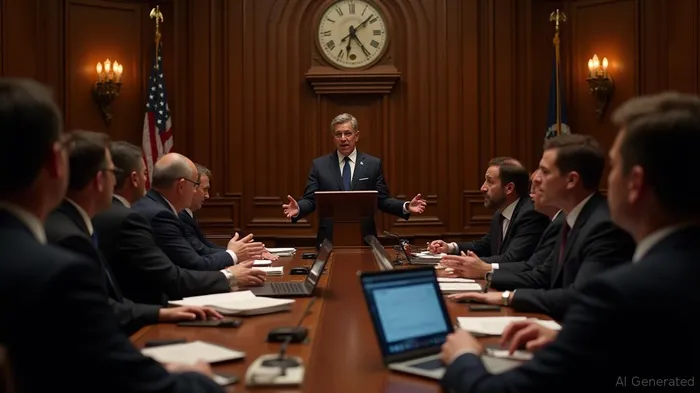
The US Senate has taken a significant step towards regulating stablecoins with the passage of the Guiding and Establishing National Innovation for US Stablecoins (GENIUS) Act. The bill, which received bipartisan support with a 68-30 vote, aims to solidify the US's position as a global leader in the crypto industry. Senate Majority Leader John Thune, who championed the legislation, echoed President Donald Trump's stance that the bill could help the US become the "crypto capital of the world" and bring cryptocurrency further into the mainstream. The vote to invoke cloture sets the stage for full debate and a potential floor vote, which could send the bill to the House of Representatives if it passes. Thune acknowledged that there is still a lot more work to be done regarding digital assetDAAQ-- regulation.
However, the bill has faced opposition from Senator Elizabeth Warren, who criticized the Senate for failing to consider key bipartisan amendments. Warren warned that the GENIUS Act contains major flaws, including weak consumer protections and national security safeguards. She also raised ethical concerns tied to Trump’s personal involvement in the crypto sector through his family-backed platform, World Liberty Financial. Warren accused the president of using crypto incentives, including dinners and privileged access, as tools to solicit support from foreign governments and wealthy donors in exchange for political favors like pardons and tariff exemptions. Despite the opposition, many Democrats supported advancing the bill, but it remains uncertain whether it will secure enough backing for final passage, particularly in a chamber where Republicans have only a narrow majority.
Meanwhile, the House of Representatives is also making progress on crypto regulation with the Digital Asset Market Clarity (CLARITY) Act. The bill, which received strong committee support, outlines roles for the SEC and CFTC in regulating digital assets and ensures user protections. It now heads to the House floor for consideration. The CLARITY Act is designed to delineate the responsibilities of the Securities and Exchange Commission (SEC) and the Commodity Futures Trading Commission (CFTC) in overseeing the crypto industry. It introduces provisional registration requirements for digital asset platforms, including crypto exchanges and broker-dealers, while also mandating adherence to disclosure rules, customer asset segregation, and recordkeeping standards. The legislation specifically includes protections for users, like the right to hold assets in non-custodial wallets and to conduct peer-to-peer transactions without interference.
Representative French Hill, who sponsored the bill, believes that it will create a fair and forward-looking regulatory environment that includes all participants in the crypto ecosystem. He described it as a foundational step for American leadership in Web3 technologies and tokenized financial services. Despite the progress, some Democrats voiced concerns. Representative Maxine WatersWAT-- proposed changes that are aimed at preventing potential conflicts of interest tied to President Donald Trump’s crypto ventures. She believes that the legislation could be used to benefit Trump and his family. Representative Brad Sherman introduced a separate amendment seeking to prohibit potential industry bailouts, due to skepticism from some lawmakers about broader industry incentives. The bill now awaits debate and a vote on the House floor.
In other regulatory news, Republican Representative William Timmons formally requested that US SEC Chair Paul Atkins release internal documents detailing the agency’s historical stance on Ethereum (ETH) under previous leadership, particularly during Gary Gensler’s tenure. Timmons argued that the SEC under Gensler failed to provide a consistent or coherent regulatory framework for digital assets, and he mentioned Ethereum as a prime example. He pointed to 2018 remarks by former SEC Director of Corporate Finance William Hinman, who publicly stated that ETH and Bitcoin should not be classified as securities. In contrast, Timmons claimed that Gensler, as SEC Chair, consistently avoided confirming ETH’s status during congressional hearings. Timmons specifically cited a hearing in April of 2023 where Gensler declined to clarify ETH’s classification, despite the fact that the SEC reportedly approved an investigation into ETH’s status just days earlier.
The situation became even more complex in 2024 when the SEC approved spot Ether exchange-traded funds (ETFs), a move that would typically imply that ETH is not considered a security. Just weeks after the ETF approvals, the SEC officially closed its investigation into ETH. According to Timmons, this series of contradictory actions caused a lot of confusion among investors and market participants, which undermined regulatory confidence in the US crypto space. Timmons' letter adds political pressure to an already ongoing legal battle involving Coinbase. In 2023, the exchange filed a Freedom of Information Act (FOIA) request seeking access to SEC documents on ETH. When the SEC denied the request, Coinbase initiated legal action, which resulted in a court ruling requiring the SEC to release certain records. Some of these disclosed documents were later published by Coinbase, and revealed that even federal prosecutors were unable to obtain a clear stance from the SEC on Ethereum’s regulatory status.

Stay ahead of the market.
Get curated U.S. market news, insights and key dates delivered to your inbox.






Comments
No comments yet