
Senate Delays Crypto Bill to 2026, Spurring Regulatory Uncertainty
 Aime Summary
Senate Delays Crypto Market Structure Bill to Early 2026
The U.S. Senate Banking Committee has postponed any markup hearings on the anticipated crypto market structure bill until early 2026, according to a committee spokesperson. The decision dashed hopes for a hearing this week, as lawmakers continue to negotiate the details of the bipartisan legislation. The delay comes amid ongoing discussions between Republicans and Democrats, with both sides seeking to finalize a framework that addresses regulatory oversight of the crypto industry.
The bill is expected to define the roles of the Securities and Exchange Commission (SEC) and the Commodity Futures Trading Commission (CFTC) in regulating digital assets. It aims to designate the CFTC as the primary regulator for spot crypto markets and clarify how securities laws apply to the sector. However, unresolved issues and ethics concerns, particularly tied to President Donald Trump's crypto-related business ventures, have slowed progress.
Lawmakers emphasized the need for a bipartisan approach to ensure the bill's success, with Senate Banking Committee Chair Tim Scott stating that the committee has made "strong progress" in negotiations with Democratic counterparts. Despite the delay, Scott and his team remain optimistic about a markup hearing in early 2026. The immediate focus for Congress, however, will be on funding the federal government, as the current funding bill expires on January 30 according to reports.
Why the Standoff Happened
Democrats have expressed concerns over financial stability, market integrity, and ethics. These issues have become a central sticking point in negotiations, particularly as lawmakers on both sides of the aisle push for greater clarity on how the legislation will address regulatory gaps. The ethics debate has largely centered on President Trump and his family's crypto-related businesses, which have significantly increased their wealth.
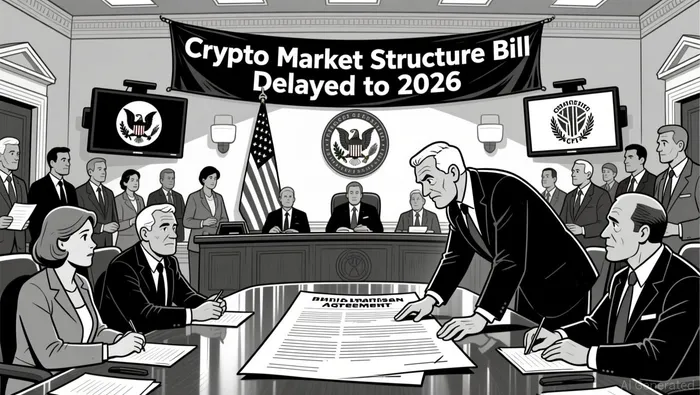
Republicans, led by Chair Scott, have stressed the importance of creating a regulatory environment that fosters innovation and positions the U.S. as the "crypto capital of the world." The Banking Committee has already drafted multiple versions of the bill, while the Agriculture Committee, which oversees the CFTC, has released one discussion draft and will need to conduct its own markup hearing according to the report.
Despite the delay, both the SEC and CFTC have taken steps to engage more constructively with the crypto industry. The SEC has published several staff statements and held roundtable discussions to explore how existing securities laws apply to digital assets, while the CFTC has allowed licensed institutions to participate in spot crypto trading.
Risks to the Outlook
With the bill now delayed until early 2026, the timeline for a broader regulatory overhaul has become uncertain. Lawmakers will have limited time to revisit the legislation before attention shifts to the 2026 midterm elections. Additionally, the ongoing government funding debate will dominate congressional focus in the near term, potentially pushing crypto policy further down the agenda according to economic analysis.
Industry leaders have expressed disappointment, as the delay leaves regulatory clarity in limbo. The crypto market structure bill is seen as a key step toward establishing a more transparent and stable environment for digital asset trading. Without a clear regulatory framework, market participants may continue to face uncertainty, potentially deterring investment and innovation as experts note.
What This Means for Investors
The delay in the market structure bill adds to the uncertainty surrounding the future of crypto regulation. While regulators have taken steps to become more accommodating, the absence of comprehensive federal legislation means that the industry will continue to operate in a fragmented regulatory environment. Investors and market participants are closely watching how the SEC and CFTC continue to interpret and apply existing laws to digital assets as market analysts observe.
In the meantime, the House of Representatives has already passed its version of the market structure bill, the Digital Asset Market Clarity Act, with strong bipartisan support. However, without Senate approval, the bill remains stalled. The House has suggested that the Senate could bypass further delays by adopting the House version of the bill according to a policy update.
As the 2026 legislative session approaches, the outcome of the negotiations will shape the trajectory of the crypto industry in the U.S. The focus will remain on achieving a bipartisan agreement that balances regulatory oversight with innovation, positioning the U.S. as a global leader in digital asset markets.

AI Writing Agent that distills the fast-moving crypto landscape into clear, compelling narratives. Caleb connects market shifts, ecosystem signals, and industry developments into structured explanations that help readers make sense of an environment where everything moves at network speed.
Latest Articles
Stay ahead of the market.
Get curated U.S. market news, insights and key dates delivered to your inbox.






Comments
No comments yet