
Senate Control: Pricing Equilibrium Amid Low Information Regime
 Aime Summary
Lead
Polymarket’s 2026 Senate control market currently prices the Democratic Party’s probability of winning the chamber at approximately 53%. This near-even split reflects a market operating in a low-information regime, where recent polling shifts have been largely absorbed into existing prices. The tight bid-ask spread and stable short-term volatility suggest that liquidity is sufficient to support the current equilibrium, yet the lack of new directional catalysts leaves the market vulnerable to sentiment-driven noise rather than fundamental reassessments.
Event Definition
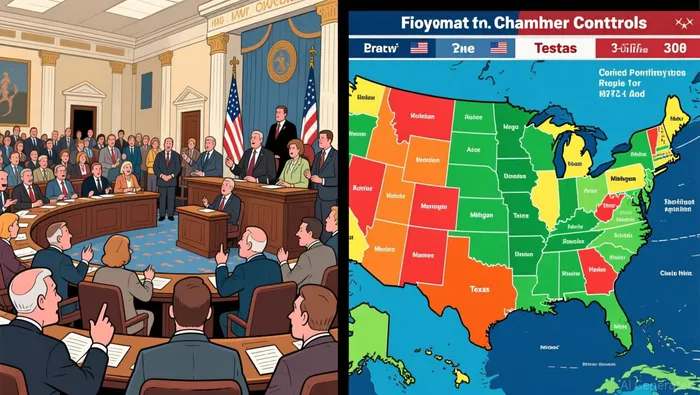
This market resolves based on which party controls the U.S. Senate following the November 3, 2026, midterm elections. Republicans currently hold a 53-47 advantage, requiring Democrats to secure a net gain of four seats to flip the chamber. The core disagreement centers on whether Democratic gains in competitive states like Michigan, Texas, and Alaska will offset Republican defenses in traditionally red states.
Latest News & Information Increments
Recent forecast updates indicate a tightening map, with key battlegrounds shifting from "Lean Republican" to "Toss-up" status in states like Alaska, Iowa, Ohio, and Texas . Decision Desk HQ recently revised its Senate control forecast to a 50-50 probability, marking a significant shift from July when Republicans held a 57% advantage . Independent analysts identify nine competitive races, with Democrats holding a slight edge in Georgia and North Carolina, while Michigan and Texas remain critical toss-ups . However, the New Hampshire primary results, featuring Republican John Sununu’s nomination, have not yet triggered a repricing, suggesting the market views the Sununu dynasty’s name recognition as a stabilizing factor for GOP defenses . In the absence of major polling shocks or economic data releases, the market is operating in a low-catalyst environment, where prices remain anchored to the median forecast rather than reacting to isolated news events.
Market Resolution Rules Analysis
The market resolves based on the party holding a majority of voting seats in the 100-seat Senate, or a tie broken by the Vice President. The determination includes regular and special elections scheduled by October 31, 2026, as well as runoffs. Vacant seats retain their current party affiliation, and independents who caucus with a party are counted toward that party’s total. The primary source for resolution is official state electoral data and consensus reporting from credible outlets.
Rule Risk Points & Disputed Scenarios
A primary risk involves the ambiguity of seat attribution for independent candidates who have not yet announced their caucus intentions. If caucus decisions cannot be determined by January 4, 11:59 PM ET, the seat will not count toward either party, potentially altering the final majority count. This rule creates a tail risk where a 50-50 tie could be resolved differently depending on the timing of independent announcements, introducing uncertainty into the final settlement.
Market Overview
The current price of 0.53 for Democrats implies a near-even probability distribution, reflecting a market with low directional conviction. The mid-price of 0.525 and a tight bid-ask spread of 0.01 indicate high liquidity depth relative to immediate trading activity. This equilibrium suggests that participants are not aggressively betting on a specific outcome, but rather positioning for a tight race. The probability tier is anchored in the mid-range, avoiding the extremes typical of high-disagreement environments, which points to a consensus uncertainty rather than polarized views.
Market Dynamics (Volatility & Volume)
Short-term volatility has been negligible, with one-day and one-week price changes of 0.0 and 0.01 respectively. This stability is supported by robust liquidity, with a total market volume of over 4.2 million and a 24-hour volume ranging between 10,000 and 50,000. The absence of significant price movement despite recent forecast shifts suggests that the market has already priced in the "Toss-up" ratings for key states. The divergence between the stable price and the underlying political volatility indicates that current pricing is driven more by liquidity constraints and passive hedging than by informed speculation on new data.
Trading Judgment & Follow-up Observation Points
Traders should monitor the final polling averages in Michigan, Texas, and Alaska for any deviation from the current median forecasts. The resolution of independent caucus intentions by early January remains a critical rule-based risk to watch. Additionally, any shift in the 24-hour volume beyond the current moderate range could signal the onset of informed trading activity, which would likely precede significant price repricing. Until then, the market remains in a holding pattern, reflecting the uncertainty of a low-information regime.

Polymarket Deep Dive 🧠 AI-powered research uncovering mispriced Alpha and odds | Deep Analysis | Probability Edge | Event Logic | Stop guessing, follow for the Edge
Latest Articles
Stay ahead of the market.
Get curated U.S. market news, insights and key dates delivered to your inbox.


AInvest
PRO
AInvest
PRO




Comments
No comments yet