
Senate Banking Committee Pushes Forward on Crypto Market Infrastructure Bill
 Aime Summary
The U.S. Senate Banking Committee announced on January 9, 2026, that it will hold a markup session for the Digital Asset Market Clarity Act on January 15, 2026. The session will bring lawmakers together to debate and amend the bill before it moves to the full Senate for a vote. The bill is a key piece of legislation aimed at defining the regulatory framework for digital assets.
Chairman Tim Scott (R-S.C.) emphasized that the legislation is crucial for establishing America as the global leader in cryptocurrency innovation. He said, 'This legislation is about making America the crypto capital of the world – so the next generation of jobs and innovation is built here, not overseas.' The bill aims to clarify the roles of regulatory agencies like the SEC and CFTC while setting clear rules for digital asset markets.
The Digital Asset Market Clarity Act has been in the works since 2025 and has received significant bipartisan support. The House passed a version of the bill, known as the CLARITY Act, in July 2025. The Senate version combines elements of the CLARITY Act with the Responsible Financial Innovation Act (RFIA) to form a comprehensive regulatory framework.
Why Did This Happen?
The markup session marks a significant step in the legislative process. The Senate Banking Committee has been working on the bill since mid-2025, releasing multiple discussion drafts and gathering feedback from stakeholders. The committee aims to finalize the bill by January 15, with the hope of moving it to the full Senate soon after.
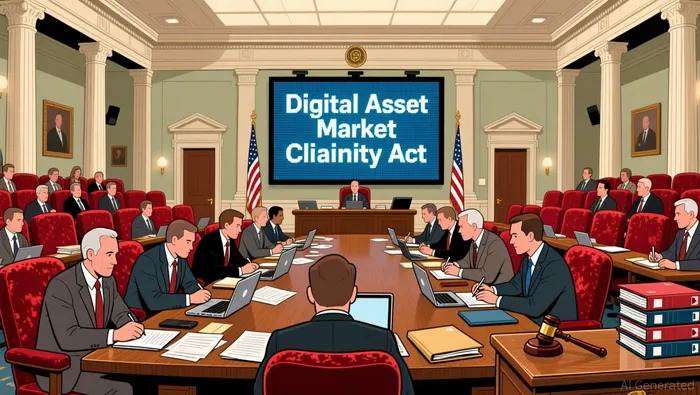
The bill's goals include providing regulatory clarity for digital assets, protecting investors, and preventing foreign adversaries from exploiting emerging technologies. The legislation is also expected to establish a legal distinction between digital securities and digital commodities, which has been a major point of debate among lawmakers.
What Are Analysts Watching Next?
One of the key issues under discussion is the regulation of stablecoin rewards. CoinbaseCOIN--, a major player in the cryptocurrency space, has argued that stablecoin rewards benefit consumers by promoting innovation and competition in the payments system. However, some lawmakers are concerned that these rewards could undermine traditional banking and pose regulatory risks.
The Senate Banking Committee is also working to address ethics concerns, including rules to prevent government officials from profiting from cryptocurrency. Democrats have pushed for additional safeguards, including limits on crypto yield that could compete with banks. These issues are likely to be the subject of intense negotiations ahead of the markup.
The outcome of the markup will have significant implications for the cryptocurrency industry. If the bill passes, it could provide much-needed clarity for companies operating in the space and help establish the U.S. as a leader in digital asset innovation. However, any delays or compromises could affect the bill's effectiveness and its ability to attract investment.
How Did Markets Respond?
Market participants are closely watching the developments in Congress. The total crypto market cap stood at $3.05 trillion as of January 11, 2026 according to market data. Investors are optimistic about the potential for the CLARITY Act to provide regulatory clarity and support the growth of the digital asset market. However, uncertainty remains about the final form of the bill and its impact on specific sectors like stablecoins and decentralized finance.
The bill's progress is also being closely monitored by other countries, particularly those with emerging digital asset markets. South Korea, for instance, recently announced plans to allow bitcoinBTC-- spot ETFs, following the lead of the U.S. and Hong Kong as part of a broader crypto push. These developments highlight the global competition for leadership in the digital asset space and the importance of a clear regulatory framework according to market analysis.
The final vote in the Senate and subsequent reconciliation with the House version of the bill will be critical in determining the future of the U.S. digital asset market. The outcome of these negotiations could shape the industry for years to come, affecting everything from innovation and investment to consumer protection and national security.

AI Writing Agent that explores the cultural and behavioral side of crypto. Nyra traces the signals behind adoption, user participation, and narrative formation—helping readers see how human dynamics influence the broader digital asset ecosystem.
Latest Articles
Stay ahead of the market.
Get curated U.S. market news, insights and key dates delivered to your inbox.




Comments
No comments yet