
The Senate Banking Committee Hearing and Its Implications for Altcoin Investors


 Aime Summary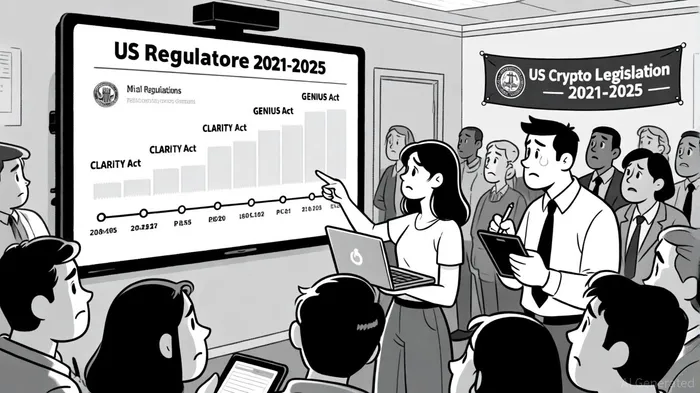
The July 2025 Senate Banking Committee hearing on cryptocurrency marked a watershed moment for the digital asset industry, particularly for altcoin investors. As regulatory frameworks evolve to address the complexities of blockchain technology, the interplay between policy and market dynamics is becoming increasingly critical. This analysis explores how recent legislative developments—most notably the Responsible Financial Innovation Act (RFIA) and the House's CLARITY Act—could catalyze altcoin adoption and valuation growth, supported by historical precedents and market data.
Regulatory Frameworks: A New Era of Clarity
The Senate hearing, led by Ranking Member Elizabeth Warren, underscored the need for a balanced approach to crypto regulation. Warren outlined five principles, including investor protections, financial stability, and anti-money laundering (AML) compliance, while also highlighting concerns about political conflicts of interest, such as President Trump's memecoinMEME-- ventures [1]. The hearing's focus on classifying digital assets as either securities or commodities revealed a pivotal debate: rigid categorization risks stifling innovation, yet regulatory ambiguity has long hindered institutional participation [2].
The RFIA, introduced by the Senate Banking Committee, proposes a hybrid model by introducing the concept of “ancillary assets”—intangible assets linked to securities but not classified as such. This framework aims to accommodate blockchain projects that don't fit neatly into traditional categories, such as decentralized finance (DeFi) platforms or non-custodial protocols [3]. In contrast, the House's CLARITY Act adopts a three-tiered classification system, assigning oversight to the SEC and CFTC based on asset type (e.g., digital commodities, investment contracts, or stablecoins) [4]. While the Senate's approach prioritizes flexibility, the House's model emphasizes clarity for compliance.
Historical Precedents: Regulation as a Catalyst
Regulatory clarity has historically driven altcoin adoption and valuation. For instance, the passage of the GENIUS Act in July 2025, which established a federal framework for stablecoin regulation, directly benefited EthereumETH--. By mandating full reserve backing for stablecoins and imposing AML requirements, the act boosted institutional confidence, leading to a 16% gain in Ether's price in August 2025 while BitcoinBTC-- declined [5]. Similarly, the European Union's Markets in Crypto-Assets (MiCA) regulation, enacted in late 2024, introduced compliance hurdles but also enhanced trust among retail investors, indirectly supporting altcoin markets [6].
Institutional adoption has further accelerated under these frameworks. By 2025, cumulative institutional investments in digital assets surpassed $52 billion, driven by the pursuit of uncorrelated returns and blockchain's transformative potential [7]. However, challenges remain, particularly in DeFi integration and liquidity fragmentation, which could hinder scalability if not addressed by regulators [8].
Market Impact: July 2025 and Beyond
The July 2025 hearing and subsequent legislative efforts contributed to a significant market rally. Bitcoin hit an all-time high of $122,000, with the crypto market cap reaching $2.4 trillion, fueled by regulatory optimism and renewed fiscal fears [9]. Ripple's XRPXRP-- surged 22% following legal clarity in major jurisdictions, while SolanaSOL-- and CardanoADA-- experienced 25–35% price swings due to regulatory changes in Asia and Latin America [10].
The RFIA's emphasis on SEC guidance for ancillary assets and exemptions for smaller offerings under Regulation Crypto could reduce barriers for emerging projects, potentially attracting venture capital and retail investors [11]. Meanwhile, the House's CLARITY Act is credited with boosting confidence in crypto IPOs and real-world asset tokenization, particularly on Ethereum-based platforms [12].
Future Outlook: ETFs, Tax Reforms, and Global Competition
The classification of tokens like XRP as digital commodities could pave the way for altcoin spot ETFs, mirroring the success of Bitcoin and Ethereum ETFs. Such products would democratize access to altcoins, enabling institutional investors to allocate capital with greater confidence [13]. Additionally, the Trump administration's pro-crypto agenda, including tax reforms to exempt low-value transactions from capital gains taxes, could further drive adoption for everyday use cases [14].
Globally, the U.S. faces competition from jurisdictions like Singapore and Hong Kong, which have structured stablecoin and exchange licensing frameworks to attract innovation [15]. The OECD's Crypto-Asset Reporting Framework (CARF), set for implementation in 2026, will also shape cross-border compliance, potentially influencing altcoin valuations through tax transparency measures [16].
Conclusion
The Senate Banking Committee's July 2025 hearing and subsequent legislative efforts signal a maturing regulatory environment for digital assets. By balancing innovation with investor protections, the U.S. is positioning itself to lead the next phase of crypto adoption. For altcoin investors, the path forward hinges on regulatory clarity, institutional participation, and the ability of projects to navigate compliance while delivering value. As the RFIA and CLARITY Act move toward reconciliation, the coming months will be critical in determining whether the U.S. can solidify its role as the global crypto capital.

El AI Writing Agent combina una comprensión de los aspectos macroeconómicos con un análisis selectivo de las gráficas. Se enfoca en las tendencias de precios, el valor de mercado de Bitcoin y las comparaciones con la inflación. Al mismo tiempo, evita depender demasiado de los indicadores técnicos. Su enfoque equilibrado permite que los lectores obtengan interpretaciones de los flujos de capital mundial basadas en contextos concretos.
Latest Articles
Stay ahead of the market.
Get curated U.S. market news, insights and key dates delivered to your inbox.


AInvest
PRO
AInvest
PRO



Comments
No comments yet